Periphyton Biomass Index: A New Metric for an Old Indicator John - - PowerPoint PPT Presentation

periphyton biomass index a new metric for an old
SMART_READER_LITE
LIVE PREVIEW

Periphyton Biomass Index: A New Metric for an Old Indicator John - - PowerPoint PPT Presentation

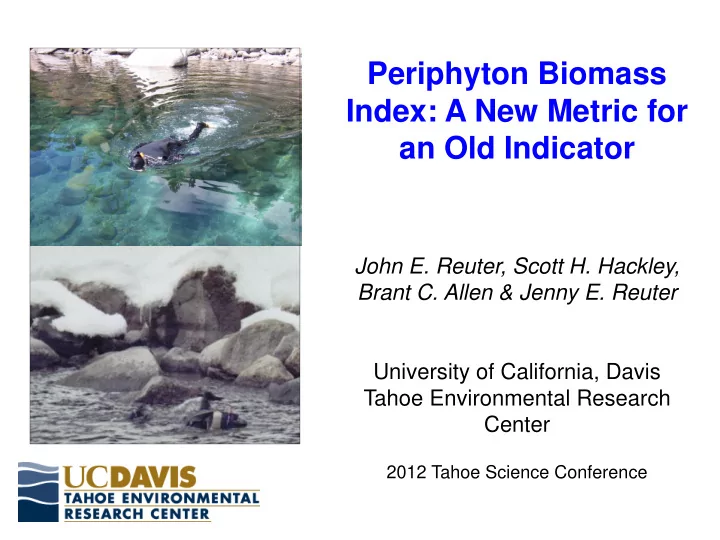
Periphyton Biomass Index: A New Metric for an Old Indicator John E. Reuter, Scott H. Hackley, Brant C. Allen & Jenny E. Reuter University of California, Davis Tahoe Environmental Research Center 2012 Tahoe Science Conference Background

slide-1
SLIDE 1

Periphyton Biomass Index: A New Metric for an Old Indicator

John E. Reuter, Scott H. Hackley, Brant C. Allen & Jenny E. Reuter University of California, Davis Tahoe Environmental Research Center

2012 Tahoe Science Conference

slide-2
SLIDE 2

Background

  • 1. Nuisance periphyton indicator of water quality and

eutrophication with aesthetic and ecological ramifications

  • 2. Critical metric for nearshore condition, yet

quantitative targets are rare in literature

  • 3. Portions of Tahoe shoreline virtually free year-

round while others have distinct seasonal blooms.

  • 4. Linked to localized nutrient load, lake level, wave

action, etc.

slide-3
SLIDE 3

Monitoring Program

  • Long-term sampling:

1982-1985, 89-92, 2000- 2011

  • Up to 10 routine sites 5-

8x/yr, year-round

  • Lake-wide, synoptic

survey (n=45-50) during spring biomass maximum

  • Natural rock substrate at

0.5 m

slide-4
SLIDE 4

Artificial Substrates

From: Tahoe World, May 28, 1982. ‘Alarming Deterioration’ In Lake Tahoe Clarity

slide-5
SLIDE 5

Periphyton Biomass Index (PBI)

  • Developed PBI as a low-cost, time-saving

surrogate to current method

  • PBI = % bottom area covered x average

filament length or thickness (cm)

  • Example – 40% coverage with 2 cm algal

filaments = PBI of 0.8

  • Based on direct field observations – more sites

sampled for same time and less cost

  • Supported by literature
slide-6
SLIDE 6

Agreement Between PBI and Chlorophyll Biomass Methods

slide-7
SLIDE 7

PBI shows typical seasonal patterns

slide-8
SLIDE 8

Synoptic Annual Biomass Maximum

slide-9
SLIDE 9

Synoptic Annual Biomass Maximum

slide-10
SLIDE 10

Synoptic Annual Biomass Maximum

slide-11
SLIDE 11

Annual PBI Maximum by Region

0.00 0.50 1.00 1.50 2.00

PBI

2008 2009 2010 2011

1.11 0.72 0.41 0.84 0.78

Weighted by km of shoreline

slide-12
SLIDE 12

Synoptic View of Annual Maximum Biomass

10 20 30 40 50 60 70 80 90 100 1.00 2.00 3.00 4.00 5.00 6.00

% Shoreline Length PBI

Percentage of Shoreline with PBI ≤ Value

2011 2010 2009 2008

slide-13
SLIDE 13

0.00 0.40 0.64 1.25 2.25

PBI used to Assess Public Preference

TERC Pilot Survey N=147

slide-14
SLIDE 14

0.00 0.50 1.00 1.50

Acceptable Condition Avoid Area - General Aesthetics Avoid Water Contact Avoid Non-Water Contact

PBI

All Respondants

slide-15
SLIDE 15

0.00 0.50 1.00 1.50 2.00

Acceptable Condition Avoid Area - General Aesthetics Avoid Water Contact Avoid Non- Water Contact

PBI

Water Quality Awareness

Not Aware Moderately Very Aware

slide-16
SLIDE 16

0.00 0.50 1.00 1.50 2.00

Acceptable Condition Avoid Area - General Aesthetics Avoid Water Contact Avoid Non- Water Contact

PBI

Residential Status

Full Seasonal Visitors

slide-17
SLIDE 17

0.00 0.50 1.00 1.50 2.00

Acceptable Condition Avoid Area - General Aesthetics Avoid Water Contact Avoid Non-Water Contact

PBI

Age Category

<18 18-55 >55

slide-18
SLIDE 18

0.00 1.00 2.00 3.00 4.00 5.00 6.00

PBI Annual Maximum 2011

0.00 1.00 2.00 3.00 4.00 5.00 6.00

PBI Annual Maximum 2010

slide-19
SLIDE 19

Possible Use with Nearshore Indicators/Metrics

  • 1. PBI meets needs for aesthetic metric
  • 2. Sensitive to detect spatial differences in biomass
  • 3. Can collect more data during periods of concern
  • 4. PBI and chl a are being evaluated to assess

reference conditions for setting numeric targets (annual maximum & mean)

  • 5. Public perception of reference conditions for Lake

Tahoe (PBI=0.47-0.64) less than or similar to US EPA statistical approach and literature guidance

slide-20
SLIDE 20

Questions & Acknowledgements