Periphyton Periphyton Stormwater Stormwater Treatment Area - - PowerPoint PPT Presentation

periphyton periphyton stormwater stormwater treatment
SMART_READER_LITE
LIVE PREVIEW

Periphyton Periphyton Stormwater Stormwater Treatment Area - - PowerPoint PPT Presentation

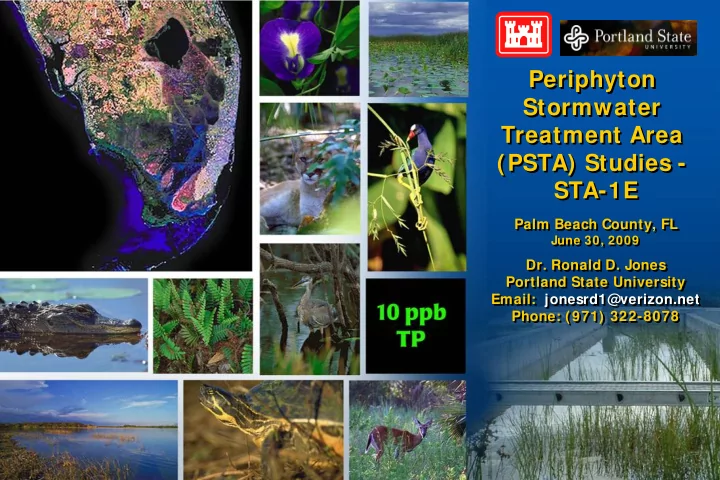
Periphyton Periphyton Stormwater Stormwater Treatment Area Treatment Area (PSTA) Studies - (PSTA) Studies - STA-1E STA-1E Palm Beach County, FL Palm Beach County, FL June 30, 2009 June 30, 2009 Dr. Ronald D. Jones Dr. Ronald D. Jones


slide-1
SLIDE 1

Periphyton Stormwater Treatment Area (PSTA) Studies - STA-1E Periphyton Stormwater Treatment Area (PSTA) Studies - STA-1E

Palm Beach County, FL

June 30, 2009

  • Dr. Ronald D. Jones

Portland State University Email: jonesrd1@verizon.net Phone: (971) 322-8078 Palm Beach County, FL

June 30, 2009

  • Dr. Ronald D. Jones

Portland State University Email: jonesrd1@verizon.net Phone: (971) 322-8078

slide-2
SLIDE 2

2

  • Introduction and Overview
  • Mesocosm Results
  • Field Scale Demonstration
  • Path Forward

Agenda Agenda

slide-3
SLIDE 3

3

DESIGN SUMMARY

PSTA Demonstration Conceptual Plan to Achieve 10 ppb Phosphorus

low phosphorus substrate

STA-1E STA-1E

  • 70ppb P

45-25 ppb P 10 ppb P Calcareous Periphyton (activated) SAV w/ Periphyton 20 - 30 ppb P Emergent Growth > 200 ppb P

slide-4
SLIDE 4

Natural System

Seasonal Dryout

Natural System

Seasonal Dryout

Corps PSTA

Repeated (forced) Dryouts Activated Periphyton

Corps PSTA

Repeated (forced) Dryouts Activated Periphyton CYANO DOMI NANT Dry conditions Summer/ Fall DI ATOM DOMI NANT Wet conditions Winter/ Spring CYANO DOMI NANT Extreme conditions

slide-5
SLIDE 5

5

Mesocosm Study Mesocosm Study

  • Substrate types
  • Hydraulic

retention times

  • Flow depths
  • Vegetative

community size and sustainability

slide-6
SLIDE 6

Mesocosm Water Budget Mesocosm Water Budget

  • perating

depth

1/ 100 foot depth accuracy

water budget rainfall and evaporation monitoring composite sampling

(2000 hrs; 1400 hrs) Feed: 1-11 cms/ day measured w/ rotameter

slide-7
SLIDE 7

7

Mesocosm : Results (7/ 2007 through 6/ 2008) Mesocosm : Results (7/ 2007 through 6/ 2008)

Total Phosphorus I nput Cell 4 Output Cell 1 Output Cell 2 Output Cell 3 Output

10 20 30 40 50 60 70 80 7/13/2007 7/23/2007 8/2/2007 8/12/2007 8/22/2007 9/1/2007 9/11/2007 9/21/2007 10/1/2007 10/11/2007 10/21/2007 10/31/2007 11/10/2007 11/20/2007 11/30/2007 12/10/2007 12/20/2007 12/30/2007 1/9/2008 1/19/2008 1/29/2008 2/8/2008 2/18/2008 2/28/2008 3/9/2008 3/19/2008 3/29/2008 4/8/2008 4/18/2008 4/28/2008 5/8/2008 5/18/2008 5/28/2008 6/7/2008

Total Phosphorus (ppb)

Cell 1 = lime sludge (over riviera sand) Cell 2 = limestone - Ft. Thompson (~ 7 years) Cell 3 = limestone - Onsite (~ 2 year) Cell 4 = limestone - Ft. Thompson over peat (~ 7 years)

slide-8
SLIDE 8

8

Field Scale Demonstration Field Scale Demonstration

  • I n 2003 PSTA Field-Scale Demonstration was authorized

and funded

  • PSTA Field Scale Demonstration Objectives:

Evaluate PSTA performance for the period of record in a

larger scale

Calibrate concentration-based PSTA model to determine full

scale sizing of PSTA technology

Demonstrate most cost-effective PSTA substrate Determine PSTA engineering and operational parameters for

full scale implementation

Determine the operations and maintenance requirements for

full scale implementation and sustainability
  • I n 2003 PSTA Field-Scale Demonstration was authorized

and funded

  • PSTA Field Scale Demonstration Objectives:

Evaluate PSTA performance for the period of record in a

larger scale

Calibrate concentration-based PSTA model to determine full

scale sizing of PSTA technology

Demonstrate most cost-effective PSTA substrate Determine PSTA engineering and operational parameters for

full scale implementation

Determine the operations and maintenance requirements for

full scale implementation and sustainability

slide-9
SLIDE 9

9

PSTA Field-Scale Test Cells PSTA Field-Scale Test Cells

A B C

6” ONSI TE LI MESTONE 6” ONSI TE LI MESTONE 1” PALM BEACH LI ME SLUDGE OVER NATI VE SAND SAV CELL CELL 1 PLUG C-51

SEEPAGE CANAL

CELL 2 BYPASS

slide-10
SLIDE 10

10

PSTA Field Scale Demonstration Results PSTA Field Scale Demonstration Results

Note: results based on a 3.5 - 7 day hydraulic retention time

1” Lime Sludge - Cell A 1” Lime Sludge - Cell A

0.0 5.0 10.0 15.0 20.0 25.0 10/2/2008 10/3/2008 10/7/2008 10/14/2008 10/21/2008 10/30/2008 11/6/2008 11/12/2008 11/20/2008 11/28/2008 12/5/2008 12/11/2008 12/18/2008 12/26/2008

Total Phosphorus (ug/L)

A Risr In A Risr Out

slide-11
SLIDE 11

11

Note: results based on a 3.5 - 7 day hydraulic retention time

PSTA Field Scale Demonstration Results PSTA Field Scale Demonstration Results

6” Onsite Limestone - Cell B 6” Onsite Limestone - Cell B

0.0 5.0 10.0 15.0 20.0 25.0 1 / 2 / 2 8 1 / 3 / 2 8 1 / 7 / 2 8 1 / 1 4 / 2 8 1 / 2 1 / 2 8 1 / 3 / 2 8 1 1 / 6 / 2 8 1 1 / 1 2 / 2 8 1 1 / 2 / 2 8 1 1 / 2 8 / 2 8 1 2 / 5 / 2 8 1 2 / 1 1 / 2 8 1 2 / 1 8 / 2 8 1 2 / 2 6 / 2 8

Total Phosphorus (ug/L)

A Risr In A Risr Out

slide-12
SLIDE 12

12

Note: results based on a 3.5 - 7 day hydraulic retention time

PSTA Field Scale Demonstration Results PSTA Field Scale Demonstration Results

6” Onsite Limestone - Cell C 6” Onsite Limestone - Cell C

A Risr In A Risr Out

0.0 5.0 10.0 15.0 20.0 25.0 1 / 2 / 2 8 1 / 3 / 2 8 1 / 7 / 2 8 1 / 1 4 / 2 8 1 / 2 1 / 2 8 1 / 3 / 2 8 1 1 / 6 / 2 8 1 1 / 1 2 / 2 8 1 1 / 2 / 2 8 1 1 / 2 8 / 2 8 1 2 / 5 / 2 8 1 2 / 1 1 / 2 8 1 2 / 1 8 / 2 8 1 2 / 2 6 / 2 8

Total Phosphorus (ug/L)

slide-13
SLIDE 13

13

PSTA Field Scale Demonstration Path Forward PSTA Field Scale Demonstration Path Forward

  • Operate temporary (10cfs) pumps from C-51 during low

flow periods to bypass cell 1

  • Plug installed isolating test cells from cell 2 bypass area,

to enable testing during high flow

  • Current Schedule:

Testing completion - August 2010 Prepare Engineering Documentation Report (EDR) –

January 2011

slide-14
SLIDE 14

Planned schedule alternating 2 months wet, 2 months dry for a period of 6-8 months

Field –Scale Operation (STA 1-E) Field –Scale Operation (STA 1-E)

November 2006 – July 2009 November 2006 – July 2009

Dry Out

START Dry Out Flooded Dry Out OPERATE

Dry Out 1 1 / 6 7 / 7 1 / 8 5 / 8 1 / 9 1 / 1

Flooded

Activation

slide-15
SLIDE 15

15

PSTA Field-Scale Test Cells PSTA Field-Scale Test Cells

A B C

6” ONSI TE LI MESTONE 6” ONSI TE LI MESTONE 1” PALM BEACH LI ME SLUDGE OVER NATI VE SAND SAV CELL CELL 1 PLUG C-51

SEEPAGE CANAL

CELL 2 BYPASS

slide-16
SLIDE 16

BACK-UP SLIDES BACK-UP SLIDES

slide-17
SLIDE 17

Chemical & Biological Reactants Naturally Found in the Everglades Marsh Chemical & Biological Reactants Naturally Found in the Everglades Marsh

Calcium - abundant Magnesium - trace Iron - trace Aluminum - trace Manganese – trace Calcium - abundant Magnesium - trace Iron - trace Aluminum - trace Manganese – trace

Calcium-based treatment technology only logical option

Require Chemical Treatment Require Chemical Treatment

slide-18
SLIDE 18

Hypothesis – Factors for Developing Calcareous Periphyton Hypothesis – Factors for Developing Calcareous Periphyton

High solar radiation High temperature Low phosphorous Dry-out High solar radiation High temperature Low phosphorous Dry-out

Manipulate hydroperiod – forced dry-outs Manipulate hydroperiod – forced dry-outs

slide-19
SLIDE 19

Corps Activated Periphyton:

Water Treatment Based on Observations in Nature

(natural system enhanced through more frequent dry-outs)

  • Low Phosphorus
  • Rainfall Driven
  • Periodic Dryouts (cyano bacteria dominance)
  • Calcite (precipitated periphyton)
  • Low Phosphorus
  • Always Wet
  • Low Phosphorus
  • Always Wet

Core Sample South

  • f Tamiami Trail

Natural Conditions

Calcite Calcite Peat Peat Pre-Tamiami Trail Construction (no obstruction to sheetflow in Everglades) Post-Tamiami Trail Construction 1920s

slide-20
SLIDE 20

PSTA Phosphorus (P) Removal Process within a Calcareous Periphyton Mat PSTA Phosphorus (P) Removal Process within a Calcareous Periphyton Mat

  • Calcium (Ca2+ )
  • Dissolved I norganic Carbon – DI C (e.g. CO3
  • - , H2CO3, HCO3
  • , CO2

)

  • High pH
  • Nucleation Sites

H2CO3 H2CO3 Ca2+ Ca2+

pH 7-8

Ca2+ Ca2+ Ca2+ Ca2+

DI C DI C Ca2+ Ca2+ Ca2+ Ca2+ TP TP TP TP TP TP TP TP OH- OH- OH- OH- Ca2+ 2HCO3 Ca2+ 2HCO3 CaCO3 CaCO3 TP TP

CYANO BACTERI A DOMI NATED CALCARI OUS PERI PHYTON MAT PERI PHYTON SEDI MENT (CALCI TE) PERI PHYTON SEDI MENT (CALCI TE) pH 8-11

Ca2+ Ca2+ OH- OH- OH- OH- Ca2+ Ca2+ DI C DI C HCO3 HCO3 H2CO3 H2CO3 HCO3 HCO3 DI C DI C DI C DI C

BACTERI A FORMS ALKALI NE PHOSPHATASE BACTERI A FORMS ALKALI NE PHOSPHATASE

TP PO4

  • TP PO4
  • PHOSPHATE CO-PRECI PI TATI ON

PHOSPHATE CO-PRECI PI TATI ON

CO3

  • CO3
  • Ca2+

Ca2+ Ca2+ Ca2+ Ca2+ Ca2+ CO2 CO2 CO2 CO2

pH 7-8 CALCI TE DEPOSI TI ON

slide-21
SLIDE 21

Enlargement of Calcareous Periphyton Assemblage Enlargement of Calcareous Periphyton Assemblage

calcium carbonate precipitation functional groups