NORTH AMERICAN PARTNERSHIP FOR PHOSPHORUS SUSTAINABILITY Currently - - PowerPoint PPT Presentation

north american partnership for
SMART_READER_LITE
LIVE PREVIEW

NORTH AMERICAN PARTNERSHIP FOR PHOSPHORUS SUSTAINABILITY Currently - - PowerPoint PPT Presentation

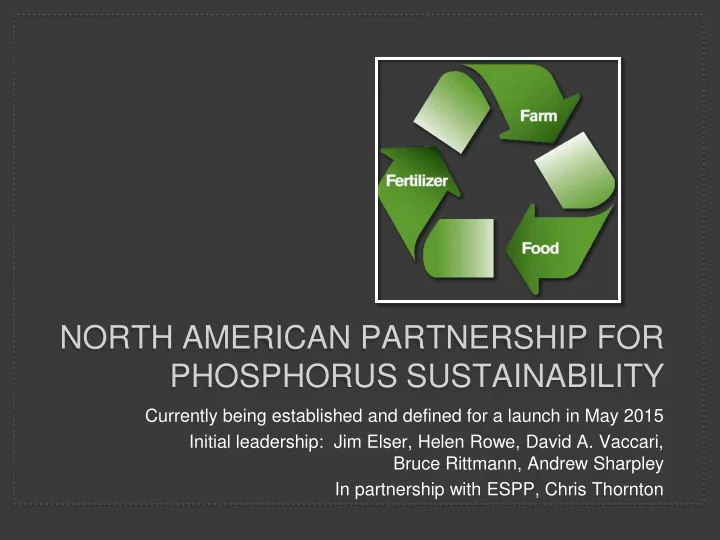
s NORTH AMERICAN PARTNERSHIP FOR PHOSPHORUS SUSTAINABILITY Currently being established and defined for a launch in May 2015 Initial leadership: Jim Elser, Helen Rowe, David A. Vaccari, Bruce Rittmann, Andrew Sharpley In partnership with


slide-1
SLIDE 1

Currently being established and defined for a launch in May 2015 Initial leadership: Jim Elser, Helen Rowe, David A. Vaccari, Bruce Rittmann, Andrew Sharpley In partnership with ESPP, Chris Thornton

NORTH AMERICAN PARTNERSHIP FOR PHOSPHORUS SUSTAINABILITY

s’

slide-2
SLIDE 2
  • The P-RCN seeks to

link research with stakeholder needs

  • NAPPS proposed at the

2nd P-RCN meeting – Jan 2014

  • Phosphorus Sustainability Research

Coordination Network (P-RCN) was created in 2013 with a grant from the US National Science Foundation

  • Centered at Arizona State University

Impetus for NAPPS

slide-3
SLIDE 3
  • NAPPS will identify and endeavor to alleviate key bottlenecks for decision-making,

policy, and implementation of P efficiency and recycling technologies and strategies

  • NAPPS will create an operational approach to facilitate business, policy and

regulatory developments, implement projects, and translate research progress into phosphorus management actions

  • Stakeholders include national and local policy makers, regulators, planners and
  • fficials, representatives of agriculture, mining and other industry, and academia

The goal of NAPPS is to work actively with stakeholders to foster and implement sustainable P solutions in public and private sectors.

slide-4
SLIDE 4

Niche for NAPPS

  • NAPPS aims to be a lasting structure

focused on the long-term implementation of P sustainability solutions in North America

  • NAPPS will engage stakeholders with each other
  • NAPPS will be a resource for creating and mobilizing a network, project

development, finding funding for projects to address identified priorities

  • NAPPS will collaborate, building on and work with other P sustainability
  • rganizations, e.g. ESPP, Global P summit, Global P Network, UN-GPNM
slide-5
SLIDE 5

NAPPS activities and stakeholder recruitment will be

  • rganized around these four themes:
  • 4. P and Water Quality
  • 2. P Efficiency in Food Production
  • 1. P Recycling
  • 3. P Demand: Population,

food choice, bioenergy

slide-6
SLIDE 6

1. Develop a common vision

for creating a sustainable P cycle in North America

2. Identifying and helping businesses and other organizations respond to opportunities offered by

challenges in P management and emerging research in P sustainability

3. Building networks

between different interest groups and sectors related to phosphorus management

4. Evaluating new P efficiency and recycling technologies,

including feasibility, availability of suppliers, cost/benefit analysis, and life cycle analyses

5. Fostering implementation of new technologies

by improving the efficiency of business value chains

6. Assessing and facilitating regulatory development pertaining to phosphorus management,

including waste, environmental, discharge, and agriculture to improve P sustainability

7. Representing stakeholders

North American phosphorus managers and innovators in international meetings and initiatives

8. Preparing funding proposals

for demonstration projects and integration and dissemination of new technologies and concepts

Representative Activities
slide-7
SLIDE 7

Funding: Current “start up” funding is from Arizona State University Investment from future partners:

  • P-recycling or P-engineering

companies

  • Agricultural companies: crops,

seeds, feeds, crops

  • Livestock industry, manure

processing

  • Biofuels companies
  • Water and waste utilities and

companies

  • Food processing & retailing

industry

  • Municipalities, local and state

authorities

  • Gov’t agencies: USDA, EPA

Phosphate Rock