Tim Adams Approved biomass sources Biomass resource availability - - PowerPoint PPT Presentation
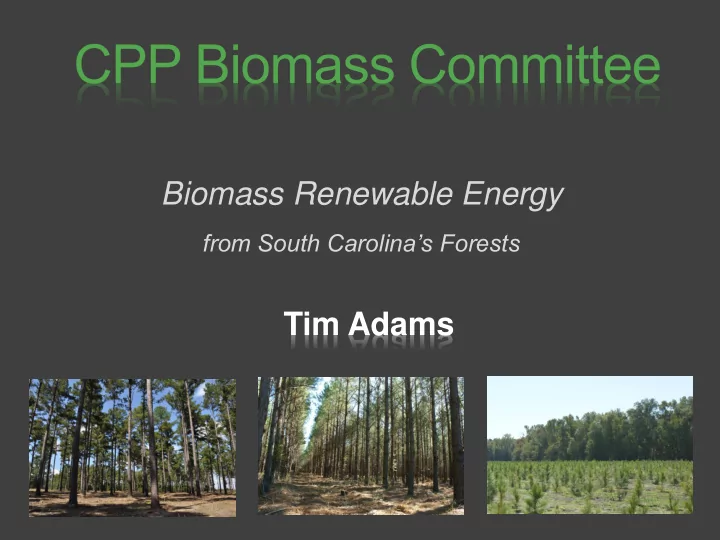
Biomass Renewable Energy from South Carolinas Forests Tim Adams Approved biomass sources Biomass resource availability studies Long-term monitoring & reporting of SCs forest resource Projections of future wood supply
- Approved biomass sources
- Biomass resource availability studies
- Long-term monitoring & reporting of
SC’s forest resource
- Projections of future wood supply
- Environmental protection programs for
forestry activities
- Chain of custody from forest to plant
- Emissions monitoring & verification
Forms of waste wood? or Pulpwood?
2,571,000 2,931,000 3,291,000 3,651,000 5,610,000 5,610,000 600,000 1,360,000 1,800,000 3,400,000 4,380,000 4,530,000 392,000 981,000 1,275,000 2,419,000 3,138,000 3,269,000 1,252,000 1,418,000 1,584,000 1,749,000 1,915,000 2,081,000 594,000
$20 $22 $24 $26 $28 $30
Cost per ton
Mill Residues Logging Residues Standing Residuals Urban Wood Precommercial Thinning Totals 15.0 million 16.1 million 11.2 million 8.0 million 6.7 million 4.8 million Currently Utilized Partially Utilized Not Utilized
Roundwood
into
Pellets
- Goal: To describe
the extent and condition of the state’s forests.
- Have completed 10
surveys between 1936 and 2011.
- Data collection – SC
Forestry Commission
- Data analysis –
USDA Forest Service
SCFC Forest Inventory & Analysis Program
0.5 1 1.5 2 2.5 3 3.5 4 Small Diameter Medium Diameter Large Diameter
Area (million acres) Stand-Size Class
Area of Forestland by Forest Type and Stand-Size Class, SC 2013
Softwood Forest Types Hardwood Forest Types
Natural Pine 24% Planted Pine 24% Mixed Pine/Hardwood 11% Upland Hardwoods 22% Lowland Hardwoods 19%
South Carolina Forest Types, 2013
7% 4% 1% 88%
Area of South Carolina Timberland by Ownership Group, 2013 Federal State and Local Forest Industry Nonindustrial Private
BMPs FOR FORESTRY IN SOUTH CAROLINA
TIMBER OPERATIONS PROFESSIONAL PROGRAM
- Silvicultural guidelines first
published in 1976
- Best management Practices for
Forested Wetlands published in 1989
- Current manual published in 1994
- Supplement addressing braided
streams published in 1999
- Biomass guidelines published in
2012
SC BEST MANAGEMENT PRACTICES MANUAL
BMPs FOR FORESTRY IN SOUTH CAROLINA
TIMBER OPERATIONS PROFESSIONAL PROGRAM
50 55 60 65 70 75 80 85 90 95 100 1991 1993 1994 2000 2005 2006 2009 2012
84.5 84.7 89.5 91.5 94 98 98.6 93.4
Percent Compliance
Harvesting BMP Compliance by Year
Percent Compliance
OVERALL BMP COMPLIANCE – 93.4%
BMPs FOR FORESTRY IN SOUTH CAROLINA
TIMBER OPERATIONS PROFESSIONAL PROGRAM
MONTHLY CE REPORT
For a high-valued product, an intensive chain of custody procedure can be required by the manufacturing plant even to the extent of bar coding each log in the woods and tracking it to the
- plant. This is typically
determined by the end user. For low-valued products, like biomass for energy, the Forestry Commission’s Courtesy Exam Program could suffice for a chain
- f custody procedure. Harvested
sites that are out-of-compliance with forestry BMP’s are listed monthly and mills that received the wood are notified.
- 1. Likely intention is to track carbon through
regulated mechanisms across utilities and states.
- 2. Possible mechanisms include carbon
registries and carbon trading.
- 3. Private sector solutions are preferred to
government programs.
- 4. The SC Forestry Commission has played a
support role.
- Approved biomass sources
- Biomass resource availability studies
- Long-term monitoring & reporting of
SC’s forest resource
- Projections of future wood supply
- Environmental protection programs for
forestry activities
- Chain of custody from forest to plant
- Emissions monitoring & verification