
SLIDE 1
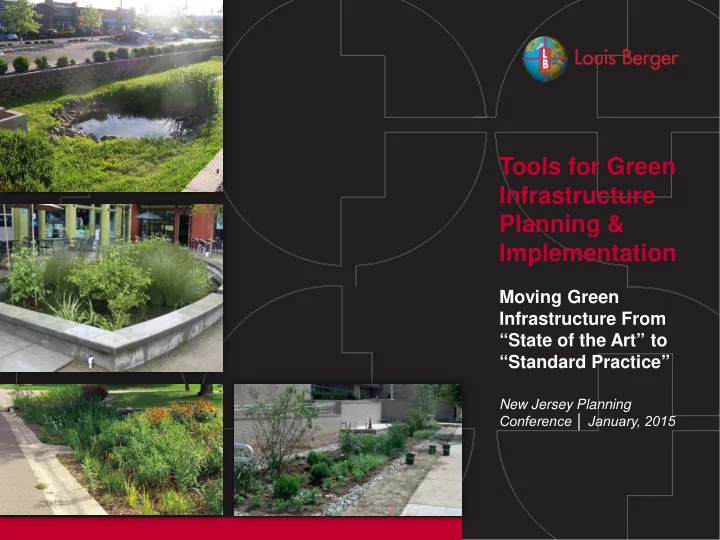
Tools for Green Infrastructure Planning & Implementation
Moving Green Infrastructure From “State of the Art” to “Standard Practice”
New Jersey Planning Conference │ January, 2015
Tools for Green Infrastructure Planning & Implementation - - PowerPoint PPT Presentation
Tools for Green Infrastructure Planning & Implementation Moving Green Infrastructure From State of the Art to Standard Practice New Jersey Planning Conference January, 2015 Step-by-Step Guide to Creating a Neighborhood
New Jersey Planning Conference │ January, 2015
Credit: www.phillywatersheds.org
3
1. Educate and Raise Awareness 2. Optimize Existing Systems and Implement Asset Management 3. Build Capacity and Foster Cross-Jurisdictional Collaboration 4. Leverage Early Successes to Generate Political Support 5. Diversify Funding Solutions
1. Support adoption of effective and innovative LTCPs 2. Optimize existing systems 3. Develop a green infrastructure focus 4. Employ resilient, state-of-the-art gray and green infrastructure 5. Identify and establish new funding tools 6. Raise awareness of CSO Problems and solutions
4
strategically implementing scalable green infrastructure BMPs, starting at the neighborhood level.
strategic planning to maximize stormwater management and water quality benefits, positioning communities to obtain funding for green infrastructure implementation.
and Environmental Commissions. Target audience includes communities with separate storm sewer systems that will not be required to draft Long Term Control Plans.
Photo Credit: Center for Neighborhood Technology
5 Graphic Credit: Rutgers Water Resources Program, Green Infrastructure Feasibility Study, Little Falls
6
New Jersey
National
Center
Technology
Plans Credit: Rutgers Cooperative Extension Water Resources Program, City Of Lancaster
7
8
Resources:
Infrastructure website
website
Website
New Jersey
What are the types of GI BMPs? Where are they most appropriate? Where are they most cost effective?
1. Menu of Green Infrastructure BMPs
2. General Siting Criteria 3. Cost Effectiveness
Graphic Credit: NJDEP, Rutgers Water Resources Program, US EPA
9
Resources:
Where does stormwater flooding occur? How does stormwater flow there?
Review Available Data: 1. Impervious cover 2. Watersheds 3. Floodprone areas 4. Geology (bedrock, groundwater table, soils) 5. Topography 6. Land use context 7. Sewer network
Map Credit: ESRI, FEMA, Rutgers
Example Community: Mountainview, Wayne, NJ
10
Resources:
Infrastructure website
Program website
New Jersey
Where is shallow depth to the water table or bedrock? How can you slow or capture water upstream from flood prone areas?
Suitable areas for: Vegetative BMPs (Infiltration) Rainwater harvesting BMPs (Detention) Storage BMPs (Retention)
A B C B C A
Map Credit: ESRI, USGS
Example Community: Mountainview, Wayne, NJ
11
Resources:
Plan
New Jersey – The Current State of Implementation, NRDC
What do you want to achieve? What goals are feasible? Over what time frame?
1. Reduction in X% impervious cover 2. Manage runoff from X% of impervious cover using GI BMPs 3. Implementation of X GI Pilot Projects 4. Implementation of X SF or number of specific BMPs
Graphic Credit: NYC DEP, Hoboken Green Infrastructure Strategic Plan
12
Resources:
What sites are most feasible for GI implementation? What land use / property
GI implementation?
Opportunity sites: Public or Community property, parks Parking Areas Nonprofit or Religious Institutions Residential and Commercial Properties
1 3 2 4
Map Credit: ESRI
Example Community: Mountainview, Wayne, NJ
13
Resources:
Calculator
Rutgers Water Resources Town Planner and Engineer Pro bono / Professional Organizations / Universities Sustainable Jersey
Which of the potential sites give you the most bang for the buck?
for those sites with the highest opportunity
most stormwater for the lowest cost?
technical assistance
Graphic Credit: EPA National Stormwater Calculator
Example Site: Ambulance Corps, Mountainview, Wayne, NJ
14
Resources:
website
How do you get there? Who are your partners? What are your highest priorities?
Impervious Area
zone' (sq. ft) Goal of Impervious Area Captured/Stored by Green Infrastructure (15 %) Distribution of Impervious Area per BMP (sq. ft.) Calculate Potential Stormwater Captured/Stored by Green Infrastructure (cu. ft)
Analysis of Hoboken’s stormwater management system Land Use Context Constraints Opportunities Impervious Coverage
Size: Drainage area, Physical Sq. Ft. Vertical Constraints: Groundwater Table, Bedrock Depth Topography: Slope, Contours Soils: Permeability, Infiltration Rate Pros / Cons
Benefits: Flooding Mitigation, Ecological, Public Health, Open Space Cost: Capital, Operations & Maintenance Useful life Storage Capacity
Identified the gray zone, modified distribution based on siting Recommended specific BMPs for each sewershed based on siting and sewershed characteristics Determined the most beneficial BMPs and ideal distribution
Jersey City
Graphic Credit: Hoboken Green Infrastructure Strategic Plan
Graphic Credit: Hoboken Green Infrastructure Strategic Plan
Jersey City
Graphic Credit: Hoboken Green Infrastructure Strategic Plan
Graphic Credit: Hoboken Green Infrastructure Strategic Plan
21
22
Regulation Rainfall Retained 1-25% 25-50% 51%+ FAR 1.0 3.2 4.0 Height 2 story 8 story 12 story Density 28 DU/ Acre 55 DU/ Acre 90 DU/ Acre
Jennifer Gonzalez, AICP Senior Environmental Planner Louis Berger jgonzalez@louisberger.com NJ Future Urban Water Infrastructure Working Group: http://www.njfuture.org/issues/environment-and- agriculture/water-sewer/urban-water-infrastructure/ Hoboken Green Infrastructure Strategic Plan: