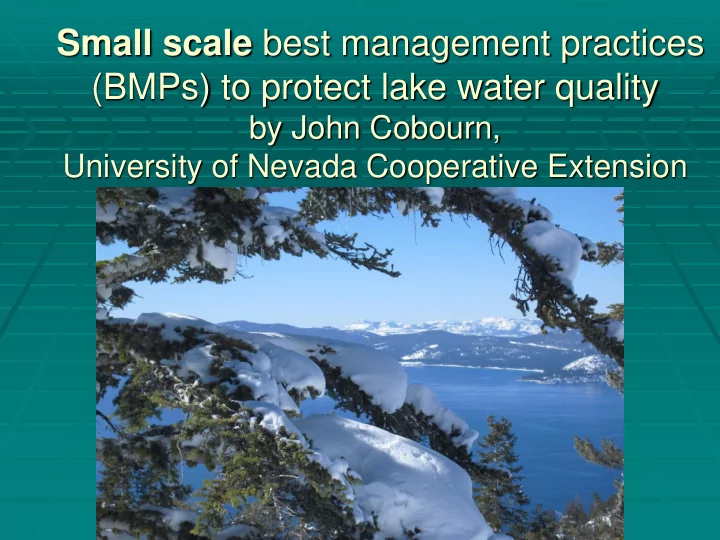
SLIDE 1
Small scale best management practices
(BMPs) to protect lake water quality
by John Cobourn, University of Nevada Cooperative Extension
SLIDE 2 Greatest Threats to Water Quality
- NUTRIENTS feed algae suspended in
water
- FINE SEDIMENTS also remain
suspended in the water
- Worst sediments are .5-10 microns
- 72% of fine sediment comes from urban
runoff
SLIDE 3
- We have two kinds of “sewer” systems
Runoff from streets, parking lots and rooftops is the enemy. It is not “treated.”
SLIDE 4 BMPs are Required at Tahoe
- All we have is Nonpoint Source
Pollution at Tahoe
- TRPA Code of Ordinances defines “BMP
Retrofit”
- These BMPs are for single family homes
and small businesses
SLIDE 5 The Steps of BMP Retrofit
- 1. Free BMP Site evaluation from TRPA or
Conservation Districts
- 2. Install the required BMPs
- 3. A Conservation District or TRPA does an
inspection, and TRPA issues a Certificate of BMP Completion
SLIDE 6 How BMPs work
- 1. “Source Control”: Vegetate and mulch
bare soil to prevent erosion
- 2. “Infiltration”: Concentrated runoff from
rooftops and pavement needs extra help to infiltrate (storage in a system)
SLIDE 7 Five Main Categories of Small Scale BMPs
- 1. Temporary (construction) BMPs
- 2. Paving and properly Draining Driveways
- 3. Infiltrating runoff into the soil
- 4. Vegetating and mulching bare soil
- 5. Stabilizing steep slopes
Each type of BMP has its own Chapter in the Contractors BMP Manual (3 ring binder)
SLIDE 8
- 1. Temporary BMPs
- Use during construction or any soil disturbance
SLIDE 9
Driveways must convey runoff to an infiltration system
SLIDE 10
Prevent concentrated runoff from reaching the street by installing a swale or channel drain across the foot of the driveway.
SLIDE 11
- 3. Infiltration Systems
- Keep the water from leaving the property.
- Install a sediment trap for ease of
maintenance
- Unless soil has rapid permeability, runoff
water usually needs to be stored
- Water infiltrates after the rain event has
ended
SLIDE 12
SLIDE 13
Dripline trench with containment border
SLIDE 14
Dripline trench with cobble border
SLIDE 15
Armored Drip Line Treatments
Drain Rock with Containment Borders
SLIDE 16
SLIDE 17
Armor under Elevated Structures
SLIDE 18
Prefabricated Infiltration Systems (Rainstore) 94% void space!
SLIDE 19 Rock Lined Basins
Maximum 2:1 side slope
Level bottom Match contour of slope Incorporate armored spillway for potential basin overflow
SLIDE 20 Vegetated Basins
Maximum 2:1 side slope
Level bottom Match contour of slope Incorporate armored spillway for potential basin overflow
SLIDE 21
SLIDE 22
SLIDE 23
Conveyance Swales
Rock lined Vegetated
SLIDE 24 Natural Infiltration or Water Spreading can work when there is a flat lawn
SLIDE 25
- 4. Vegetate and Mulch Bare Soil
- Landscape should absorb water like a sponge
- Use both Native AND Adapted plants
- Recommended plant list
Heavy rain will wash unprotected soil into the street.
SLIDE 26 Cover bare soil with vegetation and/or mulch
(Appropriate turf)
SLIDE 27
Lean, Clean, and Green Wildland Fuel Reduction Noncombustible
SLIDE 28
Structures needed for all slopes over 50%. Combine with vegetation for best results. Slope: Divide the Rise by the Run. If you have 1/2, divide 1 by 2 and you get .5 or 50%. (also known as a “2 to 1 slope”).
SLIDE 29
Slope Stabilization structures
SLIDE 30 BMPs Need to be Maintained
need BMP Retrofit if BMPs have not been maintained.
SLIDE 31
Teach BMP Installation in Spanish