Performance Venues and Cultural Impact: mapping The Circuit - - PowerPoint PPT Presentation

performance venues and cultural impact mapping the circuit
SMART_READER_LITE
LIVE PREVIEW

Performance Venues and Cultural Impact: mapping The Circuit - - PowerPoint PPT Presentation

Performance Venues and Cultural Impact: mapping The Circuit Professor Rachel Fensham and Septi Rito Tombe University of Melbourne On behalf of Creative Convergence: Evaluating the Impact of Theatre on Young People in Regional


slide-1
SLIDE 1

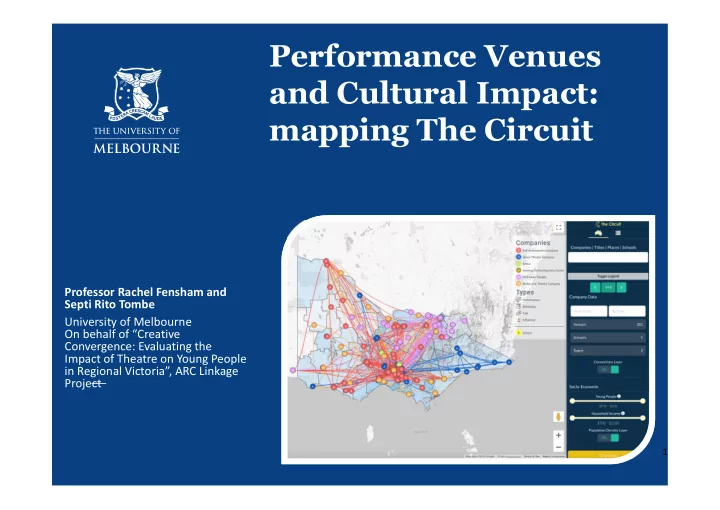
Performance Venues and Cultural Impact: mapping The Circuit

Professor Rachel Fensham and Septi Rito Tombe University of Melbourne On behalf of “Creative Convergence: Evaluating the Impact of Theatre on Young People in Regional Victoria”, ARC Linkage Project

1

slide-2
SLIDE 2

Aims of Creative Convergence

2

To evaluate the impact of regional theatre for young people in Victoria By assessing the opportunities for convergence between People, Place and Media.

slide-3
SLIDE 3

AusStage live performance database contains

  • ver 100, 000 performing arts events

including full metadata with contributors, dates, and venues. It is mostly reliable but not comprehensive, and we added items to the database from the companies. We also collected additional data internal to the companies, such as audience size, schools participation, type of program and in some cases, cost. We added: ABS data collected through the 2016 Census to provide information by local government area (LGA)

  • n population density, average household

income, youth population (under 18), and ethnicity (by ancestry). Some of these datasets were sourced from AURIN, the Australian Urban Research Infrastructure Network.

Data inputs

slide-4
SLIDE 4

The tool was created on HTML/JS/CSS stack which is usually used for the front-end (user interface) side of a web application. In modern web browsers, this storage is called "Local Storage”, and it stores all data fetched from AusStage, ABS, and AURIN. For the map, we used Google Map APIs (Application Programming Interface), to show the map layer and standard map functions such as zoom and pan.

  • On top of that layer, we usdc D3.js, a library

for JS to create the nodes, lines, population density layer. This library eases makes "svg" (a picture format) representation of the stored data based on our instructions.

4

We also used Datatables, a library which consists of JS/CSS that makes it easier to show the data in table format. All standard table functions, such as sort, filter, and paging are handled by the library, however, to match our need we introduced many modifications, for instance to our search fields.

What software was applied or developed for data integration?
slide-5
SLIDE 5

Originally, adopting the Unimelb colour scheme, the map theme was changed to a lighter colour to make the nodes, lines, and density layers more prominent. The ‘I want hue’ tool from the Sciences-Po Media Lab generates the colour of the nodes and lines, with awareness of using colourblind- friendly colours to accommodate various users, although it reduces some colour contrasts. The layout is inspired by the Gutenberg Diagram, which recommends the left side of a computer

  • screen. As our main content is the map and the

table, the filters are on the right. The filter groupings and general layout of objects were mostly based on Gestalt Principles (a common practice of web design layouts) and has been subject to continuous modification.

5

Visual display

slide-6
SLIDE 6

Events, Venues, and Schools

A later addition to the datasets was more inclusion of schools data points in order to identify their proximity to events and venues. This independent dataset has been integrated as another layer.

slide-7
SLIDE 7

Regional Distributions (2012-17) L-R, T-B: Bell Shakespeare, Melbourne Theatre Company, Geelong Performing Arts Centre, Hothouse Theatre, Arena Theatre Company, Arthur

slide-8
SLIDE 8

Regional Exposure and Geographic Isolation L-R: Western Victoria, East Gippsland

slide-9
SLIDE 9

Schools Involvement and Access (In Development) Hothouse, MTC Melbourne, Arena Touring, Bell Education Performances and Regional Mentorship

The information points do not provide representations of scale although we have discussed whether these might be added, for instance, to show an audience of 1- 50, 50-200, 200+

slide-10
SLIDE 10

Thank you

Professor Rachel Fensham University of Melbourne

The CIRCUIT, will be available from the Digital Studio project page, Creative Convergence also: