SLIDE 1
Examples: 6 = 1 + 2 + 3 28 = 1 + 2 + 4 + 7 + 14 496 = 1 = 2 + 4 + 8 + 16 + 31 + 62 + 124 + 248 Non-examples: 4 6= 1 + 2 = 3 9 6= 1 + 3 = 4 12 6= 1 + 2 + 3 + 4 + 6 = 16
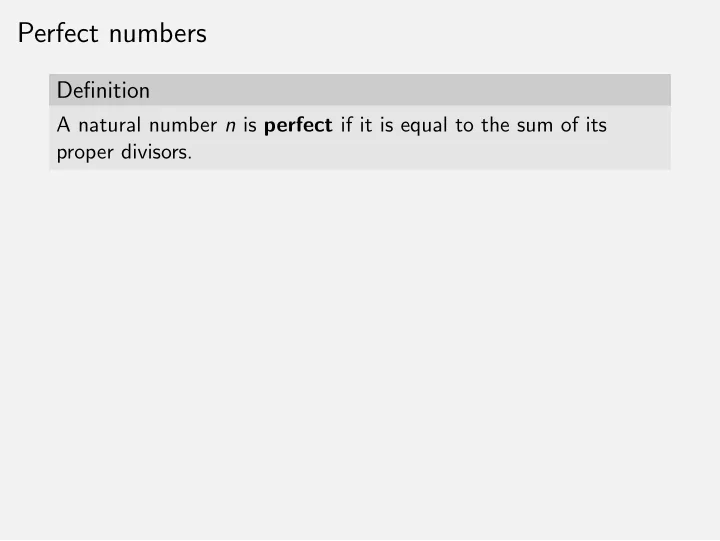
Perfect numbers
Definition
A natural number n is perfect if it is equal to the sum of its proper divisors.
SLIDE 2
Perfect numbers
Definition
A natural number n is perfect if it is equal to the sum of its proper divisors. Examples: 6 = 1 + 2 + 3 28 = 1 + 2 + 4 + 7 + 14 496 = 1 = 2 + 4 + 8 + 16 + 31 + 62 + 124 + 248 Non-examples: 4 6= 1 + 2 = 3 9 6= 1 + 3 = 4 12 6= 1 + 2 + 3 + 4 + 6 = 16
SLIDE 3
Who cares?
I Philo of Alexandria (∼ 20 BCE–50 CE), a Jewish philosopher,
claimed the world was created in 6 days that the moon orbits in 28 days because 6 and 28 are perfect.
I Greek mathematicians like Nichomachus (∼ 100 CE) knew
the perfect numbers on the last slide and the fourth: 8128.
I Egyptian mathematician Ismail ibn Fall¯
us (1194–1252 CE) knew the next three perfect numbers: 33, 550, 336; 8, 589, 869, 056; and 137, 438, 691, 328.
I Europeans were interested by the 15th century when an
unknown mathematician (re)discovered 33, 550, 336.
SLIDE 4 Definition
We define the following sets:
I P is the set of perfect numbers; I S =
n 2(n−1) (2n − 1) : n ∈ N and 2n − 1 is prime
Question
What relationship does Euclid’s theorem establish between S and P?
And Euclid
Theorem (Euclid)
Let n ∈ N. If 2n − 1 is prime, then 2(n−1) (2n − 1) is perfect.
SLIDE 5 And Euclid
Theorem (Euclid)
Let n ∈ N. If 2n − 1 is prime, then 2(n−1) (2n − 1) is perfect.
Definition
We define the following sets:
I P is the set of perfect numbers;
n
2(n−1) (2n − 1) : n ∈ N and 2n − 1 is prime ;
Question
What relationship does Euclid’s theorem establish between S and P?
SLIDE 6 Proved by Euler in the 18th century.
Theorem (Euclid-Euler)
S = P ∩ E.
Ibn al-Haytham and Euler too
Definition
We define the following sets:
I P is the set of perfect numbers;
n
2(n−1) (2n − 1) : n ∈ N and 2n − 1 is prime ;
I E is the set of even numbers.
Conjecture (Ibn al-Haytham, ∼ 1000 CE)
(P ∩ E ) ⊆ S.
SLIDE 7 Ibn al-Haytham and Euler too
Definition
We define the following sets:
I P is the set of perfect numbers;
n
2(n−1) (2n − 1) : n ∈ N and 2n − 1 is prime ;
I E is the set of even numbers.
Conjecture (Ibn al-Haytham, ∼ 1000 CE)
(P ∩ E ) ⊆ S. Proved by Euler in the 18th century.
Theorem (Euclid-Euler)
S = P ∩ E .
SLIDE 8
Definition
A prime number of the form 2n − 1 is called a Mersenne prime.
Question
Are there infinitely many Mersenne primes?
Question
Are there any odd perfect numbers?
Open questions
Question
Are there infinitely many perfect numbers?
SLIDE 9
Question
Are there any odd perfect numbers?
Open questions
Question
Are there infinitely many perfect numbers?
Definition
A prime number of the form 2n − 1 is called a Mersenne prime.
Question
Are there infinitely many Mersenne primes?
SLIDE 10
Open questions
Question
Are there infinitely many perfect numbers?
Definition
A prime number of the form 2n − 1 is called a Mersenne prime.
Question
Are there infinitely many Mersenne primes?
Question
Are there any odd perfect numbers?