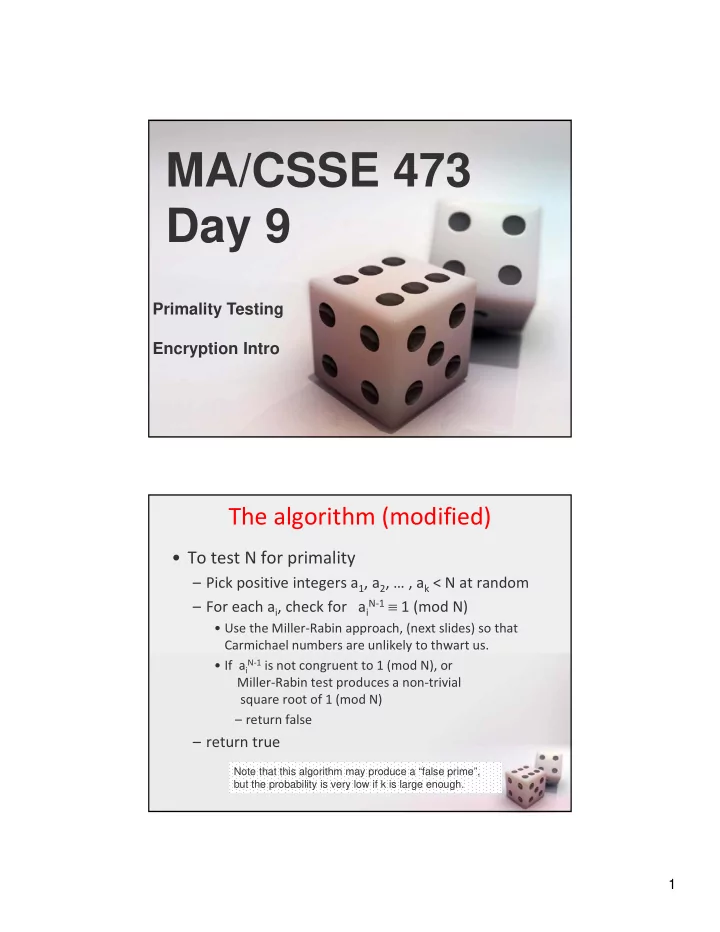
MA/CSSE 473 Day 9 Primality Testing Encryption Intro The algorithm - - PDF document

ma csse 473 day 9
SMART_READER_LITE
LIVE PREVIEW

MA/CSSE 473 Day 9 Primality Testing Encryption Intro The algorithm - - PDF document

MA/CSSE 473 Day 9 Primality Testing Encryption Intro The algorithm (modified) To test N for primality Pick positive integers a 1 , a 2 , , a k < N at random N 1 1 (mod N) For each a i , check for a i Use the Miller


slide-1
SLIDE 1

1

MA/CSSE 473 Day 9

Primality Testing Encryption Intro

The algorithm (modified)

  • To test N for primality

– Pick positive integers a1, a2, … , ak < N at random – For each ai, check for ai

N‐1  1 (mod N)

  • Use the Miller‐Rabin approach, (next slides) so that

Carmichael numbers are unlikely to thwart us.

  • If ai

N‐1 is not congruent to 1 (mod N), or

Miller‐Rabin test produces a non‐trivial square root of 1 (mod N) – return false

– return true

Note that this algorithm may produce a “false prime”, but the probability is very low if k is large enough.

slide-2
SLIDE 2

2

Miller‐Rabin test

  • A Carmichael number N is a composite number that

passes the Fermat test for all a with 1 ≤ a <N and gcd(a, N)=1.

  • A way around the problem (Rabin and Miller):

Note that for some t and u (u is odd), N‐1 = 2tu.

  • As before, compute aN‐1(mod N), but do it this way:

– Calculate au (mod N), then repeatedly square, to get the sequence au (mod N), a2u (mod N), …, a2tu (mod N)  aN‐1 (mod N)

  • Suppose that at some point, a2iu  1 (mod N), but

a2i‐1u is not congruent to 1 or to N‐1 (mod N)

– then we have found a nontrivial square root of 1 (mod N). – We will show that if 1 has a nontrivial square root (mod N), then N cannot be prime.

Example (first Carmichael number)

  • N = 561. We might randomly select a = 101.

– Then 560 = 24∙35, so u=35, t=4 – au  10135  560 (mod 561) which is ‐1 (mod 561) (we can stop here) – a2u  10170  1 (mod 561) – … – a16u  101560  1 (mod 561) – So 101 is not a witness that 561 is composite (we say that 101 is a Miller‐Rabin liar for 561, if indeed 561 is composite)

  • Try a = 83

– au  8335  230 (mod 561) – a2u  8370  166 (mod 561) – a4u  83140  67 (mod 561) – a8u  83280  1 (mod 561) – So 83 is a witness that 561 is composite, because 67 is a non‐ trivial square root of 1 (mod 561).

slide-3
SLIDE 3

3

Lemma: Modular Square Roots of 1

  • If there is an s which is neither 1 or ‐1 (mod N), but

s2  1 (mod N), then N is not prime

  • Proof (by contrapositive):

– Suppose that N is prime and s2  1 (mod N) – s2‐1  0 (mod N) [subtract 1 from both sides] – (s ‐ 1) (s + 1)  0 (mod N) [factor] – So N divides (s ‐ 1) (s + 1) [def of congruence] – Since N is prime, N divides (s ‐ 1) or N divides (s + 1) [def of prime] – S is congruent to either 1 or ‐1 (mod N) [def of congruence]

  • This proves the lemma, which validates the Miller‐Rabin

test

Accuracy of the Miller‐Rabin Test

  • Rabin* showed that if N is composite, this test will

demonstrate its non‐primality for at least ¾ of the numbers a that are in the range 1…N‐1, even if a is a Carmichael number.

  • Note that 3/4 is the worst case; randomly‐chosen

composite numbers have a much higher percentage of witnesses to their non‐primeness.

  • If we test several values of a, we have a very low

chance of incorrectly flagging a composite number as prime.

*Journal of Number Theory 12 (1980) no. 1, pp 128-138

slide-4
SLIDE 4

4

Efficiency of the Test

  • Testing a k‐bit number is Ѳ(k3)
  • If we use the fastest‐known integer

multiplication techniques (based on Fast Fourier Transforms), this can be pushed to Ѳ(k2 * log k * log log k)

Testing "small" numbers

  • From Wikipedia article on the Miller‐Rabin primality test:
  • When the number N we want to test is small, smaller fixed

sets of potential witnesses are known to suffice. For example, Jaeschke* has verified that

– if N < 9,080,191, it is sufficient to test a = 31 and 73 – if N < 4,759,123,141, it is sufficient to test a = 2, 7, and 61 – if N < 2,152,302,898,747, it is sufficient to test a = 2, 3, 5, 7, 11 – if N < 3,474,749,660,383, it is sufficient to test a = 2, 3, 5, 7, 11, 13 – if N < 341,550,071,728,321, it is sufficient to test a = 2, 3, 5, 7, 11, 13, 17

* Gerhard Jaeschke, “On strong pseudoprimes to several bases”, Mathematics of Computation 61 (1993)

slide-5
SLIDE 5

5

Generating Random Primes

  • For cryptography, we want to be able to quickly

generate random prime numbers with a large number of bits

  • Are prime numbers abundant among all integers?

Fortunately, yes

  • Lagrange's prime number theorem

– Let (N) be the number of primes that are ≤ N, then (N) ≈ N / ln N. – Thus the probability that an k‐bit number is prime is approximately (2k / ln (2k) )/ 2k ≈ 1.44/ k

Random Prime Algorithm

  • To generate a random k‐bit prime:

– Pick a random k‐bit number N – Run a primality test on N – If it passes, output N – Else repeat the process – Expected number of iterations is Ѳ(k)

slide-6
SLIDE 6

6

Interlude

CRYPTOGRAPHY INTRODUCTION

We'll only scratch the surface, but there is MA/CSSE 479

slide-7
SLIDE 7

7

Cryptography Scenario

  • I want to transmit a message m to you

– in a form e(m) that you can readily decode by running d(e(m)), – And that an eavesdropper has little chance of decoding

  • Private‐key protocols

– You and I meet beforehand and agree on e and d.

  • Public‐key protocols

– You publish an e for which you know the d, but it is very difficult for someone else to guess the d. – Then I can use e to encode messages that only you* can decode

* and anyone else who can figure out what d is if they know e.

Messages can be integers

  • Since a message is a sequence of bits …
  • We can consider the message to be a sequence
  • f b‐bit integers (where b is fairly large), and

encode each of those integers.

  • Here we focus on encoding and decoding a

single integer.

slide-8
SLIDE 8

8

RSA Public‐key Cryptography

  • Rivest‐Shamir‐Adleman (1977)

– A reference : Mark Weiss, Data Structures and Problem Solving Using Java, Section 7.4

  • Consider a message to be a number modulo N, an

k‐bit number (longer messages can be broken up into k‐bit pieces)

  • The encryption function will be a bijection on

{0, 1, …, N‐1}, and the decryption function will be its inverse

  • How to pick the N and the bijection?

bijection: a function f from a set X to a set Y with the

property that for every y in Y, there is exactly one x in X such that f(x) = y. In other words, f is both one-to-one and onto.

N = p q

  • Pick two large primes, p and q, and let N = pq.
  • Property: If e is any number that is relatively

prime to N' = (p‐1)(q‐1), then

– the mapping xxe mod N is a bijection on {0, 1, …, N‐1}, and – If d is the inverse of e mod (p‐1)(q‐1), then for all x in {0, 1, …, N‐1}, (xe)d  x (mod N).

  • We'll first apply this property, then prove it.
slide-9
SLIDE 9

9

Public and Private Keys

  • The first (bijection) property tells us that

xxe mod N is a reasonable way to encode messages, since no information is lost

– If you publish (N, e) as your public key, anyone can encrypt and send messages to you

  • The second tells how to decrypt a message

– When you receive a message m', you can decode it by calculating (m')d mod N.

Example (from Wikipedia)

  • p=61, q=53. Compute N = pq = 3233
  • (p‐1)(q‐1) = 60∙52 = 3120
  • Choose e=17 (relatively prime to 3120)
  • Compute multiplicative inverse of 17 (mod 3120)

– d = 2753 (evidence: 17∙2753 = 46801 = 1 + 15∙3120)

  • To encrypt m=123, take 12317 (mod 3233) = 855
  • To decrypt 855, take 8552753 (mod 3233) = 123
  • In practice, we would use much larger numbers for p

and q.

  • On exams, smaller numbers 
slide-10
SLIDE 10

10

Recap: RSA Public‐key Cryptography

  • Consider a message to be a number modulo N, n

k‐bit number (longer messages can be broken up into n‐bit pieces)

  • Pick any two large primes, p and q, and let N = pq.
  • Property: If e is any number that is relatively

prime to (p‐1)(q‐1), then

– the mapping xxe mod N is a bijection on {0, 1, …, N‐1} – If d is the inverse of e mod (p‐1)(q‐1), then for all x in {0, 1, …, N‐1}, (xe)d  x (mod N)

  • We have applied the property; we should prove it