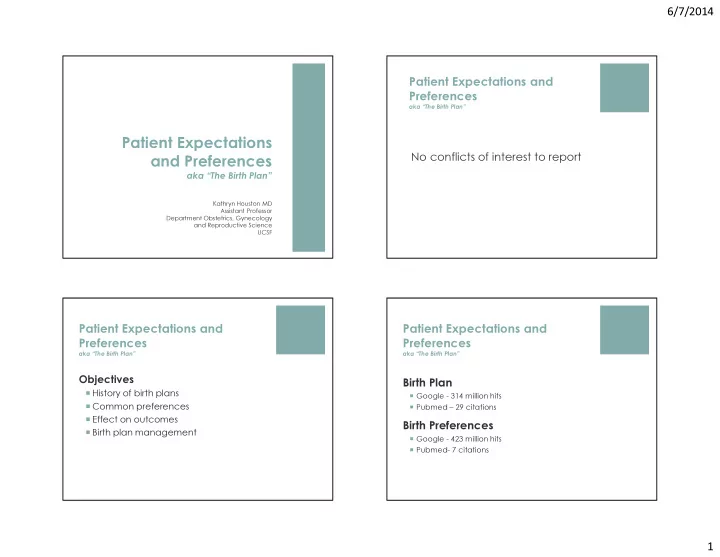
Patient Expectations No conflicts of interest to report and - - PowerPoint PPT Presentation

patient expectations
SMART_READER_LITE
LIVE PREVIEW

Patient Expectations No conflicts of interest to report and - - PowerPoint PPT Presentation

6/7/2014 Patient Expectations and Preferences aka The Birth Plan Patient Expectations No conflicts of interest to report and Preferences aka The Birth Plan Kathryn Houston MD Assistant Professor Department Obstetrics,


slide-1
SLIDE 1

6/7/2014 1

Patient Expectations and Preferences

aka “The Birth Plan”

Kathryn Houston MD Assistant Professor Department Obstetrics, Gynecology and Reproductive Science UCSF

Patient Expectations and Preferences

aka “The Birth Plan”

No conflicts of interest to report

Objectives

History of birth plans Common preferences Effect on outcomes Birth plan management

Patient Expectations and Preferences

aka “The Birth Plan”

Birth Plan

Google - 314 million hits Pubmed – 29 citations

Birth Preferences

Google - 423 million hits Pubmed- 7 citations

Patient Expectations and Preferences

aka “The Birth Plan”

slide-2
SLIDE 2

6/7/2014 2

Birth Expectations and Preferences

Education Patient Char. Patient Satisfaction Preferences/ Birth Plan Labor/Birth Experience Mode of Delivery

History of the Birth Plan

Origins Cultural, geographic and institutional differences United States

History of the Birth Plan

Origins

UK 1970s

Childbirth educators “Planning your Baby’s Birth”

WHO 1996

Useful and should be preformed

21st century

Non-intervention vs intervention

Simkin 1980, World Health Organization 1996

History of the Birth Plan

Cultural, geographic and institutional differences

Demographics

P0, white, older, higher education/SES, CNM care

Availability of education resources Availability of birth options

Bailey 2008, Hidalgo-Lopezosa 2013, Jones 2009, Miller 2012, Pennell 2011

slide-3
SLIDE 3

6/7/2014 3

History of the Birth Plan

United States

Childbirth education ACOG & AA pediatrics Cochrane Review Healthy People 2010 goal Increase participation in childbirth classes Practice models More physician/hospital based

American Academy of Pediatrics-The American College of Obstetricians and Gynecologists 2007, Gagnon 2007, Healthy People 2010

What is a Birth Plan?

“A birth plan is an approach to labor, rather than a term for a specific kind of outcome” Written or philosophical Evolves from patients values, desires and concerns of the birth process Facilitates communication between patient and provider

Discussion Birth Plan vs. Hospital Birth Plan

Wagner & Gunning 2006, Kaufman 2007

Common Birth Plan Themes

Logistics

Venue Provider Interventions Pain control Mode of delivery Infant care

Common Birth Plan Themes

Domains

CONTROL

Autonomy Safety Shared decision making Respect Knowledge

slide-4
SLIDE 4

6/7/2014 4

Do preferences affect

  • utcomes?

Provider and patient perceptions Preferences vs. written birth plan

Do preferences affect

  • utcomes?

Provider and patient perceptions

Wide variation

Worse outcomes - 65% vs 2.4% Increased CS rates – 66% vs 9%

Expectations

False sense of control Professional pressure

Grant 2010, Lundgren 2003, Welsh 2013

Do preferences affect

  • utcomes?

Preferences vs. written birth plan

Mixed results No RCTs Useful vs no difference Intapartum care, control More critical of provider

Brown 1998, Kuo 2010 Lundgren 2003, Sato 2011, Whitford 1998

Do preferences affect

  • utcomes?

Maternal

Labor interventions Pain control Mode of delivery

Neonatal

APGARS Cord gases

slide-5
SLIDE 5

6/7/2014 5

Do preferences affect

  • utcomes?

Maternal

Labor Interventions Pitocin Episiotomies Pain Control

67% no meds, 50% no epidural planned 1/3 used no meds, 1/2 no epidural 90% satisfied with epidural

Casas 2009, Deering 2007, Hilgado-Lopezosa 2013, Pennell 2011

Do preferences affect

  • utcomes?

Maternal

Mode of delivery

Vaginal Delivery

Strength of preference

Cesarean Section

Fuglenes 2012, Hadar 2012, Wu 2014

Do preferences affect

  • utcomes?

Neonatal

APGARS Cord gases

Hilgado-Lopezosa 2013

Do preferences affect

  • utcomes?

Postpartum

Patient satisfaction Goal vs. Journey Medicolegal aspects

slide-6
SLIDE 6

6/7/2014 6

Do preferences affect

  • utcomes?

Postpartum

Patient satisfaction

Personal Expectations Provider support Provider-patient relationship Involvement in decision making

Hodnett 2002

Do preferences affect

  • utcomes?

Postpartum

Goal vs. Journey Healthy Mom & Baby “The perfect birth” Long term effects Depression & mode of delivery

Rauh 2012, Sword 2011, Uplong 2006

Do preferences affect

  • utcomes?

Postpartum

Medicolegal aspects Living will for obstetrics

Provides structured discussion Reduce conflict/misunderstandings Address risk Documentation

May reduce litigation

Philepsen 2005, Richards 1999

Managing the birth plan

Advantages/disadvantages

Patient care/satisfaction Lots of TIME

Provider vs. patient perspective

Distrust vs. collaboration Evidenced based practice

Institutional constraints

Hospital policy vs. hospital routine

Epstein 2004

slide-7
SLIDE 7

6/7/2014 7

Managing the birth plan

Optimizing use Review in outpatient setting 1 page, unique wishes, flexible Education Listen, teach, build trust/partnership Shared decision making Setting expectations Avoids misunderstandings

  • n L&D

Improves satisfaction Lack of control Documentation

Birth Expectations and Preferences

Education Patient Char. Patient Satisfaction Preferences/ Birth Plan Labor/Birth Experience Mode of Delivery

Conclusions

Preferences matter

Embrace the birth plan

Clinical outcomes

Some influence

Integration into practice

Prenatal discussion