PARTNERSHIP SPREADING THE WORD Nicola Lipscombe Chair October 2015 - - PowerPoint PPT Presentation

partnership
SMART_READER_LITE
LIVE PREVIEW

PARTNERSHIP SPREADING THE WORD Nicola Lipscombe Chair October 2015 - - PowerPoint PPT Presentation

SALISBURY AREA GREENSPACE PARTNERSHIP SPREADING THE WORD Nicola Lipscombe Chair October 2015 The Vision for the Partnership Working together: To provide an overview and strong local voice for greenspace, and raise awareness of its value


slide-1
SLIDE 1

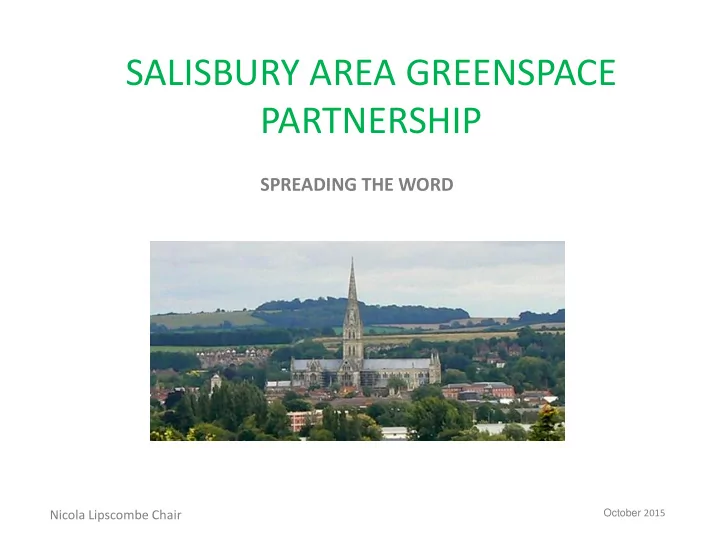
SALISBURY AREA GREENSPACE PARTNERSHIP

SPREADING THE WORD

October 2015

Nicola Lipscombe Chair
slide-2
SLIDE 2

The Vision for the Partnership

Working together:  To create a more resilient and sustainable environment for people and wildlife in Salisbury and the surrounding area  To influence policy and provision, and the enhancement and management of the greenspace network for the longer term  To provide an overview and strong local voice for greenspace, and raise awareness of its value and the benefits of good quality green infrastructure

slide-3
SLIDE 3

Where has the Partnership come from?

Urban woodlands

  • The idea
  • Launch in 2012 – keynote speaker Ian Phillips…….
  • Importance of green space/green infrastructure
  • Workshops provided mandate
  • Steering Group
slide-4
SLIDE 4

Community/ Volunteers

Friends of Harnham Watermeadows Dean & Chapter, Salisbury Cathedral Friends of Harnham Slope Friends of Churchill Gardens Sarum Academy Salisbury Wildlife Group Walking for Health Wessex Community Action

Current partners

Local Authority

Wiltshire Council – officers concerned with public

  • pen space, public rights of way, green

infrastructure strategy, spatial planning, landscape, ecology, countryside, public health Salisbury Vision

Parish Councils

Salisbury City Council Laverstock & Ford Parish Council Wilton Town Council

Local Specialist Interest Groups

South Wilts Biodiversity Group Salisbury & District Natural History Society River Bourne Community Farm CPRE South Wiltshire Group Salisbury Civic Society COGS (Cycling Opportunities Group Salisbury) Bemerton Activity Trails Salisbury Beekeepers Wiltshire Bat Group Five Rivers Association Bat Group Wiltshire Botanical Group Wilton Community Land Trust

Environmental Agencies

Natural England Link2Nature (Wiltshire & Swindon Local Nature Partnership) Forestry Commission Environment Agency RSPB Wiltshire Wildlife Trust English Heritage

slide-5
SLIDE 5

Current target area for the Partnership

Wilton Salisbury City Laverstock and Ford

slide-6
SLIDE 6
  • Pam Rouquette – Walking for Health
  • Roger Dudin – South Wiltshire Biodiversity Group
  • Les Lipscombe – Salisbury Wildlife Group
  • Councillor Michael Pope – Salisbury City Council
  • Councillor Colin Froude – Salisbury City Council
  • David Bradley – Parks Manager, Salisbury City Council
  • Mary Noyce – Technical Officer, Open Spaces, Wiltshire County
  • Phil Sheldrake – Conservation Officer, RSPB
  • Russell Spencer – Hampshire Avon Co-ordinator, Environment Agency
  • Chris Cochrane – Broken Bridges
  • Jacob Dew – Co-ordinator, Hampshire Avon Catchment Partnership
  • David Law - Laverstock & Ford PC
  • Nicola Lipscombe – Salisbury Civic Society, Current Chair

The steering group

slide-7
SLIDE 7

What is greenspace/green infrastructure?

Urban Parks Urban woodlands Allotments Playing fields Village greens Cycle ways & Footpaths Street trees Water meadows River corridors Street trees Cemeteries/ Churchyards Urban woodlands Allotments Street trees Downland Woodlands/Forest

slide-8
SLIDE 8

Why is GI so important?

 It is multifunctional and plays a vital part in delivering the ecosystem services we need to survive: varied and biodiverse habitats clean air and water climate change mitigation flood protection maintenance of soil fertility food fuel

slide-9
SLIDE 9

Why is GI so important?

 It enhances our quality of life: provides inspiring places places that are rich in wildlife places to play and exercise places to relax and enjoy places to experience and learn about the natural world

slide-10
SLIDE 10

Why is GI so important?

 It helps create attractive and distinctive places in which to live: adds value to property attracts businesses to invest in an area stimulates job opportunities brings local communities together

slide-11
SLIDE 11

 Lack of knowledge about what and where green spaces are  Poor connectivity between existing green spaces  Lack of joined up thinking  Lack of resources, skills and vision for the overall planning and management of current greenspace assets  Management regimes that bring few benefits for wildlife eg. ubiquitous grass mowing  Problems of overuse and misuse especially on the urban fringe

Local issues

slide-12
SLIDE 12

South Newton Quidhampton Britford Netherhampton Durnford Clarendon Park

Wilton Salisbury

Woodford

Avon Valley Nature Reserve Harnham Slope Woodland Laverstock & Ford Country Park at Hampton Park 2 River Bourne Community Farm

Local issue – Fragmented Ownerships

slide-13
SLIDE 13

South Newton Quidhampton Britford Netherhampton Durnford Clarendon Park

Wilton

Woodford

Longhedge Old Sarum Airfield Hampton Park Fugglestone Red Erskine Barracks Southampton Road Gateway? Laverstock & Ford

Local issue – Development Pressures

The Maltings Salisbury

slide-14
SLIDE 14

Salisbury Area Board Amesbury Area Board South West Area Board Southern Area Board

1 Local Authority, 4 Community Areas

Local issue – Complicated administrative groupings

slide-15
SLIDE 15

South Newton Quidhampton Britford Netherhampton Durnford Clarendon Park

Wilton Salisbury

Woodford

Laverstock & Ford

+ 10 Parishes

Local issue – Complicated administrative groupings

slide-16
SLIDE 16

Opportunities & priorities for action

 Fill the knowledge gaps by asset mapping & data gathering  Influence the local planning process - development control decision making as well as policy  Involve local people & businesses, & spread the message about the value of greenspace assets & green infrastructure  Create a one-stop shop for greenspace matters & volunteers  Improve habitat diversity and range; encourage reviews of existing management practices eg SAGP input into SCC review  Provide one voice for greenspace and share responsibility, skills and resources

slide-17
SLIDE 17

Greenspace audit & asset mapping

Sample Map Greenspace – what and where it is, the existing links, the gaps and the potential for making improvements

Typology:

  • 1. Readily accessible

community greenspace

  • 2. Restricted/controlled

access greenspace

  • 3. Natural/semi-natural

greenspace

  • 4. Productive greenspace
  • 5. Strategic greenspace
  • 6. Linear features
slide-18
SLIDE 18

Detailed greenspace mapping typology

slide-19
SLIDE 19

Improved grassland Broadleaved, mixed & yew woodland Neutral grassland Small swamp area River Bourne Community Farm

Phase 1 & 2 Habitat Mapping

South Wiltshire Biodiversity Group are co-ordinating the habitat mapping of area & working with Salisbury & District Natural History Society & other local specialists to survey the Cathedral Close & other priority areas. Data will be shared with WSBRC

slide-20
SLIDE 20

Public Open Space Surveys

  • Trained SAGP volunteers have

supported Wiltshire Council with their Public Open Space Survey. The data is being used to develop county wide standards & is also available for SAGP to use locally

  • WC consultation on Part 1 Draft as

part of Core Strategy Review ends

  • n 26 May

Local residents training for their hedgerow surveys in Laverstock & Ford

Parish Surveys

Gathering additional baseline data

slide-21
SLIDE 21

Evaluating the potential for improvement

Urban woodlands

Opportunities for groups & volunteers to get actively involved in more greenspace surveys to find out………

  • How greenspace is currently used
  • How people value their local green spaces – what they like & don’t

like about them

  • Historic & cultural value – of spaces & features eg. Market Place
  • Landscape/townscape value – contribution of setting & local features

such as key trees, tree groups, views, landmarks etc to local distinctiveness eg. Lombardy Poplars

  • Linear features – informal routeways, hedgerows & lines of trees often

associated with footpaths, cycle routes & other transport corridors

  • Ecosystem service delivery – contribution to biodiversity, water retention,

air quality, carbon capture, climate change mitigation, jobs, food, fuel etc

slide-22
SLIDE 22

The digital mapping set up

Wiltshire Council Server ESRI ArcGIS

OS Licence Data storage

FlexViewer ESRI ArcGIS Volunteer version Controlled access for editing etc SAGP Viewer Access for partners to view

SAGP Quantum GIS Database & workspace

MAGIC Natural England Forestry Commission English Heritage Environment Agency SAGP Wiltshire Council Wiltshire & Swindon Biological Record Centre Google Drive SAGP data storage Ordnance Survey Data sources

WFS Link Email attachment

QGIS Cloud Access for partners to view

20 September 2015

slide-23
SLIDE 23

Resources for Partners

 The greenspace asset mapping will provide a tool for managing & enhancing local greenspace, improving connectivity & developing a longer term strategy  It will be possible to see the bigger picture across wards & parishes, & allow for joined up thinking & action  It will support the neighbourhood planning process  It will be possible to better defend our green spaces against loss from development

Website: http://salisburyareagreenspacepartnership.co.uk

slide-24
SLIDE 24

Resources for Partners

 A regular greenspace forum with a co-ordinating role and to ensure local aspirations are represented to the local authority, business and developers  All green space managed to maximise the ecosystem services it provides, and in particular for wildlife, amenity value and landscape setting  Other community resources including a community greenspace project officer and dedicated fund to secure the future of local green infrastructure

Website: http://salisburyareagreenspacepartnership.co.uk

In the longer term SAGP would like to see: