Parallels between Self Supply and CLTS Lessons from Zambia Dr. - - PowerPoint PPT Presentation

parallels between self supply and clts
SMART_READER_LITE
LIVE PREVIEW

Parallels between Self Supply and CLTS Lessons from Zambia Dr. - - PowerPoint PPT Presentation

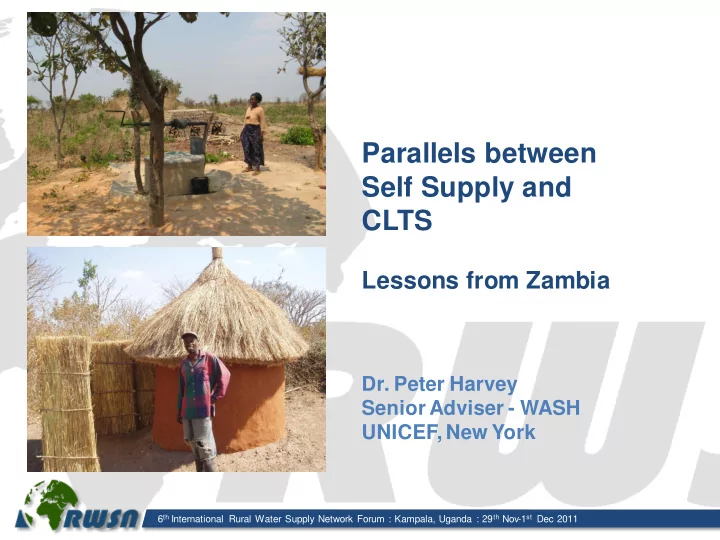
Parallels between Self Supply and CLTS Lessons from Zambia Dr. Peter Harvey Senior Adviser - WASH UNICEF, New York 6 th International Rural Water Supply Network Forum : Kampala, Uganda : 29 th Nov-1 st Dec 2011 Outline Comparative


slide-1
SLIDE 1

6th International Rural Water Supply Network Forum : Kampala, Uganda : 29th Nov-1st Dec 2011

Parallels between Self Supply and CLTS

Lessons from Zambia

  • Dr. Peter Harvey

Senior Adviser - WASH UNICEF, New York

slide-2
SLIDE 2

6th International Rural Water Supply Network Forum : Kampala, Uganda : 29th Nov-1st Dec 2011

Outline

  • Comparative analysis:

– Triggering – Household dynamics – Community dynamics – Self-financing – Private sector role – Quality of outputs – Links with sustainable development – Scaling up process

  • Conclusions and

recommendations

slide-3
SLIDE 3

6th International Rural Water Supply Network Forum : Kampala, Uganda : 29th Nov-1st Dec 2011

Triggering

  • CLTS uses negative emotions

– shame, disgust – and peer pressure to stimulate positive action.

  • Self Supply triggering is more

gradual and uses positive triggers such as status and prestige.

  • Both respond to suppressed

demand for improved living standards and enhanced quality of life.

slide-4
SLIDE 4

6th International Rural Water Supply Network Forum : Kampala, Uganda : 29th Nov-1st Dec 2011

  • Sanitation is primarily a

household responsibility – CLTS target: ‘one family, one toilet’.

  • Traditional water sources are
  • ften privately owned but

shared.

  • Key actions take place at

household level in both approaches.

  • Both approaches promote

equity through support to poorer households.

10 20 Average household size Number of people per toilet (9 months after triggering) Number of people per toilet (before triggering)

Number of people

50 100 Privately owned and shared Privately owned (not shared) Communally owned

Proportion of facilities (%)

Household dynamics

slide-5
SLIDE 5

6th International Rural Water Supply Network Forum : Kampala, Uganda : 29th Nov-1st Dec 2011

  • CLTS triggering results in a

community commitment to achieve ODF status.

  • Self Supply water sources

serve smaller communities.

  • Peer pressure and

competition play important roles in the cascade effect in both approaches.

  • Both approaches stimulate

the desire to ‘keep up with the neighbours’.

20 40 60 80 Proportion of communities ODF Toilet coverage (9 months after triggering) Toilet coverage (before triggering)

Percentage (%)

20 40 60 80 1-20 21-50 >50

Proportion of facilities (%) Number of households served

Community dynamics
slide-6
SLIDE 6

6th International Rural Water Supply Network Forum : Kampala, Uganda : 29th Nov-1st Dec 2011

Self-financing

  • Both approaches are zero subsidy

strategies.

  • The emphasis is on self-sufficiency

and self-determination of what is most appropriate.

  • Costs in Self Supply are generally

higher and micro-credit facilities are needed for some households.

  • Self-financing is essential to ensure

self-sufficiency, sustainability and scalability.

slide-7
SLIDE 7

6th International Rural Water Supply Network Forum : Kampala, Uganda : 29th Nov-1st Dec 2011

Private sector role

  • Skilled artisans are needed in

both approaches.

  • The emphasis is on locally

available materials, skills and experience.

  • Local solutions and innovations

are encouraged.

  • Private sector responds to

stimulated demand.

  • Self Supply requires greater

emphasis on private sector capacity development.

slide-8
SLIDE 8

6th International Rural Water Supply Network Forum : Kampala, Uganda : 29th Nov-1st Dec 2011

Quality of outputs

10 20 30 40 50 60 70 80 <10 10-100 >100

Proportion of samples (%) Faecal coliform counts/100ml

Protected (47) Semi-protected (58) Unprotected (72)

10 20 30 40 50 60 70 80 90 100

Proportion of toilets (%)

Toilets in use Toilets with superstructures Toilets with lid Smooth and clean squatting surface Covered toilets Toilets with handwashing facilities

slide-9
SLIDE 9

6th International Rural Water Supply Network Forum : Kampala, Uganda : 29th Nov-1st Dec 2011

Sustainable development

  • CLTS and Self Supply are true

empowerment and development strategies.

  • They represent a paradigm shift

from sustained dependency to sustained development.

  • The incremental nature of

improvement allows households to determine their own pace of development.

  • Opportunities are created for
  • ther development activities:

tree planting, food security, income generation etc.

slide-10
SLIDE 10

6th International Rural Water Supply Network Forum : Kampala, Uganda : 29th Nov-1st Dec 2011

Scaling up

  • Factors in rapid scale up of

CLTS:

– Government involvement – On-going review & evaluation – Documentation – Local and national media engagement – Role of traditional leaders – Wide range of stakeholders

  • Both approaches create a

cascade effect but Self Supply moves more slowly – from household to household rather than community to community.

HRH Chief Macha Winner of the AfricaSan Leadership Award 2009

slide-11
SLIDE 11

6th International Rural Water Supply Network Forum : Kampala, Uganda : 29th Nov-1st Dec 2011

Conclusions

  • Many commonalities between

the two approaches.

  • Self Supply triggering process

can be refined to stimulate emotional responses.

  • Role of a wider range of

stakeholders including traditional leaders and media can be used to scale up Self Supply.

  • Opportunities exist for

integrated implementation of CLTS and Self Supply.

slide-12
SLIDE 12

6th International Rural Water Supply Network Forum : Kampala, Uganda : 29th Nov-1st Dec 2011

Thank You

Hand up not hand out!