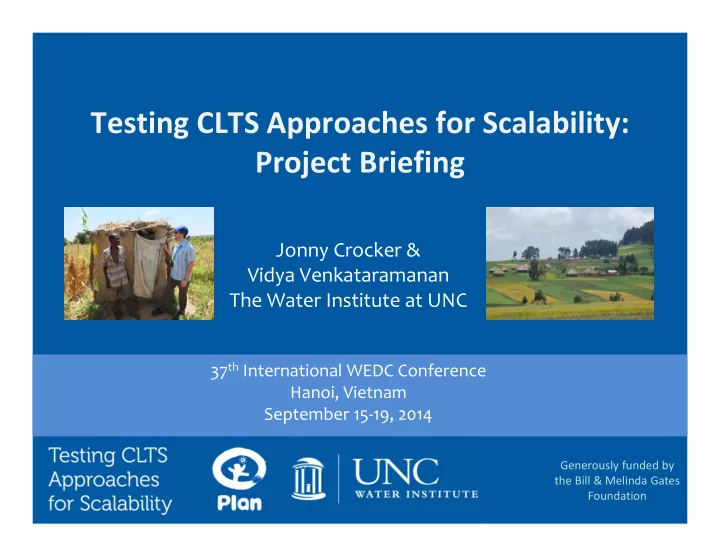
Testing CLTS Approaches for Scalability: Project Briefing Jonny - - PowerPoint PPT Presentation

testing clts approaches for scalability project briefing
SMART_READER_LITE
LIVE PREVIEW

Testing CLTS Approaches for Scalability: Project Briefing Jonny - - PowerPoint PPT Presentation

Testing CLTS Approaches for Scalability: Project Briefing Jonny Crocker & Vidya Venkataramanan The Water Institute at UNC 37 th International WEDC Conference Hanoi, Vietnam September 15 19, 2014 Generously funded by the Bill & Melinda


slide-1
SLIDE 1

Testing CLTS Approaches for Scalability: Project Briefing

Jonny Crocker & Vidya Venkataramanan The Water Institute at UNC

37th International WEDC Conference Hanoi, Vietnam September 15‐19, 2014

Generously funded by the Bill & Melinda Gates Foundation

slide-2
SLIDE 2

Outline

  • 1. Project introduction
  • 2. Project activities
  • 3. Our philosophy: relevancy and rigor
  • 4. Preliminary findings
slide-3
SLIDE 3

Objective: Evaluate the potential for scale up of CLTS by engaging local actors Partners: Plan International, The Water Institute at UNC Funder: Bill & Melinda Gates Foundation Duration: October 2011 – September 2015 Setting: 10 countries

Testing CLTS Approaches for Scalability

slide-4
SLIDE 4

Year 4 Analysis Dissemination Years 2 and 3 Implementation Data collection Year 1 Project startup

Timeline

slide-5
SLIDE 5

Facilitators Natural Leader Households NGOs Government Community Open Defecation Free Latrines Triggering Demand Construction Management

CLTS implementation – actors involved

slide-6
SLIDE 6

Project activities

  • Global literature

review

  • 7 case‐studies
  • 3 situational

assessments

  • 3 project

evaluations Broad Context High Detail

  • Understand existing

evidence

  • Broaden scope to

additional settings

  • Understand context in

focus countries

  • Detailed evaluation of

CLTS actors

Contribution Project Activities

slide-7
SLIDE 7

Three project evaluations

Evaluate the impact of building Natural Leaders’ capacity on CLTS costs and outcomes Evaluate the impact of Teachers as facilitators on CLTS costs and outcomes

Ghana Ghana Et Ethiopia

Assess the influence of training district government in CLTS program management

Ke Kenya nya

slide-8
SLIDE 8

Seven CLTS case studies

HAITI NEPAL CAMBODIA LAO PDR INDONESIA NIGER UGANDA

  • In‐depth interviews w/ government,

NGOs, and communities at national and local levels

  • Three research questions:

– What are the roles of local actors in CLTS implementation? – What enabling factors have led to successful scaling of CLTS? – What constraining factors have prevented successful scaling of CLTS?

slide-9
SLIDE 9

Relevancy and rigor

  • 1. Designing our project
  • 2. Building mutual understanding
  • 3. Revisiting our assumptions and research

questions

slide-10
SLIDE 10

Designing our project

  • What is the main barrier to CLTS reaching scale?
  • How can we address this barrier?
  • What is the most rigorous research design that fits?
slide-11
SLIDE 11
  • 1000+ records identified as relevant, 133 met criteria

for full review

  • Grey literature review released December 2013; full

literature review now being refreshed for 2015

Sample findings: Literature review

Grey Literature

More extensive than peer‐reviewed literature, with less rigorous methods

Generally, CLTS case studies of successful projects

Focus on processes and implementation

Peer‐reviewed literature

Disconnect between study design and conclusions

Generally, CLTS case studies of successful projects

Focus on impact of interventions through mixed methods Natural leaders, teachers, local government staff identified as change agents but no rigorous evidence of their impact on CLTS

slide-12
SLIDE 12

Training facilitators

International NGOs, bi‐ and multilaterals

Follow‐up

Local NGOs, environmental health officers and assistants, natural leaders

Monitoring

International and local NGOs, environmental health officers and assistants, natural leaders

Financing

Ministry of Finance, International NGOs, bi‐ and multilaterals

Triggering

International and local NGOs

Verification

Local NGOs, environmental health assistants, natural leaders

Certification

District verification team

GHANA

Sample findings: Situational assessments

Institutional arrangements for CLTS in Ghana
slide-13
SLIDE 13
  • Who is involved: triggering

Sample findings: Learning Series

slide-14
SLIDE 14

End of contract push

100 200 300 400 500 600 1 2 3 4 5 6 7 8 9 10 11 12 Total person‐hours Program Month

Time spent on facilitation in communities in Ghana (by region)

Central Upper West Volta

Triggering Natural Leader engagement Rainy season

Sample findings: Project evaluations

slide-15
SLIDE 15

Testing CLTS Approaches for Scalability

Plan International and the Water Institute at UNC

Generously funded by the Bill & Melinda Gates Foundation

Case Studies:

  • Haiti
  • Niger
  • Uganda
  • Nepal
  • Lao PDR
  • Cambodia
  • Indonesia

Project Evaluations:

  • Ghana
  • Kenya
  • Ethiopia

Literature Review:

  • Global
slide-16
SLIDE 16

Visit our project website! News – Research – Tools email: clts@unc.edu web: waterinstitute.unc.edu/clts

slide-17
SLIDE 17

Acknowledgements

  • The Water Institute at UNC
  • Plan International in USA
  • Plan International in Ethiopia, Ghana, Kenya
  • Plan International in Cambodia, Haiti, Indonesia, Lao PDR,

Nepal, Niger, Uganda

  • Bill & Melinda Gates Foundation
  • Photos by Jonny Crocker except where otherwise noted.

Unless otherwise specified, the information or findings shared in this document are a result of a sub- agreement to the University of North Carolina at Chapel Hill from Plan International USA, which was a recipient

  • f a grant from the Bill & Melinda Gates Foundation.