Papua New Guinea: Some reflections on human- environment - - PDF document

papua new guinea some reflections on human environment
SMART_READER_LITE
LIVE PREVIEW

Papua New Guinea: Some reflections on human- environment - - PDF document

29/03/2013 Papua New Guinea: Some reflections on human- environment relationships Henry Scheyvens Institute for Global Environmental Strategies, Satoyama Initiative expert workshop July 23, 2012, Pacifico Yokohama Location 1 29/03/2013


slide-1
SLIDE 1

29/03/2013 1

Papua New Guinea: Some reflections on human- environment relationships

Henry Scheyvens Institute for Global Environmental Strategies, Satoyama Initiative expert workshop July 23, 2012, Pacifico Yokohama
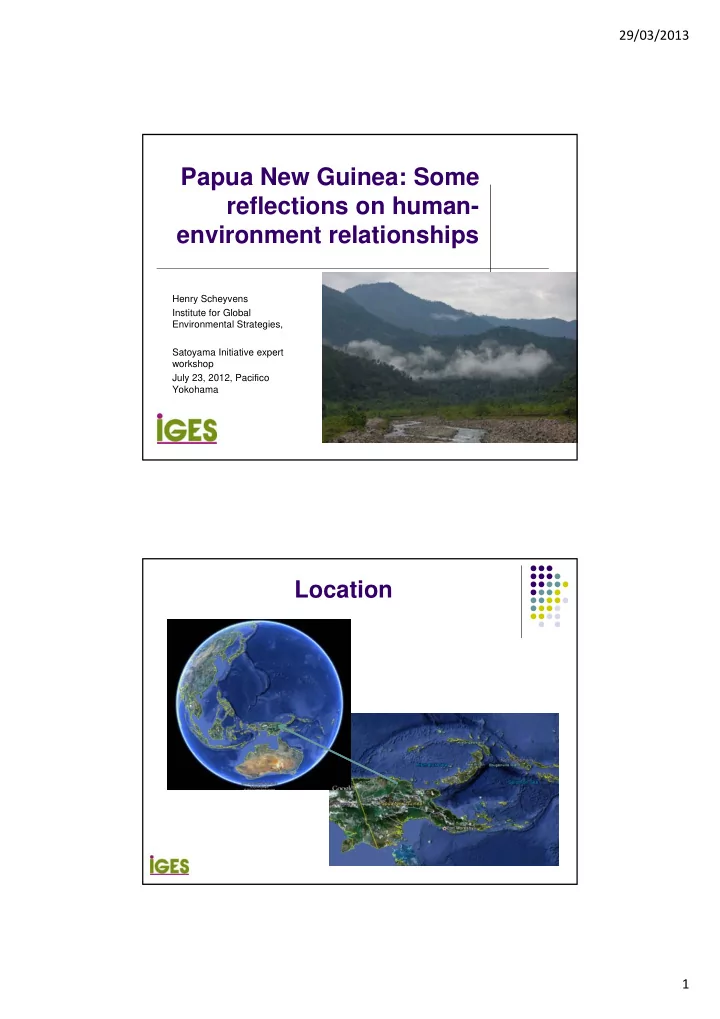
Location

slide-2
SLIDE 2

29/03/2013 2

Basic facts and figures

 Total land area of 46.17 million hectares (Japan, 37.8

million ha); Mostly mountains with coastal lowlands and rolling foothills

 Population: 6.3 million (2011); population growth rate of

1.94%

 Has several thousand separate large self-sufficient

communities, most with only a few hundred people; divided by language (over 800 distinct languages), customs, and tradition

 97% of the land owned by the people (not the state)

through customary forms of tenure

 87% of population is rural

PNG forests

 Forests cover about

60% of the country

 Well-known for

biological endemism and diversification; thought to hold more than 5% of the world’s biodiversity

 Over 2,000 timber

species

slide-3
SLIDE 3

29/03/2013 3

Human activities modifying forests

Shifting agriculture

Small-scale conversion by communities for their own commercial agriculture

Selective logging of forests at industrial scale by companies that have acquired timber rights from the communities (12 million ha)

Conversion for large-scale agriculture by companies that have acquired land rights from communities (5 million ha)

Socio- economic production landscape?

Ecosystems services critical to survival and livelihoods

slide-4
SLIDE 4

29/03/2013 4 Shifting agriculture also key to survival

slide-5
SLIDE 5

29/03/2013 5

Industrial-scale logging – many problems, few benefits

Conversion for large-scale agricultural development – many problems now associated with the “global land grab”

slide-6
SLIDE 6

29/03/2013 6

Conversion by communities for small- scale agriculture – importance source of income

IGES projects in PNG(1): Research to support small-scale, internationally certified, community- based timber harvesting

slide-7
SLIDE 7

29/03/2013 7 IGES projects in PNG (2): Training community teams to monitor forest biomass

Final observations

Supportive policies and frameworks to promote socio- ecological production landscapes needed

Participatory land-use planning key to sustainable rural communities in PNG