Panel: Hot Topics in Networking Ihsan Ayyub Qazi Marinho Barcellos - - PowerPoint PPT Presentation

panel
SMART_READER_LITE
LIVE PREVIEW

Panel: Hot Topics in Networking Ihsan Ayyub Qazi Marinho Barcellos - - PowerPoint PPT Presentation

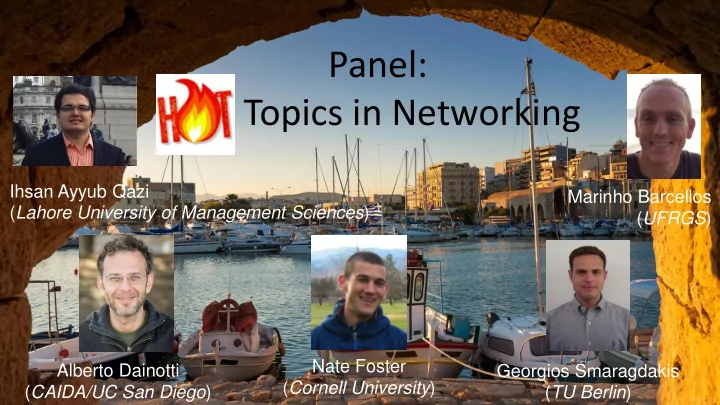
Panel: Hot Topics in Networking Ihsan Ayyub Qazi Marinho Barcellos ( Lahore University of Management Sciences ) ( UFRGS ) Nate Foster Alberto Dainotti Georgios Smaragdakis ( Cornell University ) ( CAIDA/UC San Diego ) ( TU Berlin ) ALBERTO


slide-1
SLIDE 1

Panel: Hot Topics in Networking

Ihsan Ayyub Qazi (Lahore University of Management Sciences) Nate Foster (Cornell University) Marinho Barcellos (UFRGS) Alberto Dainotti (CAIDA/UC San Diego) Georgios Smaragdakis (TU Berlin)
slide-2
SLIDE 2

ALBERTO DAINOTTI

Research Scientist CAIDA, UC San Diego

http://www.caida.org/~alberto/ Research Interests:

  • Internet Measurement and Security:

Network Outages, DoS, Botnets, Cyber-warfare, BGP Hijacking, …

  • Lots of “infrastructure” development:
  • https://ioda.caida.org

https://bgpstream.caida.org

slide-3
SLIDE 3

SOME IDEAS

1) Old topics can still be hot!

  • questions stay the same, the answers change 


E.g., understanding the Internet infrastructure 2) Multidisciplinary studies are both hot and fun

  • Joint investigations with social, political, economical scientists
  • Increasing funding encouraging multidisciplinary work
  • Examples:
  • Use of DoS attacks as a mean of either repression or protest in autocracies.
  • Internet blackouts ordered by governments (human rights, economic impact)
  • Cyberwarfare: how the macroscopic Internet topology in a country can be more/less

susceptible to high-impact targeted attacks by state actors

3) Hot is also helping the others/working with a broader community Thinking bigger than one paper and 2 co-authors.

  • Developing an open source tool
  • Organizing/participating in a hackathon
  • Work on making results easily reproducible
slide-4
SLIDE 4

1

2017 – today: Professor at TU Berlin, 2017 – today: European Research Council awardee 2014 – today: Research Associate, MIT Computer Science and Artificial Intelligence Laboratory 2017 – today: Visiting Researcher at Akamai Technologies 2017– today: Researcher, MIT Internet Policy Research Initiative 2014 – 2017: Marie Curie Fellow at MIT CSAIL 2011 – 2013: Co-founder of a DT Spin-off in Berlin 2009 – 2014: Senior Researcher at Deutsche Telekom Laboratories and TU Berlin 2008: Internship at Telefonica Research 2003 – 2008: PhD student at Boston University 1998 – 2003: Diploma student at TU Crete

slide-5
SLIDE 5

2

  • Measurements for Regulation and Audit
  • Web Privacy
  • Internet Resiliency and Cyber-attacks
  • Network Infrastructures for Self-driving cars/Drones/UVAs etc.
  • Networking Architectures to support AI/ML
  • SPACE X and other alternative communication technologies

Tips:

  • Avoid Cold Topics (and very crowded topics!); be first and they will follow!
  • Do not forget to attend my keynote at the end of the Workshop for a full list of Hot

Topics

slide-6
SLIDE 6

Panel: “Hot Topics in Networking”

ACM CoNEXT Student Workshop, 2018

Ihsan Ayyub Qazi LUMS

slide-7
SLIDE 7

Cloud Computing & Datacenters ICTD & Wireless Networks Internet Censorship & Privacy

ACM SIGCOMM’14 ACM CoNEXT’16 ACM IMC’14 ACM HotNets’15 ACM IMC’16 IEEE/ACM Trans. on Net.’17 ACM HotNets’16 IEEE INFOCOM’14 IEEE INFOCOM’17 … … … ACM SIGCOMM CCR’18 ACM HotNets’17 ACM CoNEXT 2018 ACM CoNEXT 2018 ACM SIGCOMM’18

Who am I?

Computer Science Professor at LUMS, Pakistan (~7 years)

Google Faculty Award, 2018

slide-8
SLIDE 8

Finding “good” research problems

  • Impactful research often involves taking risks
  • Courage, patience, openness, humility,…
  • How do I go about finding problems?
  • Observation and experience (e.g., YouTube censorship)
  • Making connections across disciplines (e.g., Course at CMU)
  • Reading broadly and talking to people (e.g., Facebook Free Basics)
  • Keeping an eye on technology (and other) trends (e.g., Slow devices)
  • Research tastes
  • Working in an active research space – what is my uniqueness?
  • Solving “future” problems – will this hold up?
  • “Hot Topics in Networking”
  • Plenty of ”hot” areas in networking
  • Caveat: Gold rush

Connect the dots! Take the plunge! Courage to let go! Find your uniqueness!

slide-9
SLIDE 9
  • Marinho Barcellos, 53
  • PhD Newcastle University, UK 1998
  • BT Research Labs,


U Manchester 2003-2004

  • UNISINOS University 1999-2008, 


PUCRS University 2008,
 UFRGS - 2010-now - Reader,
 UNAL invited professor

  • Head of UFRGS research group
  • CNPq - Researcher Level 1
  • SIGCOMM diversity & outreach
slide-10
SLIDE 10

2

some of the collaborations

Marinho Barcellos - marinho@acm.org

KTH - Sweden, LiU - Sweden KAUST - Saudi Arabia University of Waikato - New Zealand

slide-11
SLIDE 11

Marinho Barcellos - marinho@acm.org

how to find "hot topics” 
 in networking

  • learn how to identify "cold topics" (hard... DC was deemed

cold already in sigcomm 14). 2nd-tier, etc.

  • HotNets for green stuff to make you think out of the box
  • Jon’s re-heating lessons: extrapolate or invert; drawn

inspiration from other areas (eg sociology); new technology enablers

  • new workshops in important conferences. look who's

contributing to the pc and as authors

  • follow the pages of groups and people you admire

3

slide-12
SLIDE 12

Marinho Barcellos - marinho@acm.org

examples of hot areas

  • Self-Driving Networks: measure, optimize and control
  • AI (Big Data Analytics and Machine Learning) for networking
  • Networking to optimize AI (Network Meets AI & ML)
  • Network programmability, Softwarized Networks, InT
  • Security in Softwarized Networks
  • IoT Security and Privacy, Internet measurements for

cybersecurity, large-scale attacks affecting (b)millions

  • LEO satellite array to provide low-latency routing through space

4

slide-13
SLIDE 13

Marinho Barcellos - marinho@acm.org

more examples

  • In-network computing, offloading processing to network
  • Mobile Edge Communications
  • Kernel Bypassing Networks (RDMA, SmartNICS, DPDK)

5

slide-14
SLIDE 14

Marinho Barcellos - marinho@acm.org

summary

  • the most challenging problem is to find

early on the hot topic. should not arrive

  • late. write history, not merely read
  • look for topics in new workshops

(backed by “reliable" people)

  • Self-Driving Networks, AI for networking

& vice-versa, Softwarized Networks, Security, Telemetry, IoT S&P, Internet measurements for cybersecurity, new satellite-based networks

  • and don’t forget why you’re doing all

this, so pick a hot topic you will love

6

slide-15
SLIDE 15

Background

  • BA Williams (2001)
  • MPhil Cambridge (2008)
  • PhD UPenn (2009)
  • Postdoc Princeton (2009-2010)
  • Faculty Cornell (2010-present)
  • Sabbatical Barefoot & Stanford (2016-2017)

Interests Programming language design and implementation Research Highlights

  • Bidirectional Languages: every program can be run both forwards, from input to
  • utput, and backwards, from output back to input (lenses, Boomerang)
  • Network Programming: high-level and declarative languages for programming

network routers and switches (Frenetic, Pyretic, NetKAT, P4 etc.)

Nate Foster