Panel 1 Horizontal analyses of the negotiations for a Trade in - - PowerPoint PPT Presentation

panel 1
SMART_READER_LITE
LIVE PREVIEW

Panel 1 Horizontal analyses of the negotiations for a Trade in - - PowerPoint PPT Presentation

The voice of the European Service Industries for The voice of the European Service Industries for International Trade Negotiations in Services International Trade Negotiations in Services Panel 1 Horizontal analyses of the


slide-1
SLIDE 1

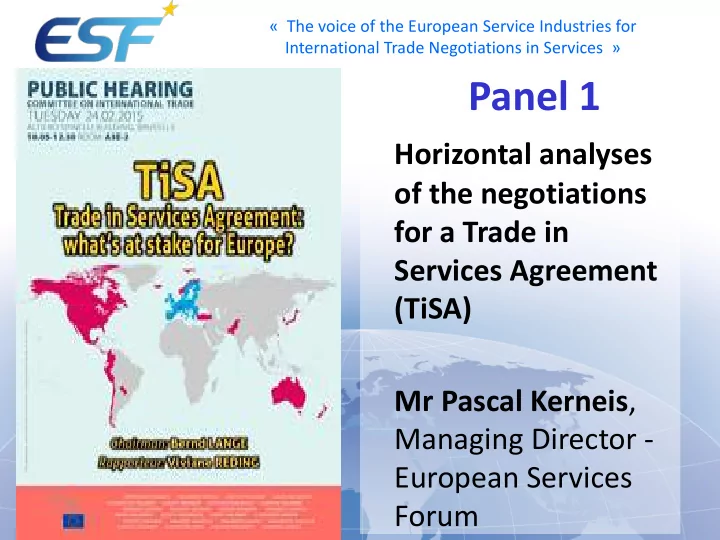
« The voice of the European Service Industries for International Trade Negotiations in Services » « The voice of the European Service Industries for International Trade Negotiations in Services »

Panel 1

Horizontal analyses

  • f the negotiations

for a Trade in Services Agreement (TiSA) Mr Pascal Kerneis, Managing Director - European Services Forum

slide-2
SLIDE 2

« The voice of the European Service Industries for International Trade Negotiations in Services »

MARKET ACCESS OFFERS

The Method: “The Hybrid List Approach”  Scheduling of Market access commitments using a Positive List (list of sectors & sub-sectors open, with list of remaining barriers)  Scheduling using Negative List for National Treatment (given by default, with negotiated exceptions)

  • ESF would have preferred the negative list approach, that allows better

transparency for the companies reading the schedules of commitments.

  • However, one of the main ESF objective for TiSA is that other developing

countries that are not used to negative list will join, so as to “multilateralise” TiSA when a critical mass will be reached. But “hybrid list” is very complicated to understand and to assess!

  • ESF support the adoption by TiSA countries of “Minimum standards of

Market Access Commitments (e.g. Removal of all equity caps, with negotiated exceptions, etc.) to enhance the ambition on market access.

slide-3
SLIDE 3

« The voice of the European Service Industries for International Trade Negotiations in Services »

ESF TISA COUNTRIES’ PRIORITIES

 The Method: To start the market access discussion by agreeing to table the highest level of commitment expressed by each party under its best (implemented) free trade agreement (FTA)  The Offers: First Offers: US & Japan: September 2013 –

  • EU: 4th November 2013; The EU offer is substantive and based on the EU-

Korea FTA. It covers all sectors and all modes.

  • Others: between 4 & 30 Nov 2013 - Today: 21 Offers on table.
  • Missing: Pakistan, Paraguay, Uruguay - Revised offers? Mexico, Chile,..?

 ESF Priorities:

  • The EU does not have any FTA with the following TiSA Countries: 1.

Australia, 2. Hong-Kong, 3. Israel, 4. Taiwan, 5. New-Zealand, 6. Pakistan, 7. Paraguay, 8. Uruguay, 9. Turkey

  • The EU has old FTA with low level of services commitments with

Chile and Mexico

slide-4
SLIDE 4

« The voice of the European Service Industries for International Trade Negotiations in Services »

RULES MAKING IN TiSA

 In addition of the Market access component, TiSA countries will also

adopt a new Set of regulatory disciplines :

  • Adoption of a Horizontal Paper on Domestic Regulation

Disciplines (transparency, licensing procedures, etc.)

  • Adoption of disciplines on temporary mobility of personnel
  • Adoption of Sector Specific Reference papers or Disciplines (e.g.
  • n Telecoms, Postal & express, Energy, Maritime transport, etc.)
  • Revision of WTO Understanding on Financial Services + Annexes
  • Adoption of disciplines on State Own Enterprises (SOEs)
  • Adoption of disciplines on cross border data flow (?)
  • Increased public procurement market access & disciplines (?)

(GPA+?)  ESF strongly supports the rules making part of TiSA

slide-5
SLIDE 5

« The voice of the European Service Industries for International Trade Negotiations in Services »

FIVE “BLUE LINES” (1)

  • 1. “Need for reciprocity, i.e. need for a real win-win agreement, and

not only the EU opening up without counterparts.” ESF Comments:

  • EU is already quite open through GATS and FTAs, and has already

benefited from this liberalisation.

  • An ambitious EU offer will improve its attractiveness for FDI.
  • We understand that “reciprocity” in broad sense that all countries

need to open up as much as the EU

  • YES, we want more opening from other Countries.
  • TiSA must have ambitious market access offers, so as to catch up

the 15 years lost during the Doha Round

  • ESF will focus in particular on the countries with which the EU

has no FTA or on-going FTA negotiations.

slide-6
SLIDE 6

« The voice of the European Service Industries for International Trade Negotiations in Services »

  • 2. “TISA should create international standards in services trade,

where the EU should export its good standards to other TISA countries (for ex. telecoms, air and maritime transport, financial services).

  • 3. TISA should bring tangible benefits to EU citizens, by expanding

EU rules to the rest of the TISA countries on issues like diminution

  • f roaming fees in telecoms, on-line consumer protection rules, on-

line banking protection rules, etc.”  ESF Comments: YES, Absolutely. In addition of ambitious market access commitments, ESF strongly supports the setting up of new Disciplines in TiSA in the various services sectors, so as to improve good regulatory standards throughout all TiSA countries, such as those in place in the EU. These standards will then become de facto international standards. There are many other sectors where EU is offensive (for ex. Prof. &

  • Bus. Services; distribution & logistics; environt. & energy relat. Ser)

FIVE “BLUE LINES” (2)

slide-7
SLIDE 7

« The voice of the European Service Industries for International Trade Negotiations in Services »

FIVE “BLUE LINES” (3)

  • 4. “China should be on-board and participate actively to the TISA
  • negotiations. Hopefully other BRICS countries should join at a

later stage.” ESF Comments: Yes, ESF has strongly advocated and supported China participation to TiSA. China has started an in-depth domestic reform in services sectors, and its participation would allow the binding of further openness that would allow greater EU FDI and trade with China (in sectors like banking, insurance, telecom, etc.).

  • But the US (& Japan) continue to block its entry.
  • Uruguay joined TiSA in February 2015.

 China Reaction? Other BRICs and ASEAN Reaction?

  • Risk of failure of the strategy of expansion of TiSA towards the

multilateralisation of the Agreement through critical mass.

slide-8
SLIDE 8

« The voice of the European Service Industries for International Trade Negotiations in Services »

  • 5. “TISA commitments and rules should be implemented and
  • respected. To achieve this, TISA should be able to use the WTO

Dispute Settlement mechanism.”  ESF Comments: Of course, commitments taken in International Treaties must be implemented by the signatories.

  • ESF can certainly support the fact that TiSA countries should be

allowed to use the WTO DSB,

  • but that would

require the acceptation by the whole WTO membership (like in GPA), while unfortunately many WTO members are opposed to TiSA (and to its multilateralisation).

  • However, should TiSA needs its own Dispute Settlement

Mechanism  Need to revised EU Regulation N° 654/2014 of 15 May 2014 concerning the exercise of the Union's rights for the application and enforcement of international trade rules (OJEU L189/50 – 27/06/2014)

FIVE “BLUE LINES” (4)

slide-9
SLIDE 9

« The voice of the European Service Industries for International Trade Negotiations in Services »

  • 1. “Services of General Interests and Public Services, like the health

services, social services, education services and water services are not for negotiations and are not for sale. They should not be negotiated in TISA.” ESF Comments: Agreed. ESF fully respect the long-lasting EU Policy of protecting the SGI and public services in these and other sectors in all exiting and future trade deals.

  • Three layers of protections of public services are enacted (i)

Exercise of “Governmental authorities”; ii) Broad horizontal reservation which preserves the right to have public monopolies; iii) Specific reservations on water, public Heath, public Education, public Social services

  • Commitments have only been taken for privately funded health and

education services.

FIVE “RED LINES” (1)

slide-10
SLIDE 10

« The voice of the European Service Industries for International Trade Negotiations in Services »

  • 2. “TISA must not include a Chapter on mobility of natural
  • persons. It will not be comprehensible that TISA would allow the

elimination of EU rules and regulations on Visas and entrance on the EU territory.” ESF Comments: ESF believes that there is some confusion here.

  • The EU has already undertaken many commitments in its various

trade agreements on the so-called “temporary movement of natural persons”, also known as the GATS Mode 4.

  • These commitments have nothing to do with the EU and national

immigration policies and the deliverance of visas. It is about temporary movement of business persons to their subsidiary or to their clients, under strict conditions, to do business and return. European business need more “Mode 4”commitments from TiSA countries. This is an important way for our companies to provide business.

FIVE “RED LINES” (2)

slide-11
SLIDE 11

« The voice of the European Service Industries for International Trade Negotiations in Services »

  • 3. “The Right of the EU to regulate must be fully and unconditionally

preserved, including the right of the EU Member States to regulate.” ESF Comments: Of course, but ESF is not aware of any trade agreement impeding a signatory’s right to regulate. Trade commitments are about non-discriminatory national treatment, not about preventing right to regulate. EU Member States rights to regulate must however respect EU internal market laws!

  • 4. “TISA should not allow social dumping in EU Construction

services and Transport services.” ESF Comments: Yes. Trade policy practice by the EU in these sectors is a good example showing that EU internal market policy and law (for ex, posting of workers directive) prevail on international trade agreements. TISA cannot dismantle EU Acquis Communautaire

FIVE “RED LINES” (3)

slide-12
SLIDE 12

« The voice of the European Service Industries for International Trade Negotiations in Services »

5. “The protection of personal data in the EU should not be put in danger by TISA. The European Parliament will not accept that data protection rules would be wiped out through the back door of a trade agreement.”

 ESF Comments: Yes, ESF agrees with the fact that EU data protection requirements must be respected. In the current global digital economy, ESF believes that TiSA is a good opportunity to include binding provisions aiming at:

  • Allowing cross-border data flows that are in compliance with the applicable

legislation on data protection of both contracting parties;

  • Ensuring that cross-border data flows are not limited by a requirement of

establishment of a local presence; with only few mutually agreed and well justified exceptions;

  • Allowing cross border data flows without requirement of locally based
  • servers. The obligation to use local infrastructure or to establish a local

presence should not be required as a condition of supplying data services.

  • Ensuring that local infrastructure used for conveyance of services on electronic

communications networks is made available to service suppliers under fully non- discriminatory terms and conditions.

FIVE “RED LINES” (4)
slide-13
SLIDE 13

« The voice of the European Service Industries for International Trade Negotiations in Services » Pascal KERNEIS Managing Director European Services Forum – ESF 168, Avenue de Cortenbergh B – 1000 – BRUSSELS Tel: + 32 2 230 75 14 Fax: + 32 2 320 61 68 Email: esf@esf.be Website: www.esf.be

Thank you for ATTENTION !