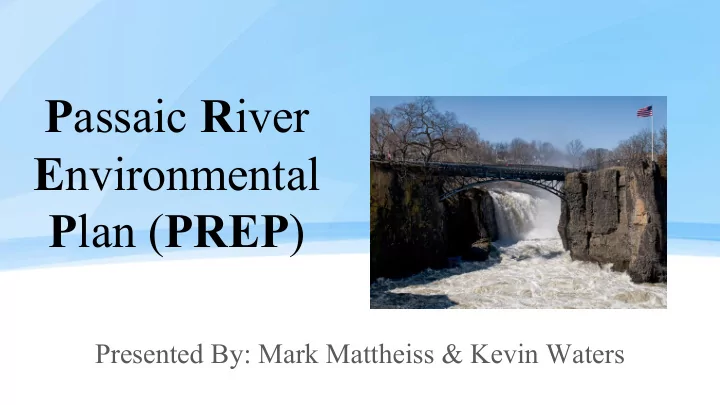
P assaic R iver E nvironmental P lan ( PREP ) Presented By: Mark - - PowerPoint PPT Presentation

p assaic r iver e nvironmental p lan prep
SMART_READER_LITE
LIVE PREVIEW

P assaic R iver E nvironmental P lan ( PREP ) Presented By: Mark - - PowerPoint PPT Presentation

P assaic R iver E nvironmental P lan ( PREP ) Presented By: Mark Mattheiss & Kevin Waters Overview Problem Statement Mission Statement History Governance Organizations Existing Plans & Actions Issues in


slide-1
SLIDE 1

Passaic River Environmental Plan (PREP)

Presented By: Mark Mattheiss & Kevin Waters

slide-2
SLIDE 2

Overview

  • Problem Statement
  • Mission Statement
  • History
  • Governance Organizations
  • Existing Plans & Actions
  • Issues in the Watershed
  • Proposed Solutions
slide-3
SLIDE 3

Problem Statement

  • Due to increased urbanization and development in northeast

New Jersey, the water temperatures of the Passaic River Watershed have become warmer. This has led to a decrease in the population of wild brook trout, which the NJDEP considers a good indicator of water quality. Also the influx of buildings and roads limits the amount of permeable land. This lowers groundwater recharge and increases chances of flooding.

slide-4
SLIDE 4

Mission Statement

  • PREP’s goal is to extend the area of wild brook trout spawning

from the headwaters of Morris County downstream and into the surrounding waters of Passaic and Essex County.

slide-5
SLIDE 5

Passaic River Watershed Characteristics

  • River length: 80 mi
  • Basin: 935 sq mi
  • Discharge(for little falls): 2,100 cu ft/s avg
  • Source: Unnamed pond in Mendham, NJ
  • Mouth: Newark Bay, NJ
  • Elevation Drop: 540 ft
  • Counties in the Watershed: Hudson, Essex, Bergen, Passaic,

Morris, Union, Somerset

slide-6
SLIDE 6

Land Use

slide-7
SLIDE 7

Land Use

(Contd.)

slide-8
SLIDE 8

Water Use

  • Upper tributaries are a drinking source for millions of people in northern NJ
  • North Jersey District Water Supply Commission serves 107 municipalities
  • Passaic Valley Water Commission serves Clifton, Passaic, Paterson and numerous
  • ther surrounding towns
  • NJ American Water Company Serves around 42 towns
  • The Passaic River and thousands of acres of floodplains serve as a habitat for many

animals and endangered animals and also absorb flood waters

  • The harbor the Passaic River flows into is home to the third biggest port in the

country Port Newark

slide-9
SLIDE 9

History

  • Originally formed by glacier waters escaping the Glacial Lake

Passaic (30,000 yrs. - 11,000 yrs. ago)

  • George Washington used the Passaic for his camp during

Revolutionary War (1778)

  • City of Paterson harnessed The Great Falls and became the first

industrial city in America thanks to Alexander Hamilton (1792)

slide-10
SLIDE 10

History (Contd.)

  • Dundee Dam was built in Garfield to provide power for all of the

factories next to the river (1859)

  • Population of NJ exceeds 1 million (1880)
  • Heavy Metals, Pesticides, Agent Orange Waste were released into

the river by various industries (Early 1900’s - 1970’s)

  • Fire raged for hours on the surface of the water between Newark

and Harrison (1918)

slide-11
SLIDE 11
slide-12
SLIDE 12

Organizations

  • Passaic River Coalition - Est. 1969 and protects water quality and quantity of entire

watershed in NJ also Rockland & Orange County, NY

  • Pequannock River Coalition - Improve ecosystems of Pequannock & Wanaque Rivers
  • Great Swamp Watershed Association - Educates communities about their effect
  • Whippany River Watershed Action Committee - Community action projects
  • Greenwood Lake Commission - Improve quality of the lake
  • Hackensack Riverkeeper - Independent & Non-Governmental
  • American Rivers - National Organization dedicated to preserve for future generations
  • River Network - National Organization includes over 2,000 grassroots organizations
  • Waterkeeper Alliance - Made up of over 200 local waterkeeper organizations
slide-13
SLIDE 13

Existing Plans & Actions

  • 1972 Clean Water Act - Health of river has improved due to this enactment
  • 2008 US EPA Settlement With Occidental Chemical Corp. & Tierra

Solutions - Major lawsuit from dioxin contamination from chemical companies and they agreed to pay $165 million for ecological damages

  • 2010 Passaic River Basin Flood Advisory Commission - Executive order

signed by Christie to develop and recommend solutions to chronic flooding problems

  • 2014 US EPA Announced New Plan - A 1.7 billion dollar plan to remove 4.3

million cubic yards of toxic mud from the lower 8 miles of the river. That section of river is considered one of the most polluted stretches of water in the nation.

slide-14
SLIDE 14

Issues In The Watershed

Problem Description Causes P1: Decrease in Trout Spawning Grounds Brook Trout used to be all over the Passaic River watershed and now they are only spawning in the headwaters of Morris County The trout problem is caused by the water

  • temperature. In order for trout to spawn

they need cold water and the waters downstream are significantly higher in temperature. P2: Increase in Severe Flooding There have been many instances of flooding and many people’s homes receiving massive water damage due to their close proximity to the river. Due to increased urbanization and less available land more and more people are moving closer and closer to the river. The runoff from this urbanization also contributes to the flooding because less water is absorbed into the ground. P3: Horrendous Factory Pollution The water quality in the Passaic River is notorious for its terrible quality. There are many factories from Paterson to Newark that have been dumping toxic chemicals into the river over the past

  • century. One major example of this was

the Agent Orange Factory in Newark that severely polluted the watershed.

slide-15
SLIDE 15
slide-16
SLIDE 16

Land Use

slide-17
SLIDE 17

Goals and Objectives

G1: To increase the trout spawning population. By decreasing the water temperature by two degrees we hope to see an increase of brook trout as far as the towns of fairfield. G2: Decrease the severity and frequency of flooding By increasing the area of floodplains and retention ponds as well as adding non-livable zones, flood water management could be improved and the amount of people affected by the flooding would be reduced. This is a difficult problem because of the dense human population throughout the watershed. G3: Limiting industrial pollution. One taxpayer costly step to combat the toxic chemicals would be to remove the already toxic mud by dredging. Another way to limit the chemicals entering the river would be to have strict regulations on industries the dumping in close proximity to the river.

slide-18
SLIDE 18

Solutions

S1: To increase the trout spawning population - Shade a larger portion of the stream by riparian (riverbank) vegetation and limit runoff by increasing the amount of stormwater that seeps into the ground S2: Decrease the severity and frequency of flooding - New zoning laws must be made to prohibit building within 75 feet from either side of the waterway and also prohibit building in current flood plains. Along with government buybacks and establishing new parks next to the river. S3: Limiting industrial pollution - Increase and enforce fines for properties that are next to the river and polluting it with garbage. Continue dredging and skimming of the lower Passaic for floating garbage

slide-19
SLIDE 19
slide-20
SLIDE 20

Conclusion

By the end of 2025 if these solutions are enacted then we estimate that brook trout will be able to be caught recreationally as far as the Dundee Dam in Garfield! Improvement in the water quality of the Passaic River Watershed would enhance the condition of the surrounding environment and make the river area much more aesthetic. This would promote economic and recreational activity.