
SLIDE 1
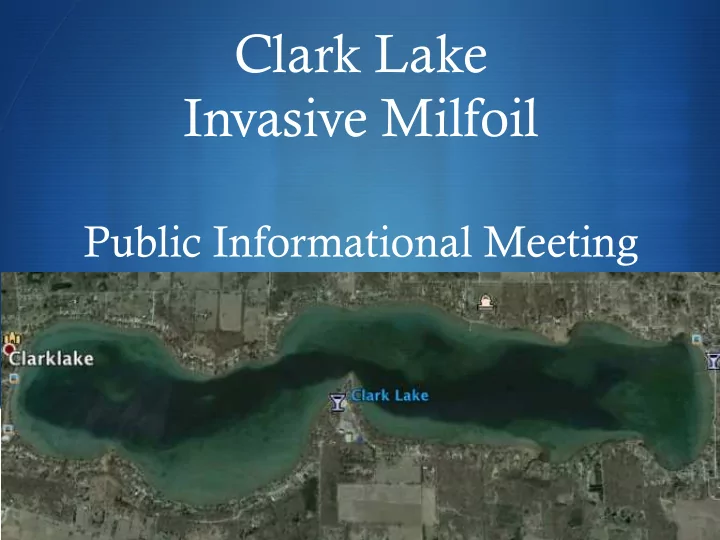
Clark Lake Invasive Milfoil Public Informational Meeting S Carley - - PowerPoint PPT Presentation
Clark Lake Invasive Milfoil Public Informational Meeting S Carley Kratz River Raisin Watershed Council S B.S. from University of Michigan specializing in botany S Ph.D. from Michigan Technological University focusing on soils S
S B.S. from University of Michigan specializing in botany S Ph.D. from Michigan Technological University focusing on
soils
S Program Director of the watershed council
S Non-political organization dedicated to supporting education,
monitoring, recreation and preservation
S Clark Lake is our headwaters www.riverraisin.org
S An aquatic plant that spreads by fragmentation and
underground runners
S Grows in nutrient rich sediment, muck S Invasive species form dense mats
S Grows earlier and more quickly than native plants S Has more leaflets than native milfoils S Hybrids between Eurasian and Native milfoil exist, and are
also invasive
S Dense mats compete with native plants S May reduce the number of macroinvertebrate
“bugs”
S Less food for fish
S Can inhibit recreation
S Swimming, boating, fishing
S May cause property values to decline
S Boats
S Proper washing of boats and
trailers between lakes
S Waterfowl
S It’s not their fault, but don’t
encourage them
S Don’t feed the wildlife!
S Education about preventing the
spread of milfoil and other invasive plants is the most important factor
S Presence of the invasive hybrid milfoil and Eurasian milfoil
was determined by DNA analysis of plant tissues at Grand Valley State
S Impossible to identify hybrid by appearance alone
S Aquatic Vegetation Assessment Survey (AVAS) conducted
by Professional Lake Management (PLM) this fall
S Over 20 acres of Clark Lake contain invasive milfoil
ü 1. Conduct vegetative survey
S Mechanical
S Harvesting (with or without suction) S Mats S Bubblers
S Biological
S Milfoil Weevil
S Chemical
S Herbicides
Removes biomass by cutting top of plant Stunts growth Fragments can be carefully removed with suction or by hand
Creates fragments that can spread and take root One fragment can great 250 million new plants in
Must be done repeatedly
Kills all plants by blocking sunlight Useful in small & shallow areas
Also kills native plants Can move with waves May be caught by propellers and fish hooks Must be cleaned to prevent muck build up Costs $62k/acre Permitting issues
Has worked to control milfoil in some shallow lakes
High electrical costs ($500/ acre) Difficult to cover large area Not practical in deep waters DEQ is concerned about negative impacts—Permitting may be impossible
Weevils have been successfully used in some cases
Expensive ($2.4k/acre) May be more effective on native milfoil than invasive varieties Native fish eat weevils Company that sells weevils may be going out
Kills milfoil without spreading it further Granular formula sinks to bottom of lake and targets milfoil not other plants Permit process is straight forwards
Must be reapplied periodically with new introductions Hybrid milfoil may require higher doses, increasing cost ($450-750/acre)
S Permits from the DEQ must be applied for 3 months before
treatment
S Spot treatments require a less complicated permitting
process vs. whole lake treatment
S PLM is most frequently used company in the state and
works closely with the DEQ and riparian land owners throughout the whole process
S triclopyr, or Renovate is frequently used S No harm to swimmers, pets, fish & other wildlife S Granular formula decreases risk for drifting S Follow-up water testing S 24 hour restriction near treated area for irrigation of
landscaping with lake water
S 2,4-D
S Synthetic plant hormone S Cheaper than Renovate S Used in whole lake treatments S 2,4-D is NOT agent orange
S Round-up, or Glycophosate
S Inhibits protein production in broadleaf plants S Used on lawns and in agriculture
S Round Lake attempted biological
control
S
Weevils died over the winter S Devil’s Lake has attempted to harvest
milfoil
S
Caused milfoil to spread S 13 lakes have used herbicides to treat
hybrid milfoil
S
7/13 use PLM to handle surveys, permitting, and dispensing of herbicides S Herbicide treatments began as early as
2003
S Shallow water, drifting fragments S Pilot project will treat a few areas
with herbicides
S Eliminate dense milfoil for visiting
swimmers
S Test effectiveness of herbicides with
vegetative surveys and water quality monitoring
S Estimated cost $2,100-$2,700
S Education
S Early Detection & Rapid Response S Prevent new introductions
S Management
S Limit social, economic and ecological
harm
S Changing treatment methods overtime
controlled
Tax deductible donations are being accepted by the Clark Lake Sprit Foundation for pilot project and future management www.clarklakespirit.com
Clark Lake Spirit Foundation PO Box 224 Clark Lake, MI 49234