Overview How Contraceptive Coverage Works Exemptions and - - PowerPoint PPT Presentation

overview
SMART_READER_LITE
LIVE PREVIEW

Overview How Contraceptive Coverage Works Exemptions and - - PowerPoint PPT Presentation

Overview How Contraceptive Coverage Works Exemptions and Accommodations Round 1: Hobby Lobby v. Burwell Round 2: Zubik v. Burwell Who are the plaintiffs? What are the arguments on both sides? Why does the type of employer


slide-1
SLIDE 1
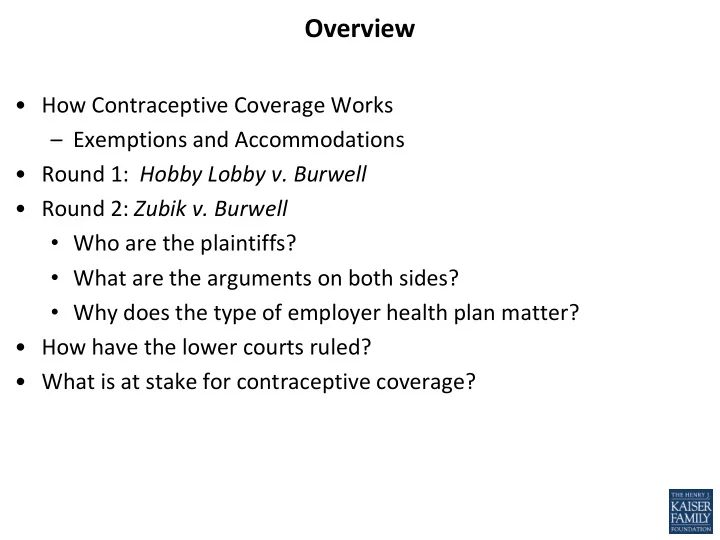
  • How Contraceptive Coverage Works

– Exemptions and Accommodations

  • Round 1: Hobby Lobby v. Burwell
  • Round 2: Zubik v. Burwell
  • Who are the plaintiffs?
  • What are the arguments on both sides?
  • Why does the type of employer health plan matter?
  • How have the lower courts ruled?
  • What is at stake for contraceptive coverage?

Overview

slide-2
SLIDE 2

How Does Where You Work Affect Your Contraception Coverage?

START HERE

Does your employer have religious objections to contraceptive coverage?

Is your employer a house of worship? Your employer is not required to include contraceptives in plan. Women workers and dependents may have limited or no coverage of FDA-approved contraceptives. Your employer must cover the full range of FDA-approved contraceptives for women. Women workers and dependents have coverage of the full range of FDA approved contraceptives. Your employer may elect an accommodation. Is your employer a religiously affiliated nonprofit or a closely held corporation?

  • Your employer must notify their

insurer, plan administrator, or HHS

  • f their objection.
  • Employer released from paying for

contraceptive coverage.

  • Insurer or administrator pays for

contraceptive coverage. EXEMPTION

YES YES YES NO

ACCOMMODATION

NO

MANDATORY

NO

slide-3
SLIDE 3
  • Case: For-profit companies with religious objections to

contraception challenged the requirement on the basis that it violated their religious rights under the Religious Freedom Restoration Act.

  • Decision: Certain closely held for-profit firms with

sincerely held religious beliefs cannot be compelled to pay for contraceptive coverage in employer health plan.

  • Outcome: Obama Administration issued new regulations

that offer the accommodation to both religiously affiliated nonprofits and closely held for-profit corporations.

SOURCE: http://www.law.cornell.edu/uscode/text/42/chapter-21B

ROUND 1: Hobby Lobby v. Burwell (For-profit)

slide-4
SLIDE 4
  • Case: Religiously-affiliated nonprofits with religious objections to contraception

claiming that the accommodation offered by HHS still results in a violation of their religious rights under the Religious Freedom Restoration Act

  • Petitioners: represent 37 different entities and individuals including:

– Universities – Nonprofit advocacy organizations – Nursing homes – “Exempt” Diocese (sponsoring health insurance for non exempt nonprofits) – Two Bishops – Employee church plans and third party administrators for a church plan

  • Employers have selected different types of health insurance plans – fully- funded,

self-funded, secular plans and church plans – and have claimed different types of burdens depending on the plan.

ROUND 2: Zubik v. Burwell (Nonprofit Employers)

slide-5
SLIDE 5

Religious nonprofits contend:

  • Their religious rights are being

violated

  • Notice will “facilitate” or “trigger” the

provision of insurance coverage for contraception.

  • Health plans used as a vehicle to bring

about a “morally objectionable wrong.”

  • When the insurer separately

contracts with an employer’s workers to cover contraception at no cost, it remains part of the employer’s plan and is financed by the employer.

What is the disagreement about the accommodation?

Government contends:

  • It is not the notification that

triggers the coverage.

  • It is federal law that requires the

insurance issuer or the third party administrator to provide this coverage.

slide-6
SLIDE 6

The Religious Freedom Restoration Act of 1993 (RFRA) provides that the government “shall not substantially burden a person’s exercise of religion” unless that burden is the least restrictive means to further a compelling governmental interest.

SOURCE: http://www.law.cornell.edu/uscode/text/42/chapter-21B

Religious Freedom Restoration Act of 1993

slide-7
SLIDE 7

Legal Analysis of the Religious Freedom Restoration Act as It Applies to Religiously-Affiliated Nonprofits

Does not violate RFRA and the “accommodation” is valid Violates RFRA and employers will qualify for an “exemption”

Is the employer a “person” capable of religious belief?

The government is not contesting that religiously affiliated nonprofits can exercise religion.

Does the requirement to notify HHS or self- certify substantially burden the employer? Does the government have a compelling interest to provide health insurance coverage for preventive care include contraceptives? Is the government “accommodation” meeting the compelling interest in the least restrictive way?

YES YES YES YES NO NO NO NO

slide-8
SLIDE 8

How Health Insurance Arrangement Used by Religious Nonprofits Affects Contraceptive Coverage for Workers

Religiously Affiliated Nonprofit

Accommodation:

Employer must notify, insurer, or third party administrator or government

Secular Health Plans Church Health Plans

House of Worship

Exempt from the ACA’s Contraceptive Coverage Requirement

Women workers and dependents may not have coverage of all FDA- approved contraceptives

Self-Insured:

Government cannot enforce the requirement for third party administrators for self- insured church plans

Fully-Insured or Self- Insured: Insurer or third

party administrator must provide contraceptives at no cost to employee

Fully-Insured:

Insurer is required to provide contraceptives at no cost to employee

slide-9
SLIDE 9

Note: As of February 18, 2016. No Nonprofit cases have been filed in the 1st, 4th, and 9th Circuit Courts of Appeals.

US Appeals Court Rulings on Lawsuits by Nonprofits Objecting to Contraception

PR GU MP VI

9 10 8 5 11 7 6 4 3 2 1

5th Circuit Ruling in Favor of Government East Texas Baptist University v. Burwell 10th Circuit Ruling in Favor of Government Southern Nazarene University v. Burwell Little Sisters of the Poor v. Burwell 7th Circuit Ruling in Favor of Government Wheaton College v. Burwell Grace Schools et al., and Diocese of Fort Wayne-South Bend, Inc et al. v. Burwell University of Notre Dame v. Sebelius 8th Circuit Ruling in Favor of the Plaintiff Sharpe Holdings, Inc et al. v. Burwell Dordt College et al. v. Burwell 3rd Circuit Ruling in Favor of Government Geneva College v. Burwell Zubik v. Burwell DC Circuit Ruling in Favor of Government Priests for Life v. HHS Roman Catholic Archbishop of Washington v. Burwell 11th Circuit Ruling in Favor of Government Eternal World Television Network v. Burwell Catholic Archdiocese of Atlanta v. Burwell Roman Catholic Archdiocese of Savannah v. Burwell 2nd Circuit Ruling in Favor of Government Catholic Health Care System v. Burwell 6th Circuit Ruling in Favor of Government Michigan Catholic Conference v. Burwell Catholic Diocese of Nashville v. Burwell

slide-10
SLIDE 10

3% 2% 5% 10%

All Firms (10

  • r More

Workers) 10-199 Workers 200-999 Workers 1,000 or More Workers

Share of Nonprofits Offering Health Insurance Notifying Insurer of Objection to Contraceptive Coverage, by Size, 2015

Note: 76% of all nonprofits and 98% of nonprofits with 199 or more workers offered health insurance. SOURCE: Data Note: Are Nonprofits Requesting an Accommodation for Contraceptive Coverage? based on Kaiser/HRET Survey of Employer-Sponsored Health Benefits, 2015.

  • Court’s ruling could affect

contraceptive coverage for women workers & dependents beyond those employed by nonprofit litigants.

  • Difference between exemption and

accommodation is the difference between coverage and no coverage for workers & dependents.

  • Ruling may set the stage for a next

round of litigation by religious for-profit firms and determine whether an accommodation is a valid option for them.

What is at stake for contraceptive coverage?