Overview What is QoS? 15-441/641: Quality of Service Queuing - - PowerPoint PPT Presentation

overview
SMART_READER_LITE
LIVE PREVIEW

Overview What is QoS? 15-441/641: Quality of Service Queuing - - PowerPoint PPT Presentation

10/12/2019 Overview What is QoS? 15-441/641: Quality of Service Queuing discipline and scheduling 15-441 Fall 2019 Profs Peter Steenkiste & Justine Sherry Traffic Enforcement Fall 2019 Integrated services


slide-1
SLIDE 1

10/12/2019 1

15-441/641: Quality of Service

15-441 Fall 2019 Profs Peter Steenkiste & Justine Sherry Fall 2019 https://computer-networks.github.io/fa19/

2

Overview

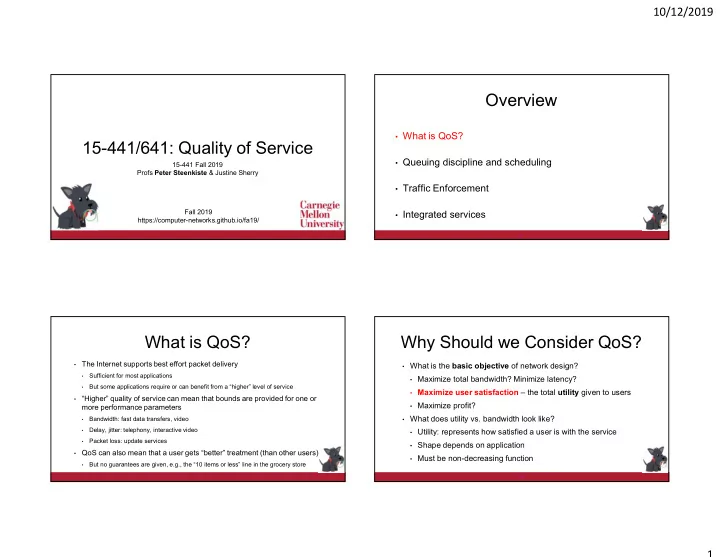
  • What is QoS?
  • Queuing discipline and scheduling
  • Traffic Enforcement
  • Integrated services

What is QoS?

  • The Internet supports best effort packet delivery
  • Sufficient for most applications
  • But some applications require or can benefit from a “higher” level of service
  • “Higher” quality of service can mean that bounds are provided for one or

more performance parameters

  • Bandwidth: fast data transfers, video
  • Delay, jitter: telephony, interactive video
  • Packet loss: update services
  • QoS can also mean that a user gets “better” treatment (than other users)
  • But no guarantees are given, e.g., the “10 items or less” line in the grocery store

4

Why Should we Consider QoS?

  • What is the basic objective of network design?
  • Maximize total bandwidth? Minimize latency?
  • Maximize user satisfaction – the total utility given to users
  • Maximize profit?
  • What does utility vs. bandwidth look like?
  • Utility: represents how satisfied a user is with the service
  • Shape depends on application
  • Must be non-decreasing function
slide-2
SLIDE 2

10/12/2019 2

Performance versus Satisfaction

Service Level User Satisfaction

No longer Matters Unacceptable

6

Utility Curve Shapes

Stay to the right and you are fine for all curves

BW U Elastic BW U Hard real-time BW U Delay- or Rate-adaptive Does equal allocation

  • f bandwidth

maximize total utility?

7

Utility curve – Elastic traffic

Bandwidth U Elastic

Does equal allocation of bandwidth maximize total utility? Does adding users increase utility?

8

Utility Curves – Inelastic traffic

BW U Hard real-time BW U Delay-adaptive

Does equal allocation of bandwidth maximize total utility? Does adding users increase utility?

slide-3
SLIDE 3

10/12/2019 3

9

Inelastic Applications

  • Continuous media applications
  • Lower and upper limit on acceptable performance.
  • BW below which video and audio are not intelligible
  • Internet telephones, teleconferencing with high delay (200 - 300ms)

impair human interaction

  • Sometimes called “tolerant real-time” since they can adapt to the

performance of the network

  • Hard real-time applications
  • Require hard limits on performance
  • E.g. control applications

Quality of Service versus Fairness

  • Traditional definition of fairness: treat all users equally.
  • E.g., share bandwidth on bottleneck link equally
  • QoS: treat users differently.
  • For example, some users get a bandwidth guarantee, while others have

to use best effort service

  • The two are not in conflict
  • All else being equal, users are treated equally
  • Unequal treatment is based on policies, price:
  • Administrative policies: rank or position
  • Economics: extra payment for preferential treatment

QoS Analogy: Surface Mail

  • The defaults is “first class mail”.
  • Usually gets there within a few days
  • Sufficient for most letters
  • Many “guaranteed” mail delivery services: next day, 2-day delivery,

next day am, …..

  • Provide faster and more predictable service at a higher cost
  • Providers differentiate their services: target specific markets with

specific requirements and budgets

  • Why don’t we do the same thing in networks?

QoS Framework

G H F E C B J I H

Admission Control

A D

Traffic Enforcement Packet Scheduling Observation: need full control over network to provide QoS Internet versus single domain

slide-4
SLIDE 4

10/12/2019 4

How to Provide QoS?

  • Admission control limits number of flows
  • You cannot provide guarantees if too many flows share resources (bandwidth)
  • For example, telephone networks - busy tone
  • This implies that your request for service can be rejected
  • Traffic enforcement limits how much traffic flows can inject based
  • n predefined limits.
  • Make sure user respects the traffic contract
  • Data outside of contract can be dropped or can be sent at a lower priority
  • Scheduling support in the routers guarantee that users get their

share of the bandwidth.

  • Again based on pre-negotiated bounds
  • Analogy: service in a grocery store

What is a flow?

  • Defines the granularity of QoS and fairness
  • TCP flow
  • Traffic to or from a device, user, or network
  • Bigger aggregates for traffic engineering purposes
  • Routers use a classifier to determine what flow a packet belongs to
  • Classifier uses a set of fields in the packet header to generate a

flow ID

  • Example: (src IP, dest IP, src port, dest port, protocol)
  • Or: (src prefix, dest prfix), i.e., some fields are wildcards

14 15

Admission Control - Elastic

  • If U(bandwidth) is concave

 elastic applications

  • Incremental utility is decreasing with increasing

bandwidth

  • It is always advantageous to have more flows

with lower bandwidth

  • Increases total utility of flows served
  • No need of admission control

This is why the Internet works!

  • Not so for delay-adaptive and real-time

applications BW U Elastic

16

Admission Control - Guarantees

  • If U is convex  inelastic

applications

  • U(number of flows) is no longer

monotonically increasing

  • Need admission control to maximize

total utility

  • Admission control  deciding

when adding more people would reduce overall utility

  • E.g., bandwidth or latency guarantees
  • Basically avoids overload

BW U Delay-adaptive

slide-5
SLIDE 5

10/12/2019 5

17

Overview

  • What is QoS?
  • Queuing discipline and scheduling
  • Traffic Enforcement
  • Integrated services

18

Queuing Disciplines

  • Each router must implement some queuing discipline
  • Since you have queues you will need a policy
  • Queuing allocates both bandwidth and buffer space:
  • Bandwidth: which packet to serve (transmit) next
  • Buffer space: which packet to drop next (when required)
  • Queuing discipline affects latency, bandwidth, ..

19

Network Queuing Disciplines

  • First-in-first-out (FIFO) + drop-tail
  • Simplest choice - used widely in the Internet
  • FIFO means all packets treated equally
  • Drop-tail: new packets gets dropped when queue is
  • Important distinction:
  • FIFO: scheduling discipline
  • Drop-tail: drop policy
  • Alternative is to do Active Queue Management
  • To improve congestion response
  • Support fairness in presence of non-TCP flows
  • To give flows different types of service – QoS

20

Alternative Drop Policies

  • Avoid lockout and full queue problems
  • Random drop and drop front policies
  • Drop random packet or packet at the head of the queue if the

queue is full and a new packet arrives

  • Solve the lock-out problem but not the full-queues problem
  • May trigger congestion response faster
  • Random Early Discard (RED) and Explicit Congestion Notification

(ECN) slow down receivers before queues are full

  • RED: drop some packets before queue is full
  • ECN: mark a bit in the headers to notify receiver (who notifies

the sender) of congestion onset without dropping a packet

slide-6
SLIDE 6

10/12/2019 6

21

Problems in Achieving fairness

  • In the Internet, fairness is only achieved if all flows play by the

same rules

  • But it is complicated: fairness is poorly defined for short flows,

many versions of TCP co-exist, etc.

  • In practice: most sources must use TCP or be “TCP friendly”
  • Most sources are cooperative
  • Most sources implement homogeneous/compatible control law
  • Compatible does not mean identical
  • Typically means less aggressive than TCP
  • What if sources do not play by the rule?
  • E.g., TCP versus UDP without congestion control

22

Fairness Goals In Practice

  • Allocate resources fairly
  • Partially achieved by using similar congestion control rules
  • Isolate ill-behaved users
  • This is challenging
  • How about users who start with a large initial congestion window
  • How about UDP flows (good news: uncommon)
  • How about users who modify TCP (good news: very hard)
  • Still achieve statistical multiplexing
  • One flow can fill entire pipe if no contenders
  • Work conserving  scheduler never idles link if it has a packet

23

What is Fairness?

  • At what granularity?
  • Flows, connections, domains?
  • What if users have different RTTs/links/etc.
  • Should it share a link fairly or be TCP fair?
  • Maximize fairness index?
  • Fairness = (Sxi)2/n(Sxi2) 0<fairness<1
  • Basically a tough question to answer!
  • Good to separate the design of the mechanisms from definition of a policy
  • User = arbitrary granularity
  • One example: max-min fairness

24

Max-min Fairness

  • Give users with “small” demand what they want, evenly divide unused

resources to “big” users

  • Formally:
  • Resources allocated in terms of increasing demand
  • No source gets resource share larger than its demand
  • Sources with unsatisfied demands get equal share of resource
slide-7
SLIDE 7

10/12/2019 7

25

Implementing Max-min Fairness

  • Generalized processor sharing
  • Fluid fairness
  • Bitwise round robin among all queues
  • Why not simple round robin?
  • Variable packet length  can get more service by sending bigger

packets

  • Unfair instantaneous service rate
  • What if packets arrive just before/after packet departs?
  • We will use bit-bit round robin as an example
  • Many other algorithms exist

26

Bit-by-bit RR Illustration

  • Send one bit for every flow

that has data queued – perfect!

  • … but not feasible to

interleave bits on real networks

  • FQ simulates bit-by-bit

RR FYI Only

27

Fair Queuing

  • Mapping bit-by-bit schedule onto packet transmission schedule
  • Transmit packet sequentially but in bit RR order
  • How do you compute this packet order?
  • Must be efficient and work for any order

FYI Only

28

Approximating Bit-by-bit RR

  • Single flow: clock ticks when a bit is transmitted. For packet i:
  • Ai = arrival time, Si = transmit start time,

Pi = transmission time, Fi = finish transmit time

  • Fi = Si+Pi = max (Fi-1, Ai) + Pi
  • Multiple flows: clock ticks when a bit from all active flows is

transmitted  round number

  • Models the fact that you would transmit one bit from each flow in

bit RR

  • Can now calculate Fi for each packet if number of flows is know

at all times – determines packet order

  • Need to know flow count to calculate clock tick time

FYI Only

slide-8
SLIDE 8

10/12/2019 8

Bit-by-bit RR Example

29

F=10 Flow 1 (arriving) Flow 2 transmitting F=2 Output F=5 F=8 Flow 1 Flow 2 Output F=10

Cannot preempt packet currently being transmitted Calculate finish time to determine transmit order

FYI Only

30

Bottleneck link (10 Mbps)

An Example: TCP versus UDP

1 UDP (10 Mbps) and 31 TCPs sharing a 10 Mbps line

UDP (#1) - 10 Mbps TCP (#2) TCP (#32) . . . UDP (#1) TCP (#2) TCP (#32) . . .

Throughput of UDP and TCP Flows With FIFO

31

1 2 3 4 5 6 7 8 9 10

1 3 5 7 9 11 13 15 17 19 21 23 25 27 29 31 Flow Number

Throughput (Mbps) FIFO

Example: Throughput of TCP and UDP Flows With Fair Queueing Router

32

0.05 0.1 0.15 0.2 0.25 0.3 0.35 0.4 0.45

1 3 5 7 9 11 13 15 17 19 21 23 25 27 29 31 Flow Number

Throughput (Mbps)

FQ

slide-9
SLIDE 9

10/12/2019 9

33

Fair Queuing Tradeoffs

  • Complex computation
  • Overhead of classification and scheduling
  • Must keep queues sorted by finish times
  • Computation changes whenever the flow count changes
  • Complex state – must keep queue per flow
  • Hard in routers with many flows (e.g., backbone routers)
  • Flow aggregation is a possibility (e.g. do fairness per domain)
  • FQ can control congestion by monitoring flows
  • Weighted fair queuing can give flows a different fraction of the bandwidth -

controlled by a weight Wi

  • Bandwidth of flow i is Wi / ∑ Wj

WFQ Illustration

34

Flow 1 Flow 2 Flow n

I/P O/P Variation: Weighted Fair Queuing (WFQ) W1 W2 Wn W3

35

Overview

  • What is QoS?
  • Queuing discipline and scheduling
  • Traffic Enforcement
  • Integrated services

36

Traffic Enforcement: Token Bucket Filter

Operation:

  • If bucket fills, tokens are discarded
  • Sending a packet of size P uses P tokens
  • If bucket has P tokens, packet sent at max

rate, else must wait for tokens to accumulate

Tokens enter bucket at rate r Bucket depth b: capacity of bucket

slide-10
SLIDE 10

10/12/2019 10

37

Token Bucket Operation

Tokens Packet Overflow Tokens Tokens Packet

Enough tokens  packet goes through, tokens removed Not enough tokens  wait for tokens to accumulate

38

Token Bucket Characteristics

  • Can characterize flow using a token bucket: smallest

parameters for which no packets will be delayed

  • On the long run, rate is limited to r
  • On the short run, a burst of size b can be sent
  • Maximum amount of traffic that can enter the network in time

interval T is bounded by:

  • Simple case: Traffic = b + r*T
  • Information useful to admission algorithm

39

Token Bucket

  • Parameters
  • r – average rate, i.e., rate at which tokens fill the bucket
  • b – bucket depth
  • R – maximum link capacity or peak rate (optional parameter)
  • A bit is transmitted only when there is an available token

r bps b bits <= R bps regulator

time bits

b*R/(R-r)

slope R slope r Maximum # of bits sent

40

Traffic Enforcement: Example

Example: r = 100 Kbps; b = 3 Kb; R = 500 Kbps

3Kb

T = 0 : 1Kb packet arrives

(a)

2.2Kb

T = 2ms : packet transmitted b = 3Kb – 1Kb + 2ms*100Kbps = 2.2Kb

(b)

2.4Kb

T = 4ms : 3Kb packet arrives

(c)

3Kb

T = 10ms :

(d)

0.6Kb

T = 16ms : packet transmitted

(e)

slide-11
SLIDE 11

10/12/2019 11

41

Token Bucket Specs - Example

BW Time 1 2 1 2 3 Flow A Flow B

Flow A: r = 1 MBps, b=1 byte Flow B: r = 1 MBps, b=1MB

42

Overview

  • What is QoS?
  • Queuing discipline and scheduling
  • Traffic Enforcement
  • Integrated services

43

Integrated Services Traffic Classes

  • IETF RFC 1633 (1994)
  • Guaranteed service
  • For hard real-time applications
  • Fixed guarantee rate, assuming clients send at agreed-upon rate
  • Predicted service
  • For delay-adaptive applications
  • Two components
  • If conditions do not change, commit to current service
  • If conditions change, take steps to deliver consistent performance (help apps minimize

playback delay)

  • Implicit assumption – network does not change much over time
  • Datagram/best effort service
  • Also includes Resource reSerVation Protocol (RSVP) for establishing

paths; may also need routing support

44

Lessons

  • What type of applications are there?  Elastic, adaptive real-time ,

and hard real-time.

  • Why do we need admission control  to maximize utility
  • How do token buckets + WFQ provide QoS guarantees?