
Iteration via Tail Recursion in Racket
CS251 Programming Languages
Spring 2019, Lyn Turbak
Department of Computer Science Wellesley College
- What is itera*on?
- Racket has no loops, and yet can express itera*on.
How can that be?
- Tail recursion!
- Tail recursive list processing via foldl
- Other useful abstrac*ons
- General itera*on via iterate and iterate-apply
- General itera*on via genlist and genlist-apply
Overview
2 Iteration/Tail Recursion
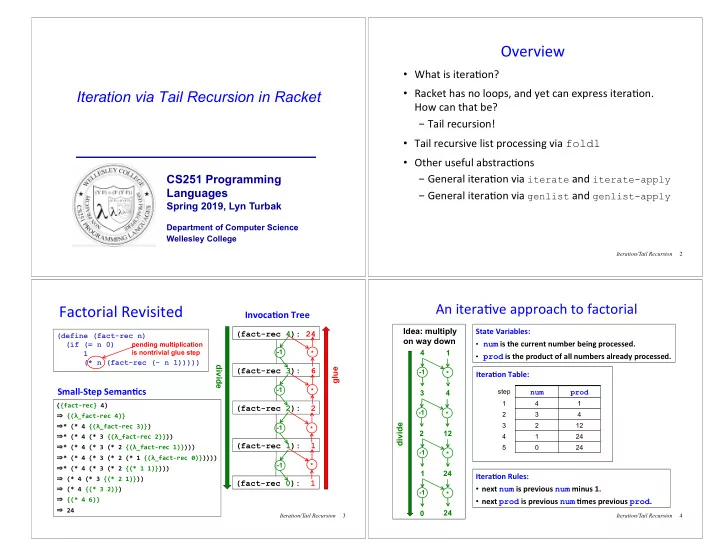
Factorial Revisited
(define (fact-rec n) (if (= n 0) 1 (* n (fact-rec (- n 1)))))
(fact-rec 4): 24 (fact-rec 3): 6 (fact-rec 2): 2 (fact-rec 1): 1 (fact-rec 0): 1
Invoca'on Tree
pending multiplication is nontrivial glue step
- 1
- 1
- 1
- 1
divide glue
* * * *
3 Iteration/Tail Recursion
({fact-rec} 4) {(λ_fact-rec 4)} * (* 4 {(λ_fact-rec 3)}) * (* 4 (* 3 {(λ_fact-rec 2)})) * (* 4 (* 3 (* 2 {(λ_fact-rec 1)}))) * (* 4 (* 3 (* 2 (* 1 {(λ_fact-rec 0)})))) * (* 4 (* 3 (* 2 {(* 1 1)}))) (* 4 (* 3 {(* 2 1)})) (* 4 {(* 3 2)}) {(* 4 6)} 24
Small-Step Seman'cs
An itera*ve approach to factorial
Itera'on Rules:
- next num is previous num minus 1.
- next prod is previous num 'mes previous prod.
State Variables:
- num is the current number being processed.
- prod is the product of all numbers already processed.
- 1
divide
*
4 1 3 4
- 1
*
2 12
- 1
*
1 24
- 1
*
24
Idea: multiply
- n way down
step
num prod
1 4 1 2 3 4 3 2 12 4 1 24 5 24
Itera'on Table:
4 Iteration/Tail Recursion