Overview Current Concepts in the Pathological Diagnosis of - - PowerPoint PPT Presentation

overview
SMART_READER_LITE
LIVE PREVIEW

Overview Current Concepts in the Pathological Diagnosis of - - PowerPoint PPT Presentation

5/23/2015 Overview Current Concepts in the Pathological Diagnosis of Pulmonary Carcinomas New WHO Classification Treatment update Staging issues Kirk D. Jones, MD UCSF Dept. of Pathology kirk.jones@ucsf.edu New WHO Classification


slide-1
SLIDE 1

5/23/2015 1

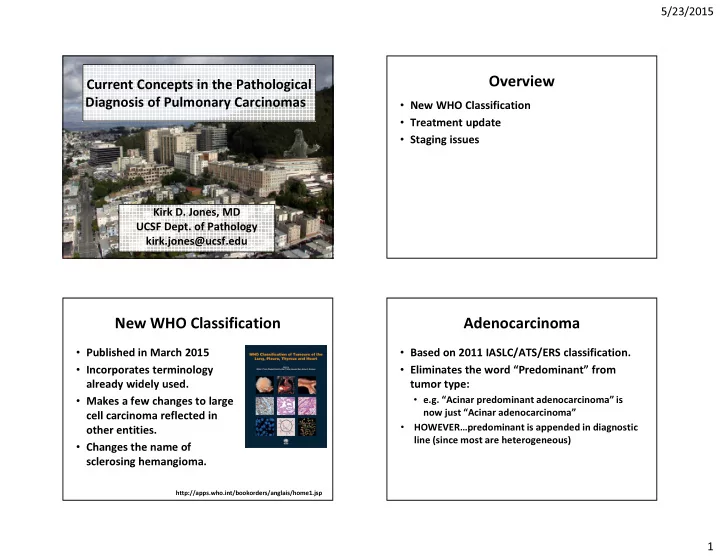
Current Concepts in the Pathological Diagnosis of Pulmonary Carcinomas

Kirk D. Jones, MD UCSF Dept. of Pathology kirk.jones@ucsf.edu

Overview

  • New WHO Classification
  • Treatment update
  • Staging issues

New WHO Classification

  • Published in March 2015
  • Incorporates terminology

already widely used.

  • Makes a few changes to large

cell carcinoma reflected in

  • ther entities.
  • Changes the name of

sclerosing hemangioma.

http://apps.who.int/bookorders/anglais/home1.jsp

Adenocarcinoma

  • Based on 2011 IASLC/ATS/ERS classification.
  • Eliminates the word “Predominant” from

tumor type:

  • e.g. “Acinar predominant adenocarcinoma” is

now just “Acinar adenocarcinoma”

  • HOWEVER…predominant is appended in diagnostic

line (since most are heterogeneous)

slide-2
SLIDE 2

5/23/2015 2

Adenocarcinoma Types

  • Lepidic
  • Acinar
  • Papillary
  • Solid
  • Micropapillary
  • These are the major non-mucinous types

Lepidic: Surface alveolar growth of tumor cells Acinar: Round, oval, or irregular glands invading in a fibrous stroma

slide-3
SLIDE 3

5/23/2015 3

Cribriform pattern included in acinar Papillary: Tumor cells grow on surface of fibrovascular cores Solid: Sheets of tumor cells without gland formation

slide-4
SLIDE 4

5/23/2015 4

Solid without mucin production – former large cell Micropapillary: Growth as small papillae without fibrovascular cores

Other Adenocarcinomas

  • Invasive mucinous adenocarcinoma
  • Colloid adenocarcinoma
  • Fetal adenocarcinoma
  • Cribriform pattern (currently under acinar,

but behaves like solid)

slide-5
SLIDE 5

5/23/2015 5

Invasive mucinous adenocarcinoma: Often shows lepidic growth… Invasive mucinous adenocarcinoma: …admixed with acinar pattern Colloid adenocarcinoma: Abundant pools of mucin replacing alveoli… Colloid adenocarcinoma: …with tumor cells floating as clusters and alveolar walls.

slide-6
SLIDE 6

5/23/2015 6

Architecture as Grade

  • Lepidic = Grade 1
  • Acinar and Papillary = Grade 2
  • Solid and Micropapillary = Grade 3
  • Mucinous, colloid, fetal = Grade 3
  • There is an additional grading scheme using

nuclear grade and mitoses that helps divide the 2’s

Yoshizawa A, et al. Mod Pathol. 2011 May;24(5):653-64. von der Thüsen JH, et al. J Thorac Oncol. 2013 Jan;8(1):37-44. Yoshizawa A, et al. Mod Pathol. 2011May; 24(5): 653-64.

Prognosis by Pattern

  • Micropapillary type shows worse prognosis.
  • Zhang J, et al. Histopathology. 2011 Dec;59(6):1204-14
slide-7
SLIDE 7

5/23/2015 7

Any Micropapillary?

Lee G, et al. Am J Surg Pathol. 2015 May;39(5):660-6. PMID: 25724001. Central scar tissue (red), Acinar (yellow), Papillary (blue), and Micropapillary (green).

Any Micropapillary?

Lee G, et al. Am J Surg Pathol. 2015 May;39(5):660-6. PMID: 25724001.

Semiquantitative Analysis

  • Divide into patterns based on 5% increments.

Then divide into predominant pattern.

  • “Weak recommendation, low-quality

evidence”

Adenocarcinoma Variants

  • Does it matter to the clinician?
  • What to put on the bottom line
  • Adenocarcinoma with a comment.
  • ____-predominant adenocarcinoma.
  • I mention if micropapillary pattern is present.
  • Lepidic pattern (AIS) has the same clinical

intrigue as BAC used to have.

slide-8
SLIDE 8

5/23/2015 8

Spread through air spaces (STAS)

  • Micropapillary clusters, solid nests, or single

cells present within alveoli outside of the main tumor mass.

  • Likely result in cases of localized recurrence

after limited resections.

  • Mention if present, particularly if present at

margin (margin is negative for invasive tumor, but presence of STAS correlated with increased risk of local recurrence).

Judging Invasion

  • Concept of AIS and MIA
  • Clear invasion
  • pattern that is not lepidic
  • vascular or pleural invasion
  • STAS
  • fibromyxoid stroma (desmoplasia)

Judging Invasion

  • Difficult to judge collapse of lepidic growth

from acinar pattern

  • Difficult to judge collapse of lepidic growth

from papillary

  • Some choose to just measure the region of

collapse (Noguchi B type)

  • Proper to measure the limited area of

fibromyxoid tissue - difficult

Squamous Cell Carcinoma

  • Previously defined histologically by

keratinization

  • Now two types:
  • Keratinizing
  • Non-keratinizing
slide-9
SLIDE 9

5/23/2015 9

p40

slide-10
SLIDE 10

5/23/2015 10

Large Cell Carcinoma

  • Previously used when no morphologic

support for squamous cell or adenocarcinoma

  • Now use immunohistochemical stains to help

subclassify into:

  • Solid type adenocarcinoma
  • Non-keratinizing squamous cell carcinoma
  • Large cell carcinoma

Potential Pitfalls

  • TTF-1:

– Thyroid carcinoma – Entrapped pneumocytes – Gyn tumors (~80% ut. carcinosarcoma) – Neuroendocrine tumors

  • Napsin-A:

– Pulmonary macrophages (darker) – Renal cell carcinoma (~80%) – GI mucinous tumors (~80%)

Potential Pitfalls

  • p63:

– Entrapped basal layer – Urothelial tumors – Metastatic squamous tumors – Adenocarcinoma of lung

  • Require >10% of nuclei to stain
  • p40:

– More specific, but similar pitfalls

Mystery Case

  • 64-year-old woman with right lower lobe

lung nodule.

  • CT-guided percutaneous fine needle

aspiration performed.

slide-11
SLIDE 11

5/23/2015 11

Using the CT scan

Bone tumors, ILD, and now lung tumors

  • Ground glass opacities versus solid masses
  • Determining extent of lepidic growth
  • Determining size of lesion
  • Border of a lesion
  • Spiculated versus smooth
  • Typical adeno vs benign or fast-growing
  • Multiplicity of lesions
  • Extrathoracic with met, lung met, synch primary
slide-12
SLIDE 12

5/23/2015 12

The Argus (Melbourne, Australia) February 6, 1936, page 10

Sclerosing Pneumocytoma

  • Formerly sclerosing hemangioma

– “Sclerosing hemangioma (histiocytoma, xanthoma) of the lung” – A.A. Liebow and D.S. Hubbell, Cancer, 1953.

  • Characteristic radiologic appearance

– Rounded edges are often either really bad (fast growing) or benign

  • Characteristic immunoprofile

– EMA positive, Keratin negative – TTF-1 positive, Napsin-A negative

  • Immature pneumocytes with surface normal

bronchiolar epithelium

Keratin

slide-13
SLIDE 13

5/23/2015 13

EMA Napsin-A TTF-1

52

Treatment Options

  • Many tumors are typically treated with

standard chemotherapy

  • In recurrent and stage 4 tumors, and

increasingly as first line, targeted treatments being used:

  • EGFR
  • EML4-ALK
  • ROS-1
  • BRAF
  • MET
slide-14
SLIDE 14

5/23/2015 14

Resistance Mutations

  • EGFR TKI-treated tumors often develop

additional mutations – commonly T790M within EGFR – Novel TKI

  • Targeting other pathways being activated

– MET, AXL

Immunotherapy

  • PD-1 and PD-L1

– Programmed death 1 receptor and its ligands – PD-1 is an inhibitory checkpoint pathway in T cells – Some tumor cells have increased surface expression

  • f PD-L1 (35-95% of NSCLC)

– Currently in trials (although already FDA approved), most often for patients that have failed first and second line therapies

Staging Issues

  • Multiple nodules
  • Pleural invasion
  • Pleural drop metastases

Multiple Nodules

  • Sometimes difficult to determine if two

tumor nodules represent – Synchronous primary tumors – Intraparenchymal metastases

slide-15
SLIDE 15

5/23/2015 15

Martini-Melamed

  • Tumors are synchronous primaries if:
  • 1. Histologically different.
  • 2. Histologically similar but…
  • A. Arise from CIS
  • B. No tumor in shared lymphatics
  • C. No extrapulmonary mets
  • At the time, histologically different meant

SqC vs adeno, and CIS was Sq.CIS

Comprehensive Histologic Assessment

  • The “histologically different” component is

expanded substantially – Percentage of adenocarcinoma subtype becomes significant – Cytologic features, stromal components also aid differentiation

  • Additional concept of AIS/Lepidic growth
  • To be discussed in the new AJCC – next year?

Pleural invasion

  • The many definitions of pleural invasion

– What we want to think versus what there is data to support – Research from Japan (lots more EVG staining going on overseas)

  • The prominent elastic layer (the visceral

pleural elastica, aka the external elastic layer)

slide-16
SLIDE 16

5/23/2015 16

slide-17
SLIDE 17

5/23/2015 17

slide-18
SLIDE 18

5/23/2015 18

Pleural Invasion

  • EVG for all tumors approaching the pleura.
  • pT2a if external elastic layer is penetrated

(visceral pleural elastica).

– Raises stage from IA to IB in small tumors.

  • Elastica of chest wall is variable, and it is

sometimes difficult to assess chest wall invasion.

– Look for penetration into parietal fat.

  • Can use PL designations if desired

– Past elastica PL1, on pleural surface PL2, into chest wall PL3

Pleural Drop Metastases

  • Tumor studding on pleural surface
  • NOT direct extension (T2, PL2)
  • NOT subpleural lymphatic invasion with

spread to other areas of the lung (T3 or T4)

  • Similar prognosis as malignant pleural

effusion (M1a)

slide-19
SLIDE 19

5/23/2015 19

Take Home Messages

  • No significant changes to adenocarcinoma

terminology since IASLC/ATS/ERS changes.

  • Splitting of large cell using IHC.
  • Sclerosing pneumocytoma.
  • Targeted therapy, targeting resistance,

immunotherapy.

  • Not all multiple lesions mean poor prognosis.
  • Treat the pleura with respect.