Overview Project Overview CEQA Disposition and Development - - PowerPoint PPT Presentation
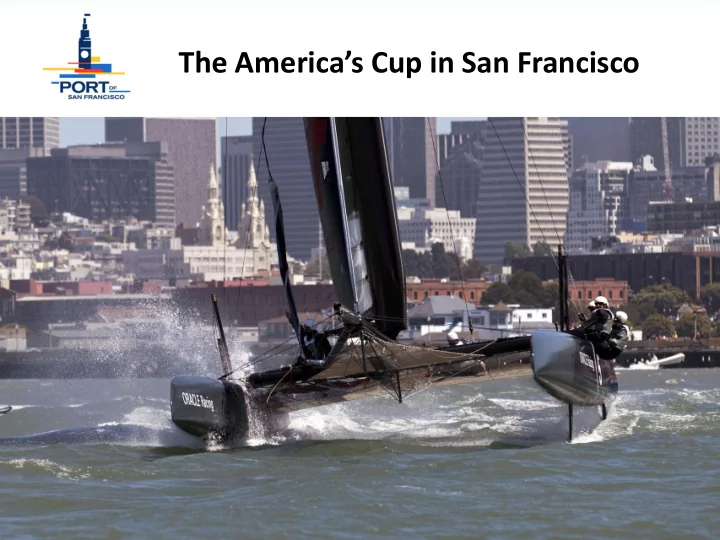
The Americas Cup in San Francisco Overview Project Overview CEQA Disposition and Development Agreement Scope of Work Approval Financial & Economic Analysis Policy Analysis & Recommendations Event Partners
- Project Overview
- CEQA
- Disposition and Development Agreement
- Scope of Work Approval
- Financial & Economic Analysis
- Policy Analysis & Recommendations
Overview
Event Partners
- City & County of San Francisco
– CEQA/NEPA, Permits, Implementation Plans
- America’s Cup Event Authority
– Sponsorship and Television
America’s Cup Race Management
– Landside & on-water event management
- America’s Cup Organizing Committee
– 501(c)3 formed to offset City’s host costs
- Signatories to the Host and Venue Agreement
Cascais, Portugal: Aug 6-14 Plymouth, UK: Sept 10-18 San Diego, USA: Nov 12-20
AC World Series
Aug 2011 - June 2012 July 4 - Sept 1, 2013 Sept 7-22, 2013
Additional 2012/2013 Dates To Be Announced
San Francisco, USA
Venice, Italy: May 12-20
Aug 2012 - June 2013
San Francisco, USA:
August 11-19 August 27- September 2
AC World Series
The America’s Cup: A Global Event
Newport, USA: June 23-July 1
Venice, Italy: April Naples, Italy: April 7-15 Naples, Italy: May 11-19
AC45 in 2012 vs. AC72 in 2013
Proposed 2013 Course Area
Implementation Plans
Table 1: Implementation Plans Available on www.oewd.org Website
Advertising Posted Team Base Operations 2012 Ambush Marketing Posted Water and Air Traffic Posted Parks Event Operations Posted Workforce Development December People (Transportation) Posted/Ac cepted Youth Involvement December Public Safety Posted Zero Waste Posted Sustainability Posted
California Environmental Quality Act
- Publication: The FEIR, with Comments and Responses
and project updates, was published on December 1
- Certified: The Planning Commission voted to certify the
EIR on December 15 by a vote of 5-0
- Appeal: A 20 day appeal period runs from Planning
Commission certification
- Findings: Based on the analysis in the FEIR, the Port
Commission must select a project by adopting CEQA findings for the project prior to taking any further steps related to the proposed project
Changes through CEQA (cont.)
- Findings: As described in the EIR and CEQA Findings, the 34th
America’s Cup Project has been refined.
- Project Changes: Changes were made in response to:
Adjustments learned from race events Authority and America’s Cup Race Management commitments to clean vessels and equipment Other Project refinements DEIR information about environmental effects comments from the public, organizations, and regulatory agencies, and through the City interagency coordination.
- Process: The process has been very rigorous and open. Port staff
believes that a better Project has emerged from the process.
Changes include the following:
- Reduced Construction: elimination of wave attenuators, reduced floating
docks and reduced construction to prepare Event Venues;
- Bay Views: reduced temporary spectator yacht berthing in the Rincon
Point Open Water Basin, and no permanent marina, to preserve Bay views from Rincon Park;
- Aquatic Park: revisions to screen viewing of events in Aquatic Park, to
preserve areas for swimmers, kayakers and recreational water users;
- Embarcadero: provisions to acknowledge a reduced scope of vehicle lane
closure along The Embarcadero to manage transportation demand; and
- Air Quality: new, additional mitigation measures to reduce the severity of
significant air quality impacts.
Changes through CEQA (cont.)
California Environmental Quality Act (cont.)
- Pier 70 Shore Power: FEIR includes a mitigation measure
requiring a new shoreside power installation at the Pier 70 Shipyard, managed by BAE Systems, San Francisco Ship Repair (“BAE”).
- Construction Schedule: Subject to final agreement,
construction of this measure would start in early 2012.
- Benefit: The new shoreside power facility will enable BAE to
provide electrical power to passenger cruise, military, cargo and other industrial maritime vessels, dramatically reducing air emissions from Pier 70 before and after the Event.
California Environmental Quality Act (cont.)
CEQA Findings describe:
- The Project being approved and its environmental impacts
- Required mitigation measures to be implemented in a Mitigation
Monitoring and Reporting Program
- The FEIR alternatives to reduce or avoid Project impacts
- Reasons for rejecting FEIR alternatives
- Overriding considerations for approving the Project
The changes and refinements incorporated in the Project for approval represents the environmentally superior program of all studied in the FEIR
California Environmental Quality Act (cont.)
Port staff recommends adoption of the project including:
- the current AC34 Event Plan;
- reduced construction activities and enhanced mitigations;
- a reduced development footprint that does not include
Piers 19, Piers 19½ and 23; and
- revised marina locations that address concerns raised by
the Bay Conservation and Development Commission.
Port Commission Approvals
- CEQA findings and mitigation monitoring program
- Disposition and Development Agreement for AC34 venues
(DDA)
- Form of Venue Leases and Licenses per DDA (early 2012)
- Transfer Agreement for Seawall Lot 330 (2012, subject to
General Plan referral)
- Tenant Relocation Plan
- Resolution of intent to form a Port Infrastructure Financing
District (IFD)
- Phase 1 construction items related to the Pier 27 James R.
Herman Cruise Terminal project
Form of Venue Lease
The following business terms have been negotiated between Port staff and the Authority, subject to approval in early 2012: Term: The Venue Leases are short-term leases covering the period leading up to the Event and up to 6 months thereafter. Commencement Date: Occupancy of various Port facilities: March 1, 2012 Pier 30-32 June 1, 2012 Piers 26, 28, 30-32, 19, 19½, 23, 29½ December 31, 2012 Seawall Lot 330 March 1, 2013 Piers 27-29
Venue Lease Premises
Development and Disposition Agreement (DDA)
The DDA is subject to approval by the Port Commission and the Board of Supervisors. Key purposes of the DDA are to:
- 1. set forth the Authority obligations to improve Port
property for the Event,
- 2. govern Port review and approval of scopes of work for
pre-Match and later improvements to Port property,
- 3. govern conditions for Port delivery of the Venues, and
- 4. set forth the means to reimburse the Authority for its
improvements on Port property.
DDA – Port Required Work
Table 1: Required Port Work
Pier 36 Removal January 1, 2013 (U.S. Army Corps of Engineers) Brannan Street Wharf June 1, 2013 Relocate Pier 27 Shore Power 2012 James R. Herman International Cruise Terminal – Pier 27 March 1, 2013 The Port will have a limited right to use Pier 27 for cruise ships between March 1 and May 31, 2013, subject to the Authority’s sole discretion.
DDA – Authority Work
Table 2: Authority Infrastructure Work and Additional Work
Authority Work Description Authority Infrastructure Work Authority Infrastructure Work (AIW) is comprised of certain pre-Match work performed by the Authority: Piers 30-32 work required to stage the Event; Demolition of the Pier 27 shed, and portions of Pier 29 (Port will undertake); $2 million for relocation of shoreside power; Regulatory Conditions of Approval; and MMRP mitigation measures compliance. Additional Work Additional Work consists of dredging to accommodate spectator vessels and substructure strengthening improvements to Piers 26 and 28.
DDA – Authority Work
Table 2: Authority Infrastructure Work and Additional Work (cont.) Authority Work Description Deferred Authority Infrastructure Work Deferred AIW consists of work at Piers 30-32 that may be deferred for up to 10 years after the Venue Lease for Piers 30-32 expires. Deferred Additional Work Deferred Additional Work consists of Piers 26 and 28 work that may be constructed up to 10 years after the Match. All Other Work The Authority may also undertake other work it deems necessary for the Event at its own expense.
DDA – Long-Term Development Rights
Table 3: Authority Long-Term Development Rights
Piers 30-32 Legacy Lease Rent-Free 66 Year Lease: Subject to $55 Million pre-Match expenditure, Authority gains a rent-free 66-year lease of Piers 30-32, subject to approval of a Public Trust-consistent use program by the Port, the Board of Supervisors and the State Lands Commission. 10 Year Option Period: The Authority will have 10 years after the Match to enter a DDA and Lease, subject to future CEQA analysis, and to complete a seismic upgrade at Piers 30-32 for future development.
DDA – Long-Term Development Rights
Table 3: Authority Long-Term Development Rights (cont.) Piers 30-32 Legacy Leases (cont.) Cost Recovery: Costs not recovered through the rent-free lease and fee title to SWL 330, along with all other pre-Match Authority Infrastructure Work, will generate rent credits with 11% annual interest repaid via:
- IFD bond proceeds from Piers 30-32 and SWL 330;
- Piers 26 & 28 interim leases at parameter rents;
- Pier 29 long-term lease at $6 psf as escalated to lease
commencement; and
- If needed, a financial participation of up to 50% of the
proprietary lease revenues from the first 15 years of a subsequent lease of Piers 30-32.
DDA – Long-Term Development Rights
Table 3: Authority Long-Term Development Rights (cont.)
Seawall Lot 330 Fee title: SWL 330 fee title is transferred to the Authority through a transfer agreement subject to performing pre-Match Authority Infrastructure Work equal to or greater $24 million. Future CEQA and Approvals: Future development will be subject to CEQA analysis and other City approvals, and final approval action by the California State Lands Commission, but no further Port approval.
Basic Deal Summary
$55 Million in Waterfront Improvements Rent-free lease for Piers 30-32, and sale of SWL 330 subject to State approval City Can Pay for Costs Above $55 Million OR Piers 30-32 and SWL 330 IFD Debt Proceeds Pier 26 and/or 28 at interim rents or $6/sf Pier 29 $6/sf indexed If needed, participation in subsequent Piers 30-32 lease
DDA – Long-Term Development Rights
Table 3: Authority Long-Term Development Rights (cont.) Piers 26 and 28 Legacy Option Leases Long-term Leases: Authority may obtain Piers 26 and 28 long- term leases at any time until 10 years after the Match, if the Authority performs Piers 26 and 28 substructure work. Cost Recovery: Piers 26 and 28 post-Match substructure work repaid by:
- Rent credits at Piers 26 & 28 base rent of $6 psf, subject to
lease escalations (with market reset after 30 years or use of all rent credits) – see next page;
DDA – Long-Term Development Rights
Table 3: Authority Long-Term Development Rights (cont.) Piers 26 and 28 Legacy Option Leases (cont.) Cost Recovery: Piers 26 and 28 post-Match substructure work repaid by (cont.):
- Piers 26-28 IFD bond proceeds;
- Historic tax credits from Piers 26-28;
- If needed, a financial participation in up to 50% of
proprietary lease revenues from the first 15 years of a subsequent lease of Piers 26 & 28, or another source of funding to rehabilitate historic resources of equal to or greater value; and
- Rent credits may transfer among Piers 26 and 28 and
marina leases.
DDA – Long-Term Development Rights
Table 3: Authority Long-Term Development Rights (cont.) Pier 29 Lease Long-Term Lease: A long-term lease at $6 per gross building sf escalated until lease commencement and interim use at parameter rents if required to reimburse Authority Infrastructure Work. Marina Leases ENA: Exclusive negotiating agreements to obtain long-term marina leases in the following areas:
- Pier 54 including the water area around Pier 54, with rent credits for
spectator yacht dredging around Piers 14 North and South and Pier 54 substructure improvements, subject to a 66 year commercially- reasonable lease starting no sooner than 5 years after the Match and no later than 10 years.
- The Brannan Street Open Water Basin, in exchange for dredging
for spectator vessels pre-Match.
Basic Deal Summary (cont.)
Legacy Option Leases at Piers 26 and 28 ($6/sf) Piers 26 and 28 IFD Debt Proceeds Federal Historic Tax Credits Or another historic rehabilitation financing tool
- f equal or greater value
If needed, participation in subsequent Piers 26 and 28 leases Rent credits are transferable among Piers 26 and 28 leases and marina leases (except for Pier 54 substructure costs)
Board of Supervisors Approvals
- Approve a resolution of intention to form an IFD
- Adopt AC34 and James R. Herman CEQA Findings
- Approve the DDA, with specific proposed
development and use at each future development site subject to further analysis pursuant to CEQA
- Approve various work plans required pursuant to the
HVA, e.g., the People Plan, Workforce Plan, Zero Waste Plan
- Approve IFD financing plan and form IFD
Scope of Work Approval
Port staff recommends approval or conditional approval of Authority Infrastructure Work, with at least 30% plans and cost estimates:
- Structural improvements to Piers 30-32, with water and
wastewater utilities and partial seismic upgrade based on further, refined seismic analysis, peer-reviewed by Port 3rd party engineer
- Piers 30-32 Stormwater Control Plan still pending review by
Water Board
- Pier 27 Stormwater Control Plan, Pier 29 pile repairs and new
Pier 29 end wall
Scope of Work Approval (cont.)
- BCDC-related costs including Pier 64 fill removal, Pier 19 south
apron repair, and Pier 23 handrail
- Dredging at Pier 9, Piers 14 North and South, and Pier 28
- south. Conditional approval of dredging at Piers 32-36, subject
to further determination of actual dredging need.
- Regulatory requirements imposed by 1) FEIR mitigation
measures, and 2) permits issued by any Regulatory Agency.
- Soft costs for this work include direct costs of developing
design and engineering plans for this work.
- Estimated pre-Match costs of $74 million.
Scope of Work Approval (cont.)
The post-Match seismic upgrade of Pier 30-32 is conditionally approved, based on:
- A requirement that the code-compliant design is produced
based on a non-linear time history seismic analysis, subject to peer review by a Port 3rd party engineer, or another mutually agreed approach
- If mapped as a flood hazard, the Authority obtains flood
mapping designations that permit mixed use development
- Soft costs for this work include direct costs of developing
design and engineering plans for this work.
- Estimated post-Match costs of $31 million.
Financial Analysis
Consistent with the Port Staff Report, negotiations to apportion these costs have been ongoing until recently.
- The staff report analyzes a different agreement;
- Port Finance Staff find that the proposed agreement is as good
as or better than the proposed terms analyzed in the Staff Report.
- Port staff will publish a revised financial analysis for
consideration by the Board of Supervisors Budget Analyst and will revise the Port Staff report to reflect the new agreement.
Financial Analysis – (cont.)
Table 4: Port Opportunity Cost Based on Parameter Rent of Existing Facilities
Land Value Seawall Lot 330 $24,000,000 Lost Rent Streams (Projected Useful Life) Present Value of Parameter Rent for Useful Life Piers 30-32 (10 years) 8,568,265 Pier 26 (15 years) 12,831,584 Pier 28 (15 years) 7,518,499 Pier 29 (30 years) 12,708,161 Pier 54 No appreciable rent loss expected Total $65,626,509
Infrastructure Financing District Debt Proceeds at all sites and the value of federal historic tax credits at Piers 26 and 28 will depend on the appraised value and eligible costs of future development proposals.
Policy Analysis – Project Benefits
- San Francisco World-Class Sailing: AC34 will establish San Francisco
Bay’s identity as a world-class venue for sailing in 2012 and 2013.
- Public Access: The Event will increase both short-term and
permanent public access to the waterfront by providing public viewing opportunities of the America's Cup live racing events.
- Port Infrastructure Upgrades: The Authority will upgrade Port
facilities consistent with the Port building code and the Secretary of the Interior’s Standards for the Treatment of Historic Properties.
- Port Tenants: AC34 will generate substantial new demand for the
Port’s retail and maritime tenants.
Policy Analysis – Project Benefits (cont.)
- Environmental Stewardship: The Authority and the City have
emphasized the Bay and natural resource stewardship in the planning and management of all race events and operations.
- Port Priorities: AC34 has helped to accelerate the James R. Herman
Cruise Terminal and Northeast Wharf Plaza.
- Waterfront Land Use Plan: The Authority will improve Piers 30-32
that is designated as a major development opportunity site in the Port’s Waterfront Land Use Plan.
- Jobs: AC34 will generate thousands of local jobs leading up to and
during the Event.
Policy Analysis – Project Risks
- Cost Increases: The projected cost of proposed waterfront
improvements ($105 million) substantially exceeds the costs previously estimated by the Authority and the Port.
- No Financial Participation: The terms of the DDA do not provide
the Port financial participation in the future development of Piers 30- 32 and Seawall Lot 330, contrary to standard Port development practice.
- Property Re-leasing Risk: Commencing in 2014, the Port may see
a return of 3 to 6 finger piers to Port control. The Port will need to lease these piers to maintain revenues after the City’s backfill of the Port’s lost rent ends. To prepare, the Port may be required to make investments in these facilities to ready the facilities for future tenants.
Recommendations
- Approve the Project, as modified through negotiation and the
CEQA process.
- Authorize Port staff to develop a plan of finance for Port-
funded improvements for Port Commission consideration.
- Approve the DDA: Forward the DDA to the Board of