Overview Important Iron Age Sites (Dyke Hills, Cherbury Camp) - - PowerPoint PPT Presentation

overview
SMART_READER_LITE
LIVE PREVIEW

Overview Important Iron Age Sites (Dyke Hills, Cherbury Camp) - - PowerPoint PPT Presentation

Roman Hanney (and Beyond) Overview Important Iron Age Sites (Dyke Hills, Cherbury Camp) Important Roman Sites (Marcham / Frilford) East Hanney Roman Settlements Is the A338 a Roman Road? 26th February 2019 William Wintle Roman


slide-1
SLIDE 1

Roman Hanney (and Beyond)

26th February 2019

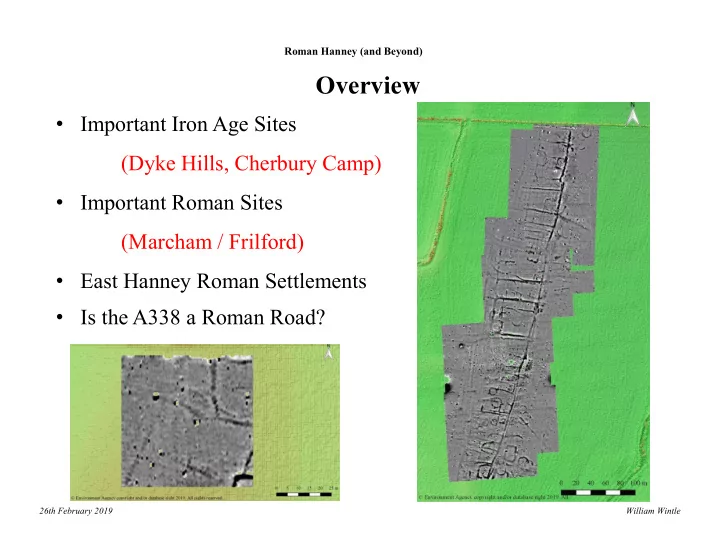
  • Important Iron Age Sites

(Dyke Hills, Cherbury Camp)

  • Important Roman Sites

(Marcham / Frilford)

  • East Hanney Roman Settlements
  • Is the A338 a Roman Road?

Overview

William Wintle

slide-2
SLIDE 2

Roman Hanney (and Beyond)

26th February 2019 William Wintle

Archaeological Periods and Dates

  • 800 – 400 BC

Early Iron Age

  • 400 – 100 BC

Middle Iron Age Hillforts, Roundhouses

  • 100 BC – AD 43 Late Iron Age

Oppida, Roundhouses, Coins

  • AD 43 – 410

Roman Period Towns, Temples, Villas, Coins, Roads

  • AD 410 – 1066

Anglo-Saxon Period SFBs, Halls, Villages, Open Fields?

slide-3
SLIDE 3

Roman Hanney (and Beyond)

Wittenham Clumps and Dyke Hills

William Wintle 26th February 2019

Google Earth Image

slide-4
SLIDE 4

Roman Hanney (and Beyond)

William Wintle 26th February 2019

Lidar Image

Wittenham Clumps and Dyke Hills

slide-5
SLIDE 5

Roman Hanney (and Beyond)

William Wintle 26th February 2019

Lidar Image

Wittenham Clumps and Dyke Hills

slide-6
SLIDE 6

Roman Hanney (and Beyond)

William Wintle 26th February 2019

Dyke Hills – a late Iron Age Enclosed Oppidum

Lidar Image

slide-7
SLIDE 7

Roman Hanney (and Beyond)

William Wintle 26th February 2019

Lidar Image

Dyke Hills – a late Iron Age Enclosed Oppidum

slide-8
SLIDE 8

Roman Hanney (and Beyond)

William Wintle 26th February 2019

Lidar Image

Cherbury Camp (Charney Bassett)

slide-9
SLIDE 9

Roman Hanney (and Beyond)

William Wintle 26th February 2019

Lidar Image

Cherbury Camp (Charney Bassett)

slide-10
SLIDE 10

Roman Hanney (and Beyond)

William Wintle 26th February 2019

Lidar Image

Cherbury Camp (Charney Bassett)

slide-11
SLIDE 11

Roman Hanney (and Beyond)

26th February 2019 William Wintle

Cherbury Camp - Geophysical Survey

slide-12
SLIDE 12

Roman Hanney (and Beyond)

26th February 2019

  • Occupation indicated by roundhouse gullies and pits. Date

and duration unclear.

  • Zoning or internal structure suggested by possible cobbled

road.

  • Not clear whether pits are for storage, rubbish (or both).
  • Does not appear to have been occupied in Roman period

William Wintle

Cherbury Camp - Geophysical Survey

slide-13
SLIDE 13

Roman Hanney (and Beyond)

26th February 2019

  • 1938 Arkell - Site defensible because largely surrounded by marshes
  • 1939 Bradford – Dated defences to 0 – 20 AD (late Iron Age)
  • 1972 Harding – Middle IA pottery, no late IA pottery. Suggests

multiple phases of construction, with abandonment in the early first century AD.

  • 1983 Hingley – Middle IA pottery. Suggests settlement began in early
  • IA. One of a number of nucleated, heavily defended settlements of the

Upper Thames Valley (Salmonsbury, Abingdon, Dyke Hills)

William Wintle

Cherbury Camp (Charney Bassett)

slide-14
SLIDE 14

Roman Hanney (and Beyond)

Cherbury Camp (Charney Bassett)

William Wintle 26th February 2019

Lidar Image

slide-15
SLIDE 15

Roman Hanney (and Beyond)

26th February 2019

Geophysical Survey and Interpretation

William Wintle

Two Phases? – Iron Age Enclosure and later Roman settlement. Trackway width ca 8.5m. Small excavation by Mr D. A. Maclean of Appleby Fruit Farm, Kingston Bagpuize in 1960s

  • 1966. Archaeological Notes from Reading Museum. Berkshire Archaeological Journal, 62, 70-76.
  • 1986. Abingdon Area Archaeology and Historical Society Newsletter. Spring 1986.
slide-16
SLIDE 16

Roman Hanney (and Beyond)

Marcham / Frilford

William Wintle 26th February 2019

Google Earth Image

slide-17
SLIDE 17

Roman Hanney (and Beyond)

William Wintle 26th February 2019

Lidar Image

Marcham / Frilford

slide-18
SLIDE 18

Roman Hanney (and Beyond)

William Wintle 26th February 2019

Lidar Image and Geophysical Survey

Marcham / Frilford

slide-19
SLIDE 19

Roman Hanney (and Beyond)

William Wintle 26th February 2019

Lidar Image and Geophysical Survey (Noah’s Ark Inn)

Marcham / Frilford

slide-20
SLIDE 20

Roman Hanney (and Beyond)

26th February 2019 William Wintle

Lidar Image and Geophysical Survey (Trendles Field)

Marcham / Frilford

slide-21
SLIDE 21

Roman Hanney (and Beyond)

26th February 2019 William Wintle

Lidar Image and Geophysical Survey (North of Cemetery)

Marcham / Frilford

slide-22
SLIDE 22

Roman Hanney (and Beyond)

26th February 2019 William Wintle

The Romano-British and Anglo-Saxon Cemetery (Bradford and Goodchild 1939, 55, Figure 12)

George Rolleston Linacre Professor of Anatomy and Physiology

Marcham / Frilford Cemetery

slide-23
SLIDE 23

Roman Hanney (and Beyond)

26th February 2019 William Wintle

The Romano-British and Anglo-Saxon Cemetery (Bradford and Goodchild 1939, 55, Figure 12)

Marcham / Frilford Cemetery

slide-24
SLIDE 24

Roman Hanney (and Beyond)

26th February 2019 William Wintle

Trench 7 (Cass and Ford 2008, Plate 2) Trench 1 (Cass and Ford 2008, Plate 1)

Marcham / Frilford Cemetery

slide-25
SLIDE 25

Roman Hanney (and Beyond)

26th February 2019 William Wintle

East Hanney

Rutland, R. and Thomas, J., 1968. Archaeological Notes from Reading Museum, Berkshire Archaeological Journal, 63, 67-75.

slide-26
SLIDE 26

Roman Hanney (and Beyond)

26th February 2019 William Wintle

East Hanney

slide-27
SLIDE 27

Roman Hanney (and Beyond)

26th February 2019 William Wintle

East Hanney

slide-28
SLIDE 28

Roman Hanney (and Beyond)

26th February 2019 William Wintle

East Hanney

slide-29
SLIDE 29

Roman Hanney (and Beyond)

26th February 2019 William Wintle

Site 110

East Hanney

slide-30
SLIDE 30

Roman Hanney (and Beyond)

26th February 2019 William Wintle

East Hanney and Drayton (Linear Settlements)

slide-31
SLIDE 31

Roman Hanney (and Beyond)

26th February 2019 William Wintle

Site 416

East Hanney

slide-32
SLIDE 32

Roman Hanney (and Beyond)

26th February 2019 William Wintle

Site 196

East Hanney

slide-33
SLIDE 33

Roman Hanney (and Beyond)

26th February 2019 William Wintle

Figure 6.27 – Chronology of Linear Sites in Drayton, East Hanney and Steventon

126 N (D) 126 S (D) 407 (S) 411 412 110 (EH) 196 (EH) 416 (EH) 1st 2nd 3rd 4th 5th 4th 3rd 2nd 1st Romano-British Period (AD) Iron Age (BC) Sites

Linear Settlements (Chronology)

slide-34
SLIDE 34

Roman Hanney (and Beyond)

William Wintle 26th February 2019

Hanney and Grove

Lidar Image

slide-35
SLIDE 35

Roman Hanney (and Beyond)

William Wintle 26th February 2019

Lidar Image, Geophysical Survey and Metal Detecting

Hanney and Grove

slide-36
SLIDE 36

Roman Hanney (and Beyond)

William Wintle 26th February 2019

Lidar Image and Modern Roads

Hanney and Grove

slide-37
SLIDE 37

Roman Hanney (and Beyond)

William Wintle 26th February 2019

Lidar Image, Modern Roads and Streams

Hanney and Grove

slide-38
SLIDE 38

Roman Hanney (and Beyond)

William Wintle 26th February 2019

Lidar Image, Modern Roads, Parish boundaries and Streams

Hanney and Grove

slide-39
SLIDE 39

Roman Hanney (and Beyond)

William Wintle 26th February 2019

Lidar Image and Rocque Map of 1761

Hanney and Grove

slide-40
SLIDE 40

Roman Hanney (and Beyond)

William Wintle 26th February 2019

Lidar Image

Hanney and Grove

slide-41
SLIDE 41

Roman Hanney (and Beyond)

William Wintle 26th February 2019

Lidar Image and GPS Points from 2009

Hanney and Grove

slide-42
SLIDE 42

Roman Hanney (and Beyond)

William Wintle 26th February 2019

Lidar Image, GPS Points and Summertown Evaluation from 2015

Hanney and Grove

slide-43
SLIDE 43

Roman Hanney (and Beyond)

26th February 2019

Summertown Evaluation 2015 Aims:

  • to determine if archaeological deposits of any period are

present;

  • to determine if any Roman roadside settlement or even

the Roman road itself are present in the eastern portion of the site;

  • to determine if any occupation deposits of Saxon or

medieval date are present; and

  • to determine if any medieval manorial remains are

present.

William Wintle

slide-44
SLIDE 44

Roman Hanney (and Beyond)

26th February 2019

Conclusions:

  • … suggesting an extensive spread of Roman occupation

and landscape deposits across the site.

  • … the settlement appears to be of relatively modest status

with no evidence of elaborate stone-built structures, … suggests there was no major Romanized building (such as a villa or temple).

  • No trace of the expected Roman road, either as

flanking ditches or metalled surfaces, was found on the eastern side of the site.

William Wintle

Summertown Evaluation 2015

slide-45
SLIDE 45

Roman Hanney (and Beyond)

26th February 2019

Ordnance Survey Maps of Roman Britain.

3rd Edition 1956 5th Edition 2001

William Wintle

Is the A338 a Roman Road?

slide-46
SLIDE 46

Roman Hanney (and Beyond)

26th February 2019

Why Study this Road?

  • Roads are an identifiable difference between an

Iron Age and a Roman Landscape

  • Roads provide a long-distance economic structure

and may influence settlement pattern

  • The date of the East Hanney to Frilford road is

uncertain.

  • Spatial relationship of the road and the Iron Age

and Roman structures at Marcham/Frilford.

William Wintle

slide-47
SLIDE 47

Roman Hanney (and Beyond)

26th February 2019

“There can be no doubt of the Roman character of the road line which runs from Besselsleigh through Frilford and passing the neighbourhood

  • f the ancient cemetery, proceeds, with arrow-like directness, to Wantage,

a Romano-British site on the Port and Ickleton Ways” (Evans 1897, 352). Arthur Evans - 1897

William Wintle

“Frilford is already a classic site within the annals of English Archaeology” (Evans 1897, 340)

Who says the A338 is a Roman Road?

slide-48
SLIDE 48

Roman Hanney (and Beyond)

26th February 2019 William Wintle

The Besselsleigh Turnpike Trust

Turnpike Acts relating to the Vale of the White Horse (Albert 1972)

slide-49
SLIDE 49

Roman Hanney (and Beyond)

William Wintle 26th February 2019

Henig and Booth (2000, 165 – figure 6.7)

Who else says the A338 is a Roman Road?

Margary, I. 1973. Roman Roads in Britain Road 164. Historic England Monument Number: 974354 NMR Number: LINEAR 213 Roman Road: Wantage to Oxford Oxfordshire HER Number: 9541 Type: Linear Name: Roman Road Parishes: Grove, East Hanney, Garford, Frilford, Marcham. Number: 12140 Type: Monument Name: Roman Road and Enclosures Summary: Roman road visible on AP as modern road diverges from Roman course. 3 or 4 ditched enclosures are visible by side

  • f road. Visible on NMR AP from 1979.
slide-50
SLIDE 50

Roman Hanney (and Beyond)

William Wintle 26th February 2019

Lidar Image and Geophysical Survey (Crossing the River Ock) Width between ditches varies between ca 10 and ca 13 metres

The Archaeological Evidence

slide-51
SLIDE 51

Roman Hanney (and Beyond)

26th February 2019

East Hanney to Frilford

Rocque’s Map 1761 Sheet XI Sheet XI Sheet X

William Wintle

slide-52
SLIDE 52

Roman Hanney (and Beyond)

26th February 2019

Robert Morden 1695

William Wintle

East Hanney to Frilford

From Oxforde to Hanney a 8. mils, a 5. mils by hilly ground well wooddid and frutefull of corne, and other 3. mils by low levelle ground in sum partes marschy. Or ever I cam at Hanney by a mile I passid over a broke, and other this was Ocke Broke that goithe to Abbandune, risinge in the vale of White Horse, or ells it rennithe in to Ocke. It ran from northe west in to the southe. Toulmin Smith, L., 1910. Leland’s Itinerary in England and Wales, Volume 5. Parts IX to XI. 78.

slide-53
SLIDE 53

Roman Hanney (and Beyond)

26th February 2019

  • The only section of the Besselsleigh to Wantage road (A338) which predates

1750 is between Frilford and East Hanney.

  • The earlier river crossing at Garford may only have gone out of use in the period

1700 to 1750. Traces of it remain in the modern landscape.

  • The route of this earlier road north of the River Ock has not been determined.
  • No strong (archaeological or historical) evidence to suggest the road from

Frilford to East Hanney is a Roman road.

  • No clear spatial relationship between projected road alignment and Roman

features at the Noah’s Ark Inn.

William Wintle

Is the A338 a Roman Road?