Overview CS20a: Models (Nov 5, 2002) Turing Machines Churchs - - PDF document

overview
SMART_READER_LITE
LIVE PREVIEW

Overview CS20a: Models (Nov 5, 2002) Turing Machines Churchs - - PDF document

Overview CS20a: Models (Nov 5, 2002) Turing Machines Churchs thesis: TM are a general model of computation But (almost) everything is undecidable Today: alternative models Primitive recursive functions Total recursive


slide-1
SLIDE 1

Overview

Computation, Computers, and Programs Recursive functions http://www.cs.caltech.edu/courses/cs20/a/ November 4, 2002

1

C A L I F O R N I A I N S T I T U T E O F T E C H N O I L O G Y If this page displays slowly, try turning off the “smooth line art” option in Acrobat, under Edit->Preferences

CS20a: Models (Nov 5, 2002)

  • Turing Machines

– Church’s thesis: TM are a general model of computation – But (almost) everything is undecidable

  • Today: alternative models

– Primitive recursive functions – Total recursive functions – Partial recursive functions

Computation, Computers, and Programs Recursive functions http://www.cs.caltech.edu/courses/cs20/a/ November 4, 2002

2

C A L I F O R N I A I N S T I T U T E O F T E C H N O I L O G Y If this page displays slowly, try turning off the “smooth line art” option in Acrobat, under Edit->Preferences

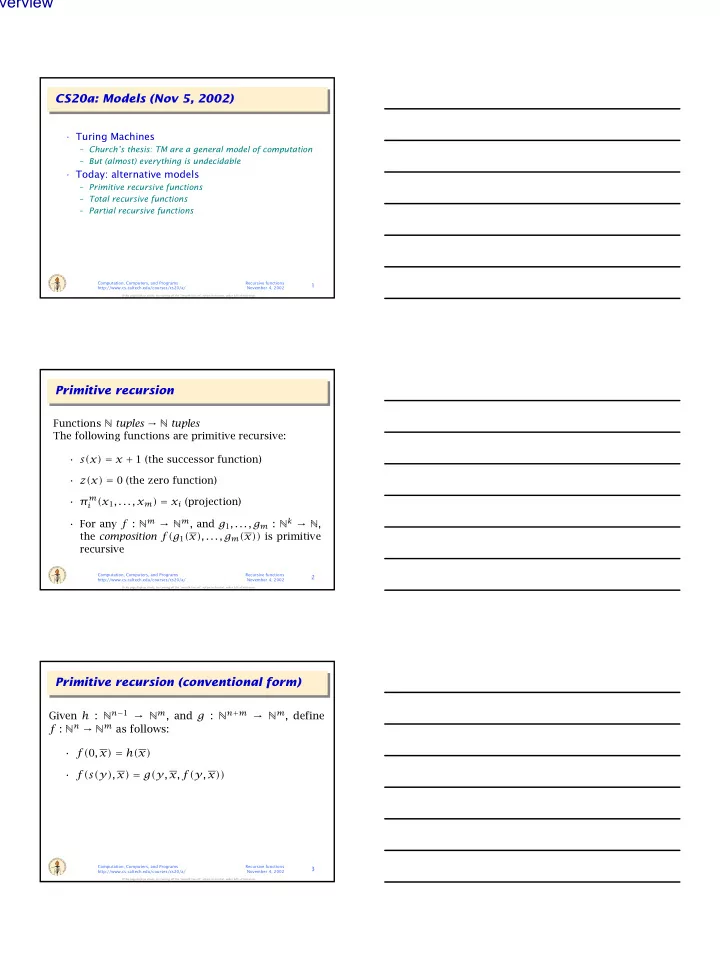
Primitive recursion

Functions N tuples → N tuples The following functions are primitive recursive:

  • s(x) = x + 1 (the successor function)
  • z(x) = 0 (the zero function)
  • π m

i (x1, . . . , xm) = xi (projection)

  • For any f : Nm → Nm, and g1, . . . , gm : Nk → N,

the composition f (g1(x), . . . , gm(x)) is primitive recursive

Computation, Computers, and Programs Recursive functions http://www.cs.caltech.edu/courses/cs20/a/ November 4, 2002

3

C A L I F O R N I A I N S T I T U T E O F T E C H N O I L O G Y If this page displays slowly, try turning off the “smooth line art” option in Acrobat, under Edit->Preferences

Primitive recursion (conventional form)

Given h : Nn−1 → Nm, and g : Nn+m → Nm, define f : Nn → Nm as follows:

  • f (0, x) = h(x)
  • f (s(y), x) = g(y, x, f (y, x))
slide-2
SLIDE 2

Overview

Computation, Computers, and Programs Recursive functions http://www.cs.caltech.edu/courses/cs20/a/ November 4, 2002

4

C A L I F O R N I A I N S T I T U T E O F T E C H N O I L O G Y If this page displays slowly, try turning off the “smooth line art” option in Acrobat, under Edit->Preferences

Arithmetic

Addition + x + y ≡ x + 1 + · · · + 1

  • y times

x + 0 = x x + s(y) = s(x + y) Multiplication ∗ xy = x + · · · + x

  • y times

x0 = x s(y) = xy + x

Computation, Computers, and Programs Recursive functions http://www.cs.caltech.edu/courses/cs20/a/ November 4, 2002

5

C A L I F O R N I A I N S T I T U T E O F T E C H N O I L O G Y If this page displays slowly, try turning off the “smooth line art” option in Acrobat, under Edit->Preferences

Exponentiation

Exponentiation xy = x · x · · · · · x

  • y times

x0 = 1 xs(y) = xy · x Hyperexponentation x ↑ y ≡ xx . . .

x

y times

x ↑ 0 = 1 x ↑ s(y) = xx↑y

Computation, Computers, and Programs Recursive functions http://www.cs.caltech.edu/courses/cs20/a/ November 4, 2002

6

C A L I F O R N I A I N S T I T U T E O F T E C H N O I L O G Y If this page displays slowly, try turning off the “smooth line art” option in Acrobat, under Edit->Preferences

Hyper-exponentation

Hyper-hyper-exponentiation x ↑↑ y ≡ x ↑ x ↑ · · · ↑ x

  • y times

x ↑↑ 0 = 1 x ↑↑ s(y) = x ↑ (x ↑↑ y)

slide-3
SLIDE 3

Overview

Computation, Computers, and Programs Recursive functions http://www.cs.caltech.edu/courses/cs20/a/ November 4, 2002

7

C A L I F O R N I A I N S T I T U T E O F T E C H N O I L O G Y If this page displays slowly, try turning off the “smooth line art” option in Acrobat, under Edit->Preferences

Ackerman’s function

A(0, x, y) = s(y) A(0, x, y) = s(y) A(1, x, y) = x + y A(1, x, 0) = x A(2, x, y) = xy A(2, x, 0) = A(n, x, 0) = 1(n ≥ 3) A(s(n), x, s(y)) = A(n, x, A(s(n), x, y)) Theorem For any fixed n, A(n, x, y) is primitive recur- sive.

Computation, Computers, and Programs Recursive functions http://www.cs.caltech.edu/courses/cs20/a/ November 4, 2002

8

C A L I F O R N I A I N S T I T U T E O F T E C H N O I L O G Y If this page displays slowly, try turning off the “smooth line art” option in Acrobat, under Edit->Preferences

Subtraction

predecessor p(0) = p(s(y)) = y subtraction x

.

− y

  • x − y

if y ≤ x

  • therwise

Algorithm: iterate predecessor on x, y times

Computation, Computers, and Programs Recursive functions http://www.cs.caltech.edu/courses/cs20/a/ November 4, 2002

9

C A L I F O R N I A I N S T I T U T E O F T E C H N O I L O G Y If this page displays slowly, try turning off the “smooth line art” option in Acrobat, under Edit->Preferences

Equality

equality |x − y| = (x

.

− y) + (y

.

− x) eq(x, y) = if x ≠ y 1 if x = y = 1

.

− |x − y| conditionals cond(x, y, z, w) = z if x = y w if x ≠ y = eq(x, y) · z + (1

.

− eq(x, y)) · w

slide-4
SLIDE 4

Overview

Computation, Computers, and Programs Recursive functions http://www.cs.caltech.edu/courses/cs20/a/ November 4, 2002

10

C A L I F O R N I A I N S T I T U T E O F T E C H N O I L O G Y If this page displays slowly, try turning off the “smooth line art” option in Acrobat, under Edit->Preferences

For-programs

  • Variables x, y, z over N
  • Simple assignments:

– x ← y – x ← s(y) – x ← 0

  • Induction: if p, q are for-programs, so are:

– p; q (sequential composition) – if x = y then p else q (conditional) – for y do p done (for-loop)

Computation, Computers, and Programs Recursive functions http://www.cs.caltech.edu/courses/cs20/a/ November 4, 2002

11

C A L I F O R N I A I N S T I T U T E O F T E C H N O I L O G Y If this page displays slowly, try turning off the “smooth line art” option in Acrobat, under Edit->Preferences

For-loop: for y do p done

  • Execute p, y times
  • Assignments to y in p do not affect the number
  • f iterations
  • for i = 1 to y do p done is equiv to

i ← 0; for y do p; i ← s(i) done

Computation, Computers, and Programs Recursive functions http://www.cs.caltech.edu/courses/cs20/a/ November 4, 2002

12

C A L I F O R N I A I N S T I T U T E O F T E C H N O I L O G Y If this page displays slowly, try turning off the “smooth line art” option in Acrobat, under Edit->Preferences

Interpretation of for-programs

  • Some variables variables are designated as input
  • Some are designated as output
  • The program defines a function Ninput

Noutput

slide-5
SLIDE 5

Overview

Computation, Computers, and Programs Recursive functions http://www.cs.caltech.edu/courses/cs20/a/ November 4, 2002

13

C A L I F O R N I A I N S T I T U T E O F T E C H N O I L O G Y If this page displays slowly, try turning off the “smooth line art” option in Acrobat, under Edit->Preferences

For programs and primitive recursion

Theorem The for-programs define exactly the primitive- recursive functions. Encoding p.r. functions with for-loops. By induction

  • n the size of the p.r. function.

f(0, x) = h(x) f (s(y), x) = g(y, x, f (y, x))

Computation, Computers, and Programs Recursive functions http://www.cs.caltech.edu/courses/cs20/a/ November 4, 2002

14

C A L I F O R N I A I N S T I T U T E O F T E C H N O I L O G Y If this page displays slowly, try turning off the “smooth line art” option in Acrobat, under Edit->Preferences

Encoding p.r. functions as for-loops

f (0, x) = h(x) f(s(y), x) = g(y, x, f (y, x)) Assume by induction that we have for-programs for g, h. Then the translation is: f (y, x) = z ← h(x); (z are new variables) i ← 0; (assume y does not appear in h, g) for y do z ← g(i, x, z); i ← s(i) done

Computation, Computers, and Programs Recursive functions http://www.cs.caltech.edu/courses/cs20/a/ November 4, 2002

15

C A L I F O R N I A I N S T I T U T E O F T E C H N O I L O G Y If this page displays slowly, try turning off the “smooth line art” option in Acrobat, under Edit->Preferences

Encoding for-loops as p.r. functions

Hard part: find a function f(y, x) =          for y do . . . body . . . done

  • By induction, we assume that there is a function

g : Nm → Nm that describes the body

  • Define: f (s(i), x) = g(f(i, x))
slide-6
SLIDE 6

Overview

Computation, Computers, and Programs Recursive functions http://www.cs.caltech.edu/courses/cs20/a/ November 4, 2002

16

C A L I F O R N I A I N S T I T U T E O F T E C H N O I L O G Y If this page displays slowly, try turning off the “smooth line art” option in Acrobat, under Edit->Preferences

Partial-recursive functions

Computation, Computers, and Programs Recursive functions http://www.cs.caltech.edu/courses/cs20/a/ November 4, 2002

17

C A L I F O R N I A I N S T I T U T E O F T E C H N O I L O G Y If this page displays slowly, try turning off the “smooth line art” option in Acrobat, under Edit->Preferences

Properties of p.r. programs

  • The programs always terminate
  • However, does not include all recursive

computations

– Can code extremely “large” functions, but some functions are not definable (Ackerman’s) – We’ll argue later that all tractable computations are primitive recursive

Computation, Computers, and Programs Recursive functions http://www.cs.caltech.edu/courses/cs20/a/ November 4, 2002

18

C A L I F O R N I A I N S T I T U T E O F T E C H N O I L O G Y If this page displays slowly, try turning off the “smooth line art” option in Acrobat, under Edit->Preferences

Partial recursive functions (Godel)

  • To capture r.e. computations, we need more
  • A partial recursive computation includes the

prim-rec computations, plus unbounded minimization

slide-7
SLIDE 7

Overview

Computation, Computers, and Programs Recursive functions http://www.cs.caltech.edu/courses/cs20/a/ November 4, 2002

19

C A L I F O R N I A I N S T I T U T E O F T E C H N O I L O G Y If this page displays slowly, try turning off the “smooth line art” option in Acrobat, under Edit->Preferences

Unbounded minimization

  • Find the least y s.t. g(x, y) = 0

f (x) = µy.g(x, y) = 0 where g is primitive recursive

  • Alternatively:

f (x) = µy.(g(x, y) = 0∧g(x, z) is defined for z ≤ y) where g does not have to be primitive recursive

Computation, Computers, and Programs Recursive functions http://www.cs.caltech.edu/courses/cs20/a/ November 4, 2002

20

C A L I F O R N I A I N S T I T U T E O F T E C H N O I L O G Y If this page displays slowly, try turning off the “smooth line art” option in Acrobat, under Edit->Preferences

While-programs

The while programs are defined inductively:

  • All for-programs are while-programs
  • Add while x ≠ y do p done, where p is a while-

program

Computation, Computers, and Programs Recursive functions http://www.cs.caltech.edu/courses/cs20/a/ November 4, 2002

21

C A L I F O R N I A I N S T I T U T E O F T E C H N O I L O G Y If this page displays slowly, try turning off the “smooth line art” option in Acrobat, under Edit->Preferences

Enumerating the partial-recursive funs Note, there is an injection {0, 1}∗ → N

  • 1. For a string w ∈ {0, 1}∗, prepend a 1
  • 2. Consider as a binary number, and subtract 1

ǫ → 1ǫ → → 10 → 1 1 → 11 → 2 00 → 100 → 3

slide-8
SLIDE 8

Overview

Computation, Computers, and Programs Recursive functions http://www.cs.caltech.edu/courses/cs20/a/ November 4, 2002

22

C A L I F O R N I A I N S T I T U T E O F T E C H N O I L O G Y If this page displays slowly, try turning off the “smooth line art” option in Acrobat, under Edit->Preferences

Indexing partial recursive funs

ϕ0, ϕ1, . . . , ϕi, . . .

  • i is called the index
  • ϕi is the function, a semantic concept

Axiom of extensionality: two functions are equal, if they are equal on all arguments. (∀x.ϕi(x) = ϕj(x)) ⇒ ϕi = ϕj

Computation, Computers, and Programs Recursive functions http://www.cs.caltech.edu/courses/cs20/a/ November 4, 2002

23

C A L I F O R N I A I N S T I T U T E O F T E C H N O I L O G Y If this page displays slowly, try turning off the “smooth line art” option in Acrobat, under Edit->Preferences

Universal functions

  • There is a universal function U(i, x) = ϕi(x),

where U = ϕj for some j

  • There is a while-program interpreter that takes

char strings, treats them as an encoding of a while program, and simulates then. Moreover, the inter- preter can be written as a while program.

Computation, Computers, and Programs Recursive functions http://www.cs.caltech.edu/courses/cs20/a/ November 4, 2002

24

C A L I F O R N I A I N S T I T U T E O F T E C H N O I L O G Y If this page displays slowly, try turning off the “smooth line art” option in Acrobat, under Edit->Preferences

Godel numbering

Gödel numbering:

  • There is a universal function U(i, x) = ϕi(x)
  • For any m, n there is a total recursive function Sm

n

(a partial recursive function defined on all inputs), s.t. for any i and x1, . . . , xn, y1, . . . , ym ϕSm

n (i,x1,...,xn)(y1, . . . , ym) = ϕi(x1, . . . , xn, y1, . . . , ym)

An indexing is acceptable iff it satisfies these two prop- erties.

slide-9
SLIDE 9

Overview

Computation, Computers, and Programs Recursive functions http://www.cs.caltech.edu/courses/cs20/a/ November 4, 2002

25

C A L I F O R N I A I N S T I T U T E O F T E C H N O I L O G Y If this page displays slowly, try turning off the “smooth line art” option in Acrobat, under Edit->Preferences

Composition

Composition is effective: (ϕi ◦ ϕj)(x) = ϕi(ϕj(x)) ϕcomp(i,j) = ϕi(ϕj(x)) = U(i, U(j, x)) = U ◦ (π3

1 , U ◦ (π3 2 , π3 3 ))(

  • i, j, x
  • )

= ϕk(

  • i, j, x
  • )

(for some k) = ϕS1

2(k,i,j)(x)

So comp(i, j) = S1

2(k, i, j)

Computation, Computers, and Programs Recursive functions http://www.cs.caltech.edu/courses/cs20/a/ November 4, 2002

26

C A L I F O R N I A I N S T I T U T E O F T E C H N O I L O G Y If this page displays slowly, try turning off the “smooth line art” option in Acrobat, under Edit->Preferences

Constant functions Constant functions: ϕconst(x) = k (for any x) = π2

1 (k, x)

= ϕl(k, x) (for some l) = ϕS1

1 (l,k)(x)

So take const = S1

1(l, k)

Computation, Computers, and Programs Recursive functions http://www.cs.caltech.edu/courses/cs20/a/ November 4, 2002

27

C A L I F O R N I A I N S T I T U T E O F T E C H N O I L O G Y If this page displays slowly, try turning off the “smooth line art” option in Acrobat, under Edit->Preferences

Recursion theorem

Theorem (Fixed-point theorem) For all total recursive functions f : N → N, there is an index i s.t. ϕi = ϕf (i). Proof Take any v ∈ N, and consider a recursive function that does the following on x:

  • 1. Compute ϕv(v)
  • 2. If it halts, apply f to get f (ϕv(v))
  • 3. Use it as an index: compute ϕf (ϕv(v))(x)
slide-10
SLIDE 10

Overview

Computation, Computers, and Programs Recursive functions http://www.cs.caltech.edu/courses/cs20/a/ November 4, 2002

28

C A L I F O R N I A I N S T I T U T E O F T E C H N O I L O G Y If this page displays slowly, try turning off the “smooth line art” option in Acrobat, under Edit->Preferences

Recursion theorem proof (cont.)

  • 3. Use it as an index: compute ϕf(ϕv(v))(x)
  • 4. There is a total recursive function h : N → N s.t.

ϕh(v)(x) = ϕf(ϕv(v)(x)

  • 5. Since h is total, it has an index h = ϕu

ϕh(u) = ϕϕu(u) = ϕf (ϕu(u))

  • 6. So ϕu(u) is a fixed-point of f .
Computation, Computers, and Programs Recursive functions http://www.cs.caltech.edu/courses/cs20/a/ November 4, 2002

29

C A L I F O R N I A I N S T I T U T E O F T E C H N O I L O G Y If this page displays slowly, try turning off the “smooth line art” option in Acrobat, under Edit->Preferences

Rice’s theorem

Theorem (Rice's theorem) Every non-trivial property of the partial recursive func- tions is undecidable. That is, there is no total recursive function p : N → {0, 1} s.t.

  • p(k) ≠ p(l)
  • For any i, j, if ϕi = ϕj, then p(i) = p(j)

Proof Suppose p exists. Define f(i) = k if p(i) = p(l) l if p(i) = p(k) f is total, and it has no fixpoint.