Overview Extremely over-simplified view of graphics (60 min) IMGD - - PDF document

overview
SMART_READER_LITE
LIVE PREVIEW

Overview Extremely over-simplified view of graphics (60 min) IMGD - - PDF document

Overview Extremely over-simplified view of graphics (60 min) IMGD 3000: Basic Computer Graphics Purpose of Computer Graphics in a Game Engine Representations of Data William DiSanto Geometry Light Computer Science Dept.


slide-1
SLIDE 1
  • IMGD 3000: Basic Computer Graphics

William DiSanto

Computer Science Dept. Worcester Polytechnic Institute (WPI)

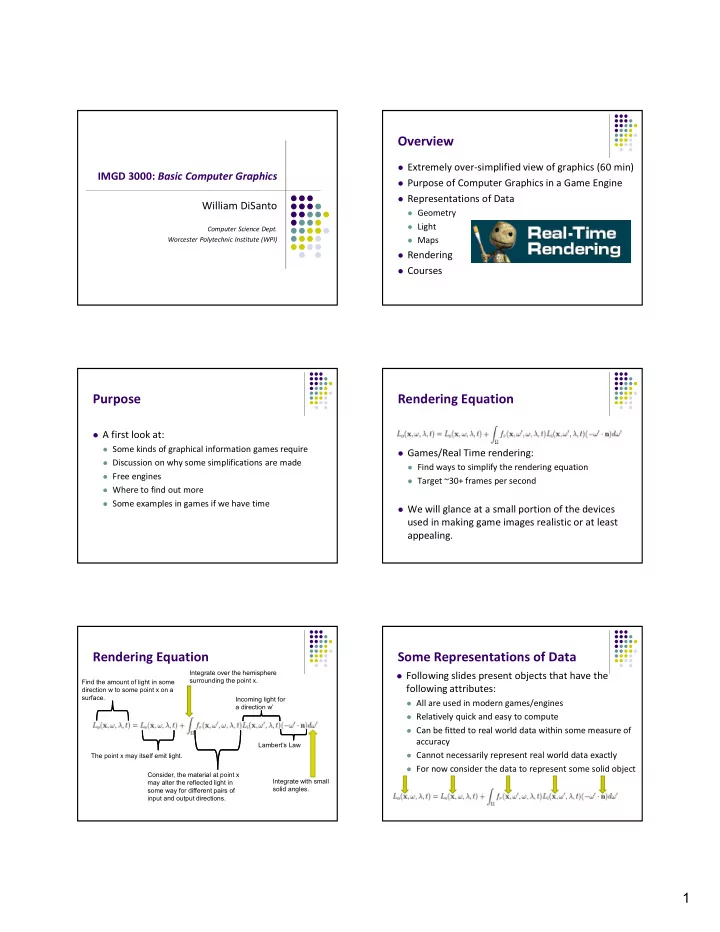
Overview

Extremely over-simplified view of graphics (60 min) Purpose of Computer Graphics in a Game Engine Representations of Data

Geometry Light Maps

Rendering Courses

Purpose

A first look at:

Some kinds of graphical information games require Discussion on why some simplifications are made Free engines Where to find out more Some examples in games if we have time

Rendering Equation

Games/Real Time rendering:

Find ways to simplify the rendering equation Target ~30+ frames per second

We will glance at a small portion of the devices

used in making game images realistic or at least appealing.

Rendering Equation

  • Some Representations of Data

Following slides present objects that have the

following attributes:

All are used in modern games/engines Relatively quick and easy to compute Can be fitted to real world data within some measure of

accuracy

Cannot necessarily represent real world data exactly For now consider the data to represent some solid object

slide-2
SLIDE 2

! Exact

Use equations, parametric functions, etc. Can be evaluated at arbitrary degree of accuracy

Remember that your graphics card has limited accuracy

Mesh

Mesh: connected set of vertices Maintained as lists of connections and vertex locations Compact and malleable Used to establish boundaries in the game world

Subdivision Surface

Insert new vertices and smooth

Spline

Splines: interpolate around a set of control points Defined parametrically

NURBS / B-Spline

NURBS/B-Splines

Local Editing Transform Invariant Control over continuity Well defined derivatives, normals, position Some editing techniques are expensive Can represent conics The NURBS Book

NURBS / B-Spline

slide-3
SLIDE 3

" Frequency

Decompose data into collection of equivalent

scaled/modified basis functions

Performance gain for certain operations Expensive to represent high detail objects

Radial Basis Function

Decompose data into collection of equivalent

scaled/modified basis functions at different centers

Inexpensive Can model solid objects, dense objects, fog like media

Density Grid

Density data contained in a 3D grid Many ways to render #$%#

Light Models

Different ways of representing light sources of different

shape and distance from rendering area.

Shape can be defined with previously mentioned

representations

Simplified model of light used to allow faster rendering

Measure of Energy Light

Typical Simplifying Assumptions:

Unpolorized Sample few wavelengths Speed is not considered (considered with refraction) Other assumptions where appropriate

slide-4
SLIDE 4

& Propagation of Light

Rays of light will reflect and refract depending on the

nature of the object they hit

More rays produced, each go on to reflect and refract

  • ff other surfaces

Too expensive: reduce number of bounces

Spot + Directional

Light originates at a point or a infinite plane and moves

in a direction (all rays in directional case are parallel)

'$%#()#

Area Lighting

Light originates from many locations on a surface Many surfaces too complicated to integrate directly Sample or average to increase frame rate

Environment Lighting

Light originates from many locations on a surface Many surfaces too complicated to integrate directly Sample or average to increase frame rate

Mappings

OpenGL DirectX support 2D + 3D textures Textures can be used to map information to other

  • bjects in ways that can improve rendering efficiency.

Require the mapped-to object to store map coordinates

They can be viewed as objects themselves:

Vertex/index data can be written to texture Can be used as flat sprites 3D textures as voxel grids (density/opacity) Can model any part of the rendering function

Color Texturing

Set or modify the color of an object Map pixels in texture to surface of triangles

slide-5
SLIDE 5

* Bump/Normal Mapping

Set or modify the normal of an object

Shadow/RSM

Render scene from perspective of light source Use pixels to indicate regions that receive light or

generate indirect illumination

Transformations

Matrix transformation of:

Control Points Vertices, Normals, directions Centers Other matrix transforms

Rotate, Scale, Translate,

Project, …

Animation

An area of study in its own right.

Important to CG since animation transformations may

take place on the graphics hardware

We will ignore that animations: Can collide Have mass and acceleration Limited degrees of translational and rotational freedom Etc.

Forward Kinematic

Compute orientations of the armature

from the root of the chain to the effector.

http://demonstrations.wolfram.com/ForwardKinematics/

Inverse Kinematic

Compute orientations of the armature

from the effector to the root Many solutions

http://demonstrations.wolfram.com/InverseKinematics/

slide-6
SLIDE 6

+ Projection: Perspective/Ortho

  • Sample the world with rays from the camera

Rendering

Sample the world over a given interval

Select w rays along which light energy is integrated Combine observations together with other effects

Camera lenses distortion Focus/blur Pretty much anything from image processing

Graphics Pipeline

Broken into stages: some controlled by shader programs

Free Engines

Ogre Unity (to some degree) Blender

Miscellaneous

Real time graphics is becoming increasingly

influenced by physical models

Most convincing renders are computed with

information taken from experiment

Graphics hardware has progressed to the point were

some ray-trace scenes are realizable with at least interactive frame rates

CryENGINE: LPV, SSAO

slide-7
SLIDE 7

, What was Missed?

How to do any of these things How to do them in an efficient manner How to program with OpenGL or DirectX How to program shaders Any ray casting techniques A whole lot more…

Graphics Oriented Classes

CS 4731 Computer Graphics CS 545 Digital Image Processing CS 549 Computer Vision CS 563 Advanced Computer Graphics

Courses will generally focus on aspects graphics itself rather

than graphics as it applies to games in particular.

References

Wan, L., Wong, T.‐T., and Leung, C.‐S. (2007).

Isocube: Exploiting the Cubemap Hardware. IEEE Transactions on Visualization and Computer Graphics, 13(4):720–731.

Michael Kazhdan , Thomas Funkhouser , Szymon

Rusinkiewicz, Rotation invariant spherical harmonic representation of 3D shape descriptors, Proceedings

  • f the 2003 Eurographics/ACM SIGGRAPH

symposium on Geometry processing, June 23‐25, 2003, Aachen, Germany

References

Carsten Dachsbacher , Jan Kautz, Real‐time global

illumination for dynamic scenes, ACM SIGGRAPH 2009 Courses, p.1‐217, August 03‐07, 2009, New Orleans, Louisiana

http://en.wikipedia.org/wiki/Inertial_frame_of_refere

nce (figure of reference frames)

https://developer.apple.com/library/mac/#document

ation/graphicsimaging/conceptual/OpenGL- MacProgGuide/opengl_shaders/opengl_shaders.html (shader pipeline image)

References

Kaplanyan, A. (2009). Light propagation volumes in

cryengine 3.

The CG Tutorial

by Randima Fernando and Mark J. Kilgard

Physically Based Ray Tracing

by Matt Pharr and Greg Humphreys

Real Time Rendering

By Tomas Akenine‐Möller, Eric Haines and Naty Hoffman