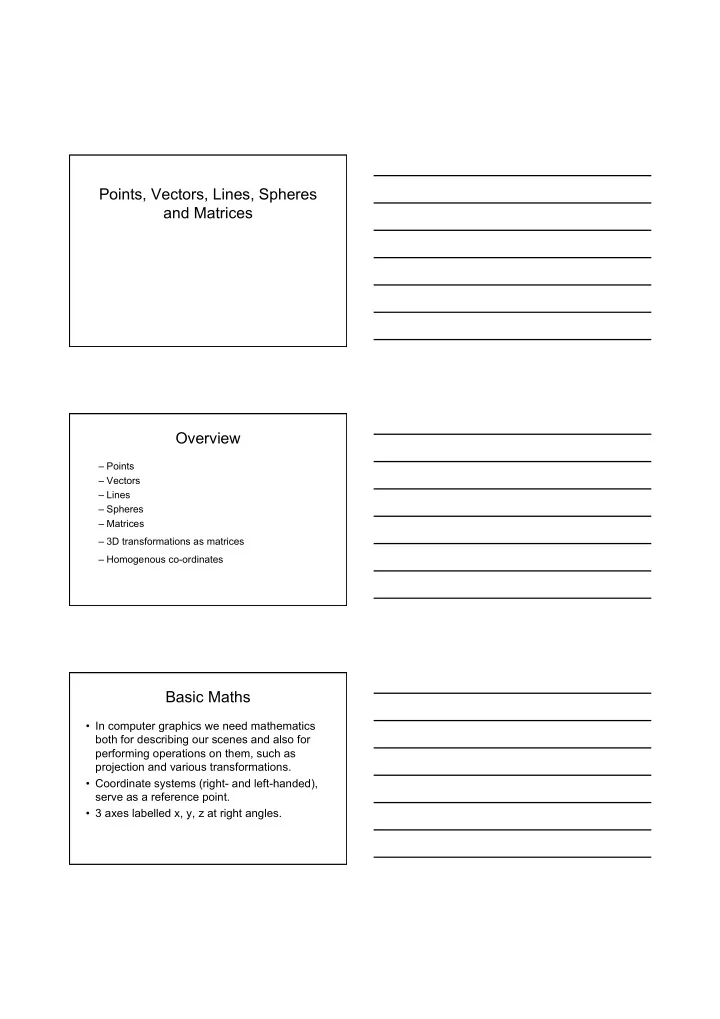
Overview Points Vectors Lines Spheres Matrices 3D - - PDF document

overview
SMART_READER_LITE
LIVE PREVIEW

Overview Points Vectors Lines Spheres Matrices 3D - - PDF document

Points, Vectors, Lines, Spheres and Matrices Overview Points Vectors Lines Spheres Matrices 3D transformations as matrices Homogenous co-ordinates Basic Maths In computer graphics we need mathematics both for


slide-1
SLIDE 1

Points, Vectors, Lines, Spheres and Matrices

– Points – Vectors – Lines – Spheres – Matrices – 3D transformations as matrices – Homogenous co-ordinates

Overview Basic Maths

  • In computer graphics we need mathematics

both for describing our scenes and also for performing operations on them, such as projection and various transformations.

  • Coordinate systems (right- and left-handed),

serve as a reference point.

  • 3 axes labelled x, y, z at right angles.
slide-2
SLIDE 2

Co-ordinate Systems

X Y Z Right-Handed System (Z comes out of the screen) X Y Z Left-Handed System (Z goes in to the screen)

Points, P (x, y, z)

  • Gives us a position in relation to the origin of
  • ur coordinate system

Vectors, V (x, y, z)

  • Represent a direction (and magnitude) in 3D

space

  • Points != Vectors

Vector +Vector = Vector Point – Point = Vector Point + Vector = Point Point + Point = ?

slide-3
SLIDE 3

Vectors, V (x, y, z)

v w v + w Vector addition sum v + w v 2v (-1)v (1/2)V Scalar multiplication of vectors (they remain parallel) v w Vector difference v - w = v + (-w) v

  • w

v - w x y Vector OP P O

Vectors V

  • Length (modulus) of a vector V (x, y, z)

|V| =

  • A unit vector: a vector can be normalised such

that it retains its direction, but is scaled to have unit length:

2 2 2

z y x + +

| | V

  • f

modulus V vector

^

V V

V

= =

Dot Product

u · v = xu ·xv + yu ·yv + zu ·zv u · v = |u| |v| cosθ ∴cosθ = u · v/ |u| |v|

  • This is purely a scalar number not a vector.
  • What happens when the vectors are unit
  • What does it mean if dot product == 0 or == 1?
slide-4
SLIDE 4

Cross Product

  • The result is not a scalar but a vector which is

normal to the plane of the other 2

  • Can be computed using the determinant of:

u x v = i(yuzv -zuyv), -j(xuzv - zuxv), k(xuyv - yuxv)

  • Size is |u x v| = |u||v|sinθ
  • Cross product of vector with itself is null

v v v u u u

z y x z y x k j i

v v v u u u

z y x z y x k j i

v v v u u u

z y x z y x k j i

v v v u u u

z y x z y x k j i

Parametric equation of a line (ray)

Given two points P0 = (x0, y0, z0) and P1 = (x1, y1, z1) the line passing through them can be expressed as:

P(t) = P0 + t(P1 - P0) x(t) = x0 + t(x1 - x0) y(t) = y0 + t(y1 - y0) z(t) = z0 + t(z1 - z0) = With - ∞ < t < ∞

Equation of a sphere

a b c hypotenuse a2 + b2 = c2 P

xp yp

(0, 0)

r x2 + y2 = r2

  • Pythagoras Theorem:
  • Given a circle through

the origin with radius r, then for any point P on it we have:

slide-5
SLIDE 5

Equation of a sphere

* If the circle is not centred on the origin:

(0, 0)

P

xp yp

r

xc yc

a b a b a2 + b2 = r2 We still have but a = xp- xc b = yp- yc So for the general case

(x- xc)2 + (y- yc)2 = r2 (xp,yp) (xc,yc)

Equation of a sphere

* Pythagoras theorem generalises to 3D giving a2 + b2 + c2 = d2 Based on that we can easily prove that the general equation of a sphere is:

(x- xc)2 + (y- yc)2 + (z- zc)2 = r2

and at origin: x2 + y2 + z2 = r2

Matrix Math

slide-6
SLIDE 6

Vectors and Matrices

  • Matrix is an array of numbers with

dimensions M (rows) by N (columns)

– 3 by 6 matrix – element 2,3 is (3)

  • Vector can be considered a 1 x M

matrix

Types of Matrix

  • Identity matrices - I
  • Diagonal
  • Symmetric

– Diagonal matrices are (of course) symmetric – Identity matrices are (of course) diagonal

Operation on Matrices

  • Addition

– Done elementwise

  • Transpose

– “Flip” (M by N becomes N by M)

slide-7
SLIDE 7

Operations on Matrices

  • Multiplication

– Only possible to multiply of dimensions

  • m1 by n1 and m2 by n2 iff n1 = m2

– resulting matrix is m1 by n2

  • e.g. Matrix A is 2 by 3 and Matrix by 3 by 4

– resulting matrix is 2 by 4

  • Just because A x B is possible doesn’t mean B x A is

possible!

Matrix Multiplication Order

  • A is m by k , B is k by n
  • C = A x B defined by
  • BxA not necessarily

equal to AxB

Example Multiplications

slide-8
SLIDE 8

Inverse

  • If A x B = I and B x A = I then

A = B-1 and B = A-1

3D Transforms

  • In 3-space vectors are transformed by 3 by 3

matrices

Scale

  • Scale uses a diagonal matrix
  • Scale by 2 along x and -2 along z
slide-9
SLIDE 9
  • Rotation about z axis
  • Note z values remain the same whilst x and y change

Rotation

Y X

        1

θ

cos sin

  • sin

θ

cos

( )

y.cos x.sin , y.sin

  • x.cos

+

θ θ

θ θ θ θ

θ

Rotation X, Y and Scale

  • About X
  • About Y
  • Scale (should look

familiar)

          cos sin

  • sin

cos 1         cos sin 1 sin

  • cos

θ θ θ θ θ θ θ θ

Homogenous Points

  • Add 1D, but constrain that to be equal to 1 (x,y,z,1)
  • Homogeneity means that any point in 3-space can

be represented by an infinite variety of homogenous 4D points

– (2 3 4 1) = (4 6 8 2) = (3 4.5 6 1.5)

  • Why?

– 4D allows us to include 3D translation in matrix form

slide-10
SLIDE 10

Homogenous Vectors

  • Vectors != Points
  • Remember points can not be added
  • If A and B are points A-B is a vector
  • Vectors have form (x y z 1)
  • Addition makes sense

Translation in Homogenous Form

  • Note that the homogenous component is

preserved (* * * 1), and aside from the translation the matrix is I

Putting it Together

  • R is rotation and scale components
  • T is translation component
slide-11
SLIDE 11

Order Matters

  • Composition order of transforms matters

– Remember that basic vectors change so “direction” of translations changed

Exercises

  • Calculate the following matrix: Π/2 about X then Π/2

about Y then Π/2 about Z (remember “then” means multiply on the right). What is a simpler form of this matrix?

  • Compose the following matrix: translate 2 along X,

rotate Π/2 about Y, translate -2 along X. Draw a figure with a few points (you will only need 2D) and then its translation under this transformation.

Matrix Summary

  • Rotation, Scale, Translation
  • Composition of transforms
  • The homogenous form