Overview & Natural Language Processing: Natural Synergies to - - PDF document

overview
SMART_READER_LITE
LIVE PREVIEW

Overview & Natural Language Processing: Natural Synergies to - - PDF document

7/3/2016 Bibliometrics, Information Retrieval Overview & Natural Language Processing: Natural Synergies to Support Digital Information Library Research Bibliometrics Retrieval (IR) Dietmar Wolfram NLP & Other University of


slide-1
SLIDE 1

7/3/2016 1 Bibliometrics, Information Retrieval & Natural Language Processing:

Natural Synergies to Support Digital Library Research

Dietmar Wolfram University of Wisconsin-Milwaukee

BIRNDL 2016

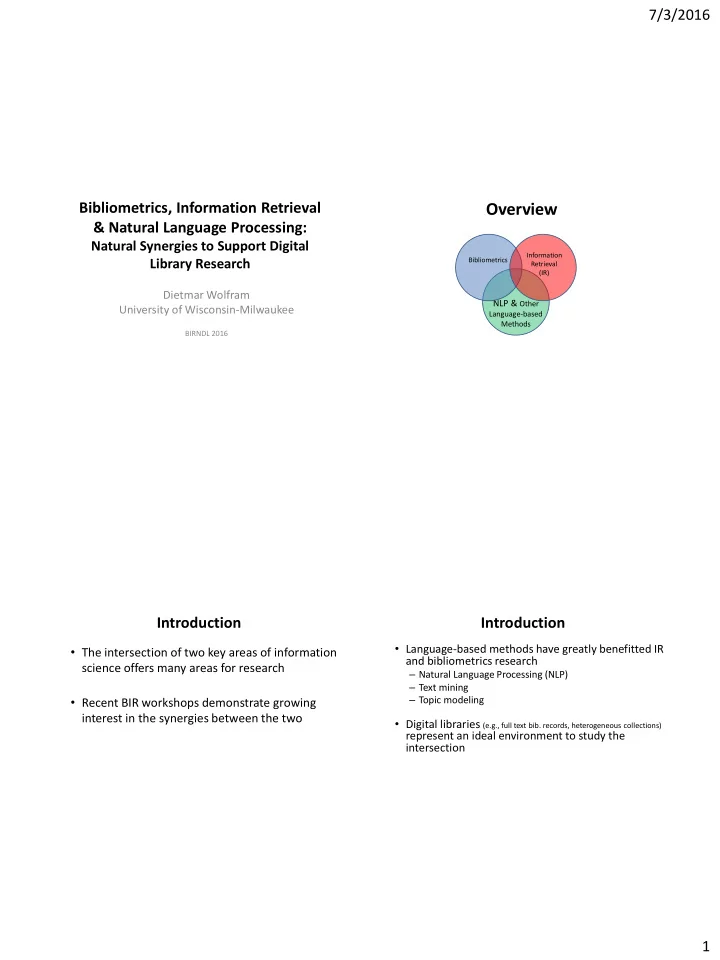
Overview

NLP & Other

Language-based Methods

Bibliometrics Information Retrieval (IR)

Introduction

  • The intersection of two key areas of information

science offers many areas for research

  • Recent BIR workshops demonstrate growing

interest in the synergies between the two

Introduction

  • Language-based methods have greatly benefitted IR

and bibliometrics research

– Natural Language Processing (NLP) – Text mining – Topic modeling

  • Digital libraries (e.g., full text bib. records, heterogeneous collections)

represent an ideal environment to study the intersection

slide-2
SLIDE 2

7/3/2016 2

Language-based Methods & IR

  • Beneficial for
  • 1. Content representation (NLP)
  • 2. Contending with large datasets & higher

computational overhead (latent semantic analysis, topic

modeling)

  • 3. More intuitive interface for users (NLP)

Language-based Methods & -metrics Research

  • Citations & collaborations form the foundation of

traditional comparative analysis

  • Downside: No link  No relationship
  • Language can expand relationship possibilities
  • Term co-occurrence
  • Topic modeling
  • Identifying hidden patterns with text mining

Bibliometrics Information Retrieval Bibliometrics Information Retrieval

slide-3
SLIDE 3

7/3/2016 3

Areas of Application

  • Modeling IR processes

– System indexing & retrieval – IR system simulation

  • IR & allied system design & evaluation

– Using graph-based approaches / link analysis (co-authorship,

citations, hyperlinks)

  • Ranking results
  • Supporting browsing & expanding results

Adapted from Wolfram, D. (2003). Applied informetrics for information retrieval research. Westport, CT: Libraries Unlimited.

IR Processes & Associated Data

IR System Content Regularities

  • Units: words/terms, fields, links, documents
  • Indexing exhaustivity/specificity distributions
  • Term co-occurrence relationships
  • Growth of indexes and databases
  • Persistence of documents

Observed Patterns in Content & Use Frequency

0.1 0.2 0.3 0.4 0.5 0.6 0.7 0.8 10 20 30

Size Probability

“Zipfian” or “Lotkaian” (Power Law) Mode = 1, sometimes 0 “Unimodal” Mode > 1

0.02 0.04 0.06 0.08 0.1 0.12 0.14 10 20 30

Size Probability

slide-4
SLIDE 4

7/3/2016 4

Effects of Indexing Decisions on Document Spaces

Wolfram, D., & Zhang, J. (2008). The influence of indexing practices and term weighting algorithms on document spaces. Journal of the American Society for Information Science and Technology, 59(1), 3-11.

IR System Usage

  • Content Use

– Website visitation – Document requests

  • User search characteristics

– Terms – Queries – Sessions (search and browsing actions)

Relationship Between Resources and Usage

User Population

(Requestors)

IP Address 1 IP Address 2 IP Address 3 Document A Document B Document C

Site Visitations Resource Requests

Resource Provider

Ajiferuke, I., Wolfram, D., & Xie, H. (2004). Modelling website visitation and resource usage characteristics by IP address data. In H. Julien & S. Thompson (Eds.) CAIS/ACSI 2004 - Access to Information: Technologies, Skills, and Socio-Political Context.

Search Action Relationships

Han, H.J., Joo, S., & Wolfram, D. (2014). Using transaction logs to better understand user search session patterns in an image-based digital library. Journal of the Korean Biblia Society for Library and Information Science.

slide-5
SLIDE 5

7/3/2016 5

Linking Citing & Cited Documents Ranking Documents

  • HITS (Kleinberg, 1997)
  • PageRank (Page et al., 1999)
  • Hw-rank (Bar-Ilan & Levene, 2015)
  • Bradfordizing & author centrality (Mutschke & Mayr, 2015)
  • Article-level Eigenfactor (Wesley-Smith, Bergstrom, & West, 2016)

Bibliometrics Information Retrieval

Reciprocal Contributions

  • With growing datasets, new ways to store, process and

display data are needed

  • IR frameworks provide tools & approaches for -metrics

researchers

– Database design for bibliographic datasets

  • Relational & graph-based DBMSs, IR software & toolkits

– Application of vector space & probabilistic IR models to compare data

slide-6
SLIDE 6

7/3/2016 6 Some Examples

  • White (2007) – applied IR measures of term weighting

(tf*idf) to bibliometric data

  • Applications of Web link analysis

– Research by Thelwall, Vaughan (many examples) – Use of PageRank for bibliometric ranking

PageRank Comes Full Circle

Using Language-based Relationships to Complement Link-based Relationships

Language expands studied relationships

  • 1. Co-word analysis / Term co-occurrence
  • 2. Topic modeling
  • 3. Text mining

1) Co-word Analysis

  • Longstanding use in metrics research

(e.g., Braam & Moed, 1991; Ding, Chowdhury & Foo, 1997)

  • Simple to use
  • Independence assumption limitations
  • IR matching methods can be used
slide-7
SLIDE 7

7/3/2016 7

2) Topic Modeling

  • Applications of topic modeling

– Tang et al. (2008) – applied Latent Dirichlet Allocation to

academic search

– Lu & Wolfram (2012) – compared author research

similarity using topic modeling, co-authorship & co-citation

– Ding & Song (2014) – measuring scholarly impact

Author-Topic Modeling for Author Research Relatedness

An A-T model produced more coherent groupings

  • f prolific authors in

information science than co-citation analysis

Lu, K., & Wolfram, D. (2012). Measuring author research relatedness: A comparison of word- based, topic-based and author co-citation

  • approaches. Journal of the American Society for

Information Science and Technology, 63(10), 1973- 1986.

3) Text Mining

  • Can be combined with bibliometric methods

– Citation mining for user research profiling (Kostoff et al., 2001) – Clustering of scientific fields (Janssens, 2007) – Knowledge structure of bioinformatics (Song & Kim, 2013)

  • Text mining techniques are integrated into some

bibliometric mapping software, including

– VOSviewer - http://www.vosviewer.com/ – CiteSpace - http://cluster.cis.drexel.edu/~cchen/citespace/

Bibliometric-Enhanced Prototype & System Examples

  • I3R (Croft & Thompson, 1987)
  • Bibliometric Information Retrieval System (BIRS)

(Ding et al., 2001)

  • BibNetMiner (Sun et al., 2007)
  • Aminer (Tang et al., 2008)
  • Ariadne context explorer (Koopman et al., 2015)
slide-8
SLIDE 8

7/3/2016 8

Aminer

Search results based on bibliometric networks (aminer.org)

Ariadne

DIGITAL HUMANITIES

Related words [humanities scholars] [humanities computing] Related ISSN [issn:0268-1145| journal of the Association for Literary and Linguistic Computing.] Related persons [author:warwick claire] [author:cantara linda] [author:schreibman susan] [author:rimmer jon] [author:warwick c Related DDC [dewey:022] [dewey:829][dewey:429] [dewey:011]

Future Directions

  • Complexities of bibliometric datasets lend themselves to IR

techniques

– Resulting “big data” require data and text processing or mining techniques to identify overt & hidden patterns

  • Topic modeling and other text-based methods show great

promise in providing complementary approaches to citation & co-authorship data

– Computational overhead to train models is still high

  • Need for better evaluation methods for visualization
  • utcomes

For More Information

  • BIR Workshop Proceedings

– 2014 - Mayr, Scharnhorst, Larsen, Schaer, & Mutschke – 2015 - Mayr, Frommholz, Scharnhorst, & Mutschke – 2016 - Mayr, Frommholz, & Cabanac

  • Wolfram, D. (2015). The symbiotic relationship between information

retrieval and informetrics. Scientometrics, 102(3), 2201-2214.

  • Ding, Y., Rousseau, R., & Wolfram, D. (Eds.). (2014). Measuring

scholarly impact: Methods and practice. Berlin: Springer.

  • Wolfram, D. (2003). Applied informetrics for information retrieval
  • research. Libraries Unlimited.