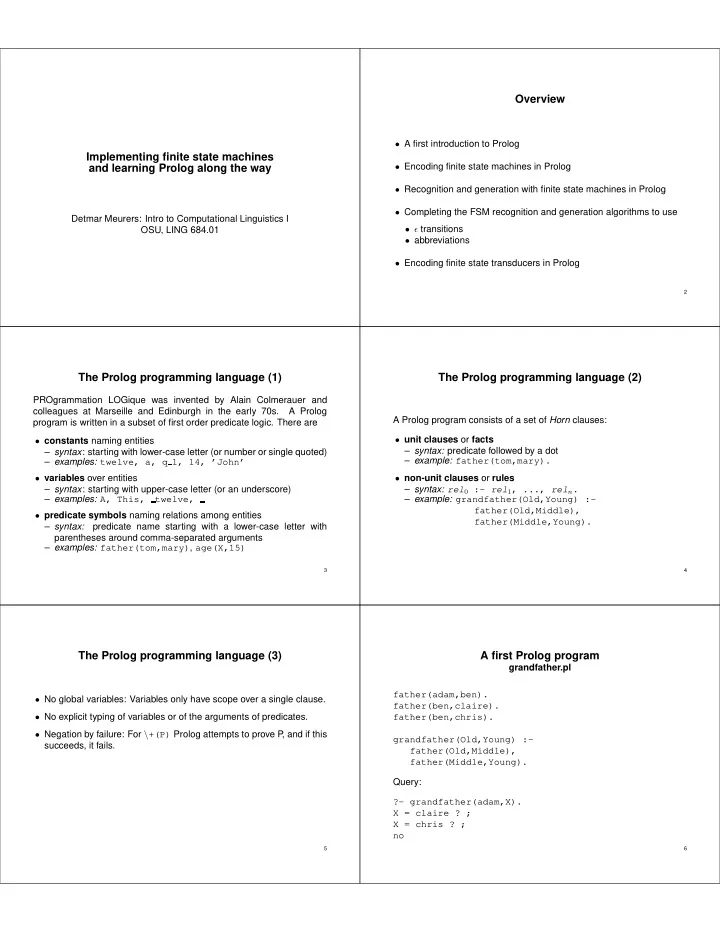
Overview A first introduction to Prolog Implementing finite state - - PDF document

overview
SMART_READER_LITE
LIVE PREVIEW

Overview A first introduction to Prolog Implementing finite state - - PDF document

Overview A first introduction to Prolog Implementing finite state machines and learning Prolog along the way Encoding finite state machines in Prolog Recognition and generation with finite state machines in Prolog Completing the


slide-1
SLIDE 1

Implementing finite state machines and learning Prolog along the way

Detmar Meurers: Intro to Computational Linguistics I OSU, LING 684.01

Overview

  • A first introduction to Prolog
  • Encoding finite state machines in Prolog
  • Recognition and generation with finite state machines in Prolog
  • Completing the FSM recognition and generation algorithms to use
  • ǫ transitions
  • abbreviations
  • Encoding finite state transducers in Prolog

2

The Prolog programming language (1)

PROgrammation LOGique was invented by Alain Colmerauer and colleagues at Marseille and Edinburgh in the early 70s. A Prolog program is written in a subset of first order predicate logic. There are

  • constants naming entities

– syntax: starting with lower-case letter (or number or single quoted) – examples: twelve, a, q 1, 14, ’John’

  • variables over entities

– syntax: starting with upper-case letter (or an underscore) – examples: A, This, twelve,

  • predicate symbols naming relations among entities

– syntax: predicate name starting with a lower-case letter with parentheses around comma-separated arguments – examples: father(tom,mary), age(X,15)

3

The Prolog programming language (2)

A Prolog program consists of a set of Horn clauses:

  • unit clauses or facts

– syntax: predicate followed by a dot – example: father(tom,mary).

  • non-unit clauses or rules

– syntax: rel0 :- rel1, ..., reln. – example: grandfather(Old,Young) :- father(Old,Middle), father(Middle,Young).

4

The Prolog programming language (3)

  • No global variables: Variables only have scope over a single clause.
  • No explicit typing of variables or of the arguments of predicates.
  • Negation by failure: For \+(P) Prolog attempts to prove P

, and if this succeeds, it fails.

5

A first Prolog program

grandfather.pl father(adam,ben). father(ben,claire). father(ben,chris). grandfather(Old,Young) :- father(Old,Middle), father(Middle,Young). Query: ?- grandfather(adam,X). X = claire ? ; X = chris ? ; no

6

slide-2
SLIDE 2

Recursive relations in Prolog

Compound terms as data structures To define recursive relations, one needs a richer data structure than the constants (atoms) introduced so far: compound terms. A compound term comprises a functor and a sequence of one or more terms, the argument.1 Compound terms are standardly written in prefix notation.2 Example: – binary tree: bin tree(mother, l-dtr, r-dtr) – example: bin tree(s, np, bin tree(vp,v,n))

1An atom can be thought of as a functor with arity 0. 2Infix and postfix operators can also be defined, but need to be declared. 7

Recursive relations in Prolog

Lists as special compound terms

  • empty list: represented by the atom ”[]”
  • non-empty list: compound term with ”.” as binary functor

– first argument: first element of list (“head”) – second argument: rest of list (“tail”) Example: .(a, .(b, .(c, .(d,[]))))

8

Abbreviating notations for lists

  • bracket notation: [ element1 | restlist ]

Example: [a | [b | [c | [d | []]]]]

  • element separator: [ element1 , element2 ]

= [ element1 | [ element2 | []]] Example: [a, b, c, d]

9

An example for the four notations

[a,b,c,d] = .(a, .(b, .(c, .(d,[])))) = [a | [b | [c | [d | []]]]] = a b c d [] . . . .

10

Recursive relations in Prolog

Example relations I: append

  • Idea: a relation concatenating two lists
  • Example: ?- append([a,b,c],[d,e],X). ⇒ X=[a,b,c,d,e]

append([],L,L). append([H|T],L,[H|R]) :- append(T,L,R).

11

Recursive relations in Prolog

Example relations IIa: (naive) reverse

  • Idea: reverse a list
  • Example: ?- reverse([a,b,c],X). ⇒ X=[c,b,a]

naive_reverse([],[]). naive_reverse([H|T],Result) :- naive_reverse(T,Aux), append(Aux,[H],Result).

12

slide-3
SLIDE 3

Recursive relations in Prolog

Example relations IIb: reverse reverse(A,B) :- reverse_aux(A,[],B). reverse_aux([],L,L). reverse_aux([H|T],L,Result) :- reverse_aux(T,[H|L],Result).

13

Some practical matters

  • To start Prolog on the Linguistics Department Unix machines:
  • SWI-Prolog: pl (on Mac OSX: swipl)
  • SICStus: prolog or M-x run-prolog in XEmacs
  • At the Prolog prompt (?-):
  • Trace the next command: trace.
  • Exit Prolog: halt.
  • Consult a file in Prolog: [filename].3
  • The manuals are accessible from the course web page.

3The .pl suffix is added automatically, but use single quotes if name starts with a capital letter or

contains special characters such as ”.” or ”–”. For example [’MyGrammar’]. or [’˜/file-1’].

14

Encoding finite state automata in Prolog

What needs to be represented? A finite state automaton is a quintuple (Q, Σ, E, S, F) with

  • Q a finite set of states
  • Σ a finite set of symbols, the alphabet
  • S ⊆ Q the set of start states
  • F ⊆ Q the set of final states
  • E a set of edges Q × (Σ ∪ {ǫ}) × Q

15

Prolog representation of a finite state automaton

The FSA is represented by the following kind of Prolog facts:

  • initial nodes: initial(nodename).
  • final nodes: final(nodename).
  • edges: arc(from-node, label, to-node).

16

A simple example

FSTN representation of FSM: 1 2 3 4 5 6 c r u r

  • l
  • Prolog encoding of FSM:

initial(0). final(1). arc(0,c,6). arc(6,o,5). arc(5,l,4). arc(4,o,2). arc(2,r,1). arc(2,u,3). arc(3,r,1).

17

An example with two final states

FSTN representation of FSM: 1 2 3 c a d b Prolog encoding of FSM: initial(0). final(1). final(2). arc(0,c,1). arc(1,d,1). arc(0,a,3). arc(3,b,2).

18

slide-4
SLIDE 4

Recognition with FSMs in Prolog

fstn traversal basic.pl test(Words) :- initial(Node), recognize(Node,Words). recognize(Node,[]) :- final(Node). recognize(FromNode,String) :- arc(FromNode,Label,ToNode), traverse(Label,String,NewString), recognize(ToNode,NewString). traverse(First,[First|Rest],Rest).

19

Generation with FSMs in Prolog

generate :- test(X), write(X), nl, fail.

20

Encoding finite state transducers in Prolog What needs to be represented?

A finite state transducer is a 6-tuple (Q, Σ1, Σ2, E, S, F) with

  • Q a finite set of states
  • Σ1 a finite set of symbols, the input alphabet
  • Σ2 a finite set of symbols, the output alphabet
  • S ⊆ Q the set of start states
  • F ⊆ Q the set of final states
  • E a set of edges Q × (Σ1 ∪ {ǫ}) × Q × (Σ2 ∪ {ǫ})

21

Prolog representation of a transducer

The only change compared to automata, is an additional argument in the representation of the arcs: arc(from-node, label-in, to-node, label-out). Example:

initial(1). final(5). arc(1,2,where,ou). arc(2,3,is,est). arc(3,4,the,la). arc(4,5,exit,sortie). arc(4,5,shop,boutique). arc(4,5,toilet,toilette). arc(3,6,the,le). arc(6,5,policeman,gendarme).

22

Processing with a finite state transducer

test(Input,Output) :- initial(Node), transduce(Node,Input,Output), write(Output),nl. transduce(Node,[],[]) :- final(Node). transduce(Node1,String1,String2) :- arc(Node1,Node2,Label1,Label2), traverse2(Label1,Label2,String1,NewString1, String2,NewString2), transduce(Node2,NewString1,NewString2). traverse2(Word1,Word2,[Word1|RestString1],RestString1, [Word2|RestString2],RestString2).

23

FSMs with ǫ transitions and abbreviations

Defining Prolog representations

  • 1. Decide on a symbol to use to mark ǫ transitions: ’#’
  • 2. Define abbreviations for labels:

macro(Label,Word).

  • 3. Define a relation special/1 to recognize abbreviations and epsilon

transitions: special(’#’). special(X) :- macro(X,_).

24

slide-5
SLIDE 5

FSMs with ǫ transitions and abbreviations

Extending the recognition algorithm test(Words) :- initial(Node), recognize(Node,Words). recognize(Node,[]) :- final(Node). recognize(FromNode,String) :- arc(FromNode,Label,ToNode), traverse(Label,String,NewString), recognize(ToNode,NewString).

25

traverse(Label,[Label|RestString],RestString) :- \+ special(Label). traverse(Abbrev,[Label|RestString],RestString) :- macro(Abbrev,Label). traverse(’#’,String,String). special(’#’). special(X) :- macro(X,_).

26

A tiny English fragment as an example

(fsa/ex simple engl.pl) initial(1). final(9). arc(1,np,3). arc(1,det,2). arc(2,n,3). arc(3,pv,4). arc(4,adv,5). arc(4,’#’,5). arc(5,det,6). arc(5,det,7). arc(5,’#’,8). arc(6,adj,7). arc(6,mod,6). arc(7,n,9). arc(8,adj,9). arc(8,mod,8). arc(9,cnj,4). arc(9,cnj,1). macro(np,kim). macro(np,sandy). macro(np,lee). macro(det,a). macro(det,the). macro(det,her). macro(n,consumer). macro(n,man). macro(n,woman). macro(pv,is). macro(pv,was). macro(cnj,and). macro(cnj,or). macro(adj,happy). macro(adj,stupid). macro(mod,very). macro(adv,often). macro(adv,always). macro(adv,sometimes).

27

Reading assignment

  • Pages 1–26 of Fernando Pereira and Stuart Shieber (1987): Prolog

and Natural-Language Analysis. Stanford: CSLI.

28