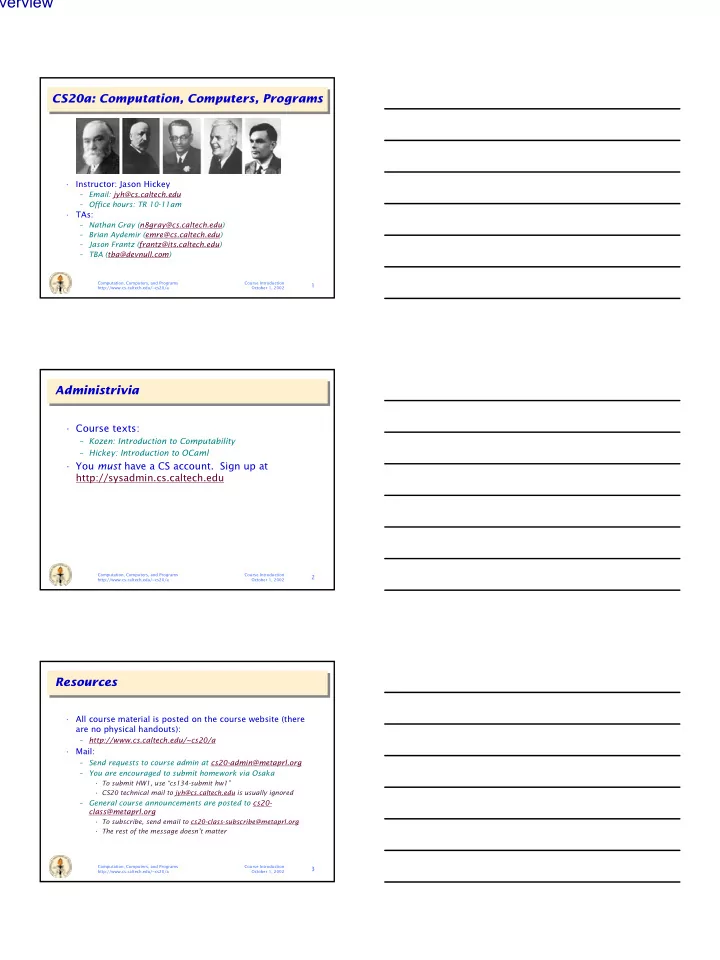
Overview CS20a: Computation, Computers, Programs Instructor: Jason - - PDF document

overview
SMART_READER_LITE
LIVE PREVIEW

Overview CS20a: Computation, Computers, Programs Instructor: Jason - - PDF document

Overview CS20a: Computation, Computers, Programs Instructor: Jason Hickey Email: jyh@cs.caltech.edu Office hours: TR 10-11am TAs: Nathan Gray (n8gray@cs.caltech.edu) Brian Aydemir (emre@cs.caltech.edu) Jason Frantz


slide-1
SLIDE 1

Overview

Computation, Computers, and Programs Course Introduction http://www.cs.caltech.edu/~cs20/a October 1, 2002

1

CS20a: Computation, Computers, Programs

  • Instructor: Jason Hickey

– Email: jyh@cs.caltech.edu – Office hours: TR 10-11am

  • TAs:

– Nathan Gray (n8gray@cs.caltech.edu) – Brian Aydemir (emre@cs.caltech.edu) – Jason Frantz (frantz@its.caltech.edu) – TBA (tba@devnull.com)

Computation, Computers, and Programs Course Introduction http://www.cs.caltech.edu/~cs20/a October 1, 2002

2

Administrivia

  • Course texts:

– Kozen: Introduction to Computability – Hickey: Introduction to OCaml

  • You must have a CS account. Sign up at

http://sysadmin.cs.caltech.edu

Computation, Computers, and Programs Course Introduction http://www.cs.caltech.edu/~cs20/a October 1, 2002

3

Resources

  • All course material is posted on the course website (there

are no physical handouts):

– http://www.cs.caltech.edu/~cs20/a

  • Mail:

– Send requests to course admin at cs20-admin@metaprl.org – You are encouraged to submit homework via Osaka

  • To submit HW1, use “cs134-submit hw1”
  • CS20 technical mail to jyh@cs.caltech.edu is usually ignored

– General course announcements are posted to cs20- class@metaprl.org

  • To subscribe, send email to cs20-class-subscribe@metaprl.org
  • The rest of the message doesn’t matter
slide-2
SLIDE 2

Overview

Computation, Computers, and Programs Course Introduction http://www.cs.caltech.edu/~cs20/a October 1, 2002

4

Prerequisites

  • CS20 is typically taken 2nd year undergrad.
  • CS1,2 or equivalent is required.
  • Basic knowledge of algorithms and discrete data

structures.

  • Knowledge of some programming in a basic

imperative language like C/C++, Pascal, Modula 3, Java, Oberon, Eiffel, etc.

Computation, Computers, and Programs Course Introduction http://www.cs.caltech.edu/~cs20/a October 1, 2002

5

Course work

  • There are 9 homeworks, due each Monday
  • One midterm and final
  • Extension policy

– You get 8 24-hour extensions, use up to 2 on any assignment – Submit with cs20-submit, extend with cs20-extend – Extensions are only for HW/labs, not exams

Computation, Computers, and Programs Course Introduction http://www.cs.caltech.edu/~cs20/a October 1, 2002

6

Grading policy

  • Grade distribution

– Homework/Labs: 50%, Midterm: 20%, Final: 30%

  • Style grading

– Written work 10% style, labs 20% style

  • Due dates

– Assignments are due 11:59pm on due date – Late penalties

  • 25% penalty up to 1 week late
  • 50% 2 weeks late
  • No credit after that

– There will be extra credit work

  • You can get a grading summary online
slide-3
SLIDE 3

Overview

Computation, Computers, and Programs Course Introduction http://www.cs.caltech.edu/~cs20/a October 1, 2002

7

Grading policy

  • Collaboration is encouraged on homeworks and
  • labs. You may discuss the problems freely, but

you must write your code and homework submissions yourself. See the Policy page on the course web site.

  • Solutions are posted on the due date. Do not

look at them if you have not completed the assignment.

Computation, Computers, and Programs Course Introduction http://www.cs.caltech.edu/~cs20/a October 1, 2002

8

Laboratory assignments

  • Typically, each homework will include a lab

component.

  • For labs, we will be using the OCaml

programming language

– You can work at home, or the machines in JRG 154 – Lab submissions must be online using Osaka grader

  • HW/Lab assignments will take roughly 6

hours/week.

  • OCaml

– If you like, you may take CS11 concurrently

Computation, Computers, and Programs Course Introduction http://www.cs.caltech.edu/~cs20/a October 1, 2002

9

Year outline

  • CS20a: computability

– What is computable?

  • CS20b: complexity

– What is effectively computable?

  • CS20c:

– TBA

slide-4
SLIDE 4

Overview

Computation, Computers, and Programs Course Introduction http://www.cs.caltech.edu/~cs20/a October 1, 2002

10

CS20: Fundamental concepts in CS

  • The CS20 series is primarily a theory course

– You will learn fundamental concepts like: – Computability:

  • what is computable, what is hard to compute?

– Computational models

  • Automata, Turing machines, recursive functions, lambda

calculus, …

– Programs

  • What is a program or specification?
  • When are two programs equal?
  • What is a proof?
Computation, Computers, and Programs Course Introduction http://www.cs.caltech.edu/~cs20/a October 1, 2002

11

CS20a: Computability

  • Automata theory
  • Formal languages
  • Program equivalence
  • Basic computational models

– Automata – Recursive functions – Lambda calculus

  • Turing machines

– Recursive, recursively-enumerable sets

Computation, Computers, and Programs Course Introduction http://www.cs.caltech.edu/~cs20/a October 1, 2002

12

CS20a: Course Outline

  • Regular languages

– Deterministic Finite Automata (DFAs) – Nondeterministic Finite Automata (NFAs)

  • Context-free languages

– Pushdown automata (non/deterministic) (PDAs)

  • Recursive, R.E. languages

– Turing machines

slide-5
SLIDE 5

Overview

Computation, Computers, and Programs Course Introduction http://www.cs.caltech.edu/~cs20/a October 1, 2002

13

Basic set theory

  • We take the naïve point of view regarding sets

– The meaning of the word “set” is intuitively obvious – We will deal with sets in an intuitive manner

  • Careless use of set theory can lead to contradiction
  • Russell’s paradox: what is the set of all sets that do not

contain themselves?

  • Notation

– Lowercase letters stand for elements – Uppercase letters stand for sets – a A

Computation, Computers, and Programs Course Introduction http://www.cs.caltech.edu/~cs20/a October 1, 2002

14

Set predicates, construction

  • a is a member of A: a ∈ A
  • set A is a subset of set B: A ⊆ B
  • set A is a proper subset of set B: A ⊊ B
  • set A has elements a, b, c: A = {a, b, c}
  • Comprehe

is used to collect all the elements

  • f a set A that have some property P

B = {i | i is an even integer}

Computation, Computers, and Programs Course Introduction http://www.cs.caltech.edu/~cs20/a October 1, 2002

15

Basic set operations

  • The symbol ∨ means or (and it is inclusive)
  • The symbol ∧ means and
  • A ∪ B ≡ {x | x ∈ A ∨ x ∈ B}
  • A ∩ B ≡ {x | x ∈ A ∧ x ∈ B}
  • The power set: 2A ≡ {B | B ⊆ A}
  • Difference A − B ≡ {x | x ∈ A ∧ x ∉ B}
slide-6
SLIDE 6

Overview

Computation, Computers, and Programs Course Introduction http://www.cs.caltech.edu/~cs20/a October 1, 2002

16

Cartesian product

  • A

B ≡ {(a, b) | a ∈ A ∧ b ∈ B}

  • A relation R on a set A is a set of ordered pairs

from A: R ⊆ A × A

  • We often write a1 R a2 for (a1, a2) ∈ R
  • For example, consider the relation

< ≡ {(0, 1), (0, 2), . . . , (1, 2), (1, 3), . . .}. We write i < j if (i, j) ∈ <.

Computation, Computers, and Programs Course Introduction http://www.cs.caltech.edu/~cs20/a October 1, 2002

17

Orders

  • An equivalence relation R on a set A has the fol-

lowing properties: – For each x ∈ A, x R x. – If x R y, then y R x. – If x R y and y R z, then x R z.

  • A total order R on a set A is a relation with the

following properties: – If x ≠ y, then x R y or y R x. – For no x ∈ A does x R x hold. – If x R y, and y R z, then x R z.

Computation, Computers, and Programs Course Introduction http://www.cs.caltech.edu/~cs20/a October 1, 2002

18

Functions

  • A function f : A → B is a relation (f ⊆ A × B), and

it is single-valued: If (a1, b1) ∈ f and (a2, b2) ∈ f and a1 = a2, then b1 = b2.

  • An injection: if f(a1) = f(a2), then a1 = a2.
  • A surjection: for each b ∈ B, there is an a such

that f(a) = b.

  • A bijection is an injection and a surjection.
slide-7
SLIDE 7

Overview

Computation, Computers, and Programs Course Introduction http://www.cs.caltech.edu/~cs20/a October 1, 2002

19

Examples

  • Natural numbers: N ≡ {0, 1, 2, 3, . . .}
  • Real numbers: R
  • Nonnegative reals: R+ ≡ {x ∈ R | x ≥ 0}
  • f (x) = x2 is neither an injection nor a surjection
  • n R → R
  • f (x) = x2 is an injection on N → N
  • f (x) = x2 is a bijection on R+ → R+
Computation, Computers, and Programs Course Introduction http://www.cs.caltech.edu/~cs20/a October 1, 2002

20

Countable sets

  • A set A is finite if there is a bijection A → {1, . . . , n}

for some n ∈ N.

  • A set is infinite if it is not finite.
  • A set A is countable if it is finite, or it is infinite

and there is a bijection f : N → A.

  • A set is uncountable if it is not countable.
Computation, Computers, and Programs Course Introduction http://www.cs.caltech.edu/~cs20/a October 1, 2002

21

Countable examples Theorem The set N × N is countable. Proof (by picture)

1 2 4 7 11 3 5 8 12 6 9 13 10 14

slide-8
SLIDE 8

Overview

Computation, Computers, and Programs Course Introduction http://www.cs.caltech.edu/~cs20/a October 1, 2002

22

Countable examples Real proof Let f (x, y) = (x + y − 1, y). Let g(x, y) = (x − 1)x/2 + y. Then g ◦ f is a bijection N × N → N. Corollary The set of rationals Q is countable.

Computation, Computers, and Programs Course Introduction http://www.cs.caltech.edu/~cs20/a October 1, 2002

23

Reals are uncountable (Cantor)

Theorem The real numbers R are uncountable. Proof

  • 1. Assume [0, 1) is countable, and enumerate the in-

terval.

  • 2. Construct a new number by selecting digits along

the diagonal, where if the nth digit of the nth num- ber is i, the nth digit of the constructed number is some digit other than i and not 0 and not 9.

  • 3. The constructed number is not in the list.
Computation, Computers, and Programs Course Introduction http://www.cs.caltech.edu/~cs20/a October 1, 2002

24

Reals are uncountable

  • Cantor’s

diagonalization argument

0. 7 3 5 9 2... 1 0. 3 7 7 1 8... 2 0. 1 0... 3 0. 9 7 9 1 4... 4 0. 8 1 5 2 5... 5 0. 6 6 6 0... 0. 4 1 8 3 1...

slide-9
SLIDE 9

Overview

Computation, Computers, and Programs Course Introduction http://www.cs.caltech.edu/~cs20/a October 1, 2002

25

Countability in the plane

  • It is possible to draw an uncountable number of

circles on the plane

– For each real number x, draw a circle of radius x about the origin

Computation, Computers, and Programs Course Introduction http://www.cs.caltech.edu/~cs20/a October 1, 2002

26

What about non-intersecting figure-8s?

Computation, Computers, and Programs Course Introduction http://www.cs.caltech.edu/~cs20/a October 1, 2002

27

Figure-8s

Theorem Only a countable number of non-intersecting figure-8s can be drawn on the plane. (Semi) proof

  • 1. The real numbers R and the rational numbers Q

are dense: for any two numbers a < b, there is a third such that a < c < b.

  • 2. Each figure-8 can be uniquely identified by choos-

ing two rational numbers, one in each loop.

  • 3. Since Q is countable, so is Q × Q, so the number
  • f figure-8s is countable.