Overview of Japanese Research Overview of Japanese Research Activity - - PowerPoint PPT Presentation

overview of japanese research overview of japanese
SMART_READER_LITE
LIVE PREVIEW

Overview of Japanese Research Overview of Japanese Research Activity - - PowerPoint PPT Presentation

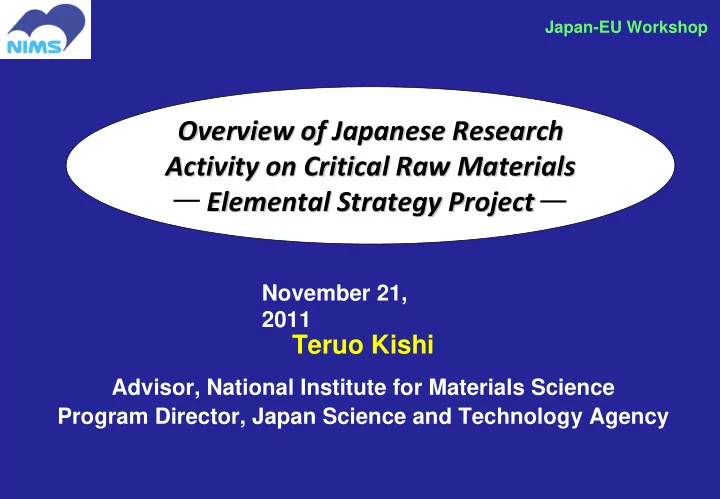
Japan-EU Workshop Overview of Japanese Research Overview of Japanese Research Activity on Critical Raw Materials Activity on Critical Raw Materials Elemental Strategy Project Elemental Strategy Project November 21, 2011 Teruo Kishi Advisor,


slide-1
SLIDE 1

Teruo Kishi

Advisor, National Institute for Materials Science Program Director, Japan Science and Technology Agency November 21, 2011

Overview of Japanese Research Overview of Japanese Research Activity on Critical Raw Materials Activity on Critical Raw Materials Elemental Strategy Project Elemental Strategy Project

Japan-EU Workshop

slide-2
SLIDE 2

2

Energy Generation, conversion, storage Energy use Heat, actuation, illumination, information cleaning Fuel Cell Solar Cell Battery Thermo- Electric Motor LED Electronics Catalyst Ga As In Cd Ru Pt Rh La Ce Gd Li Co Ni R.E. Bi Te Co Sb Dy Nd S m Co B Ga In La Eu Y Ag Au Pd Rh In W Pt Pd Rh R.E. Research Institutes and Funding System in Japan METI MEXT Ministry of Education, Culture, Sports, and Science and Technology (MEXT) JST JSPS Universities NIMS NEDO AIST Strategic Research Applied Research RIKEN Basic Research Industry funding agencies

funding agency

Ministry of Economy, Trade and Industry (METI)

Critical Materials for Energy and Environment Critical Materials for Energy and Environment

slide-3
SLIDE 3

3

"An elemental strategy project" "Rare metal substitution material development project "

( MEXT &METI )

Target : Rare and harmful elements Basic Research ↓ ・ Drastic substitution ・ Vast reduction of consumption amount The proposal of the new paradigm

  • f Material Research

Elements which need urgent provisions such as

In, Dy, W, Pt, Tb, Eu, Ce

Aim: 30~80% Reduction The promotion of Research Development

MEXT

An elemental strategy project

METI

Rare metal substitution material development project

Joint adoption, Joint symposium, Joint session of shared research equipment and etc.

Examination of developing METI project at a point

  • f time when the assignment ends in 5years

Setting the numerical target of reduction amount Aiming to reach to the sample level

slide-4
SLIDE 4

4

MEXT JST Project

slide-5
SLIDE 5

Background

  • Rare resources, represented by rare earth and other

rare metal elements which are being utilized for the advanced industries such as electronics, automotives, information technologies, robots, etc., are facing their price increase and tight supply due to rapid increase of their consumptions and producing countries’ resource management policies accompanying with the global economic growth and advanced industries’ expansion.

Elements Science and Technology Project Elements Science and Technology Project

  • Designing Material Functions through Fundamental Research on Elements’ Roles -

5

slide-6
SLIDE 6

Project Outline

  • This project started in 2007 aiming at the

establishment of fundamentals on roles of material’s elements responsible for the material properties and the development of alternative materials substituting rare metals and rare earth elements by ubiquitous and nonhazardous ones.

  • Research subjects which see their paving ways for

their practical stages are expected to explore

  • pportunities for further development by applied

research funding programs after their accomplishment.

Elements Science and Technology Project Elements Science and Technology Project

  • Designing Material Functions through Fundamental Research on Elements’ Roles -

6

slide-7
SLIDE 7

7

An elemental strategy project : in FY2007

No. Subject of research Research leader/ Adoption entrepreneur 1

Development of Hot-dipped Aluminum Alloy Coated Steels

Toru Tsuru Tokyo Institute of Technology

2

Development of the next-generation nonvolatile memory using anodized aluminum film

Giyuu Kido National Institute for Materials Science (NIMS)

3

The new function which hydrogen induces in subnano lattice substance

Masuo Okada Tohoku University

4

Self-forming Nano-particle Catalyst without Precious Metals

Yasuo Nishihata Japan Atomic Energy Agency

5

Development of Barium-based New Lead-free Piezoelectric Materials with Ultrahigh Piezoelectric Property for Piezoelectric Frontier

Satoshi Wada University of Yamanashi

6

Development of TiO2-based Transparent Electrode

Tethuya Hasegawa Kanagawa Academy of Science and Technology (KAST)

7

High Performance Anisotropic Nano composite Permanent Magnets with Low RareEarth Content

Satoshi Hirosawa Hitachi Metals

slide-8
SLIDE 8

8

An elemental strategy project : in FY2008

No. Subject of research Research leader/ Adoption entrepreneur

1

Material Design and Processing of Highly-Dispersed Catalysts with Minimum Precious Metal Loadings

Masato Machida Kumamoto University

2

Nano-hybridized Precious-metal-free Catalysts for Chemical Energy Conversion

Kohei Uosaki Hokkaido University

3

Development of Innovative Energy Conversion Systems with Molecular Catalysts Replacing Precious Metals

Yoshinori Naruta Kyushu University

4

Ubiquitous Element Strategy for Function Emergence

Hideo Hosono Tokyo Institute of Technology

5

Functional design by precise synthesis of silicon oxide compounds

Kazuyuki Kuroda Waseda University

slide-9
SLIDE 9

9

An elemental strategy project : in FY2009

No.

Subject of research

Research leader/ Adoption entrepreneur 1

Design and Processing of Functional Materials with Multi-elements Based on Chemical Potential Diagrams

Tetsuya Uda Kyoto University 2

Organic Molecular Approach to High-performance secondary Batteries and Mechanistic Elucidation of Charge-discharge Processes

Yasushi Morita Osaka University 3

Development of the platinoid-elements free functional magnetic material by compound interface control

Eiji Kita University of Tsukuba 4

Development of Eco-friendly Post Lithium-ion Batteries

Shigeto Okada Kyushu University

slide-10
SLIDE 10

10

New Projects of MEXT (2011) Crest

  • PD. Prof. Tamao

さきがけ

  • PD. Prof. Hosono
slide-11
SLIDE 11

11

National Instiute for Materials Science (NIMS)

National Research Institute for Metals (NRIM) (since 1956) National Institute for Research in Inorganic Materials (NRIM) (since 1966) Budget : $200 million (Subsidy : from MEXT $150M) Personnel : 450 Scientists, 100 staffs 500 visiting researchers

Independent Administrative Institution

National Institute for Materials Science

- The only national lab dedicated to materials science in Japan -

  • 1. Fundamental and inovative research on materials science
  • 2. Promotion of widespread use of research results and applications
  • 3. Shared use of advanced research facilities
  • 4. Cultivation of researchers in the materials science discipline

Science and Technology Agency

April 2001 MEXT

slide-12
SLIDE 12

General Affairs Division

6 Offices

International Center for Young Scientists(ICYS) International Center for Young Scientists(ICYS)

Information Analysis Office Information Analysis Office Compliance Office Compliance Office TIA Promotion Office TIA Promotion Office Fellow/Emeritus Fellow Audit Office Audit Office Secretary’s Office Secretary’s Office

Senior Director of Administration

Vice President Advisory Board Auditor

Advanced Key Technologies Division

7 Units

Nano Characterization Unit Computational Materials Science Unit Surface Physics and Structure Unit Polymer Materials Unit Materials Processing Unit Photonic Materials Unit

12 Units

Environment and Energy Materials Division

Environmental Remediation Materials Unit Optical and Electronic Materials Unit Sialon Unit Superconducting Properties Unit Superconducting Wires Unit Battery Materials Unit Materials Reliability Unit Magnetic Materials Unit High Temperature Materials Unit Hybrid Materials Unit Hydrogen Materials Unit Photovoltaic Materials Unit

NIMS Advisor Senior Adviser Emeritus Senior Distinguished Adviser

Namiki Site Managing Office

Construction Office for Environmental technology Research and Development Center, etc

Gender Equality Office Safety Management Office General Affairs Office Information Technology Office

Planning Division

Strategy Office Research Evaluation Office Public Relations Office Human Resources Development Office Planning & Coordination Office Scientific Information Office

6 Offices

Research Center for Strategic Materials

1 Unit

Structural Materials Unit

NIMS Organization(2011/4/1)

Research Network and Facility Services Division

Global Research Center for Environment and Energy based on Nanomaterials Science International Center for Nanotechnology Network

Center of Materials Research for Low Carbon Emission

Materials Information Station Materials Manufacturing & Engineering Station High Magnetic Field Station Transmission Electron Microscopy Station NIMS Beamline Station at Spring-8 Materials Analysis Station Nanotechnology Innovation Station Administration Office

3 Centers 7 Stations 2 Offices 1 Lab

NIMS-Leica Bio-imaging Laboratory NIMS Office at EMPA

External Collaboration Division

Research Collaboration Office Academic Collaboration Office NIMS-TOYOTA Materials Center of Excellence for Sustainable Mobility NIMS Saint-Gobain Center of Excellence for Advanced Materials

3 Offices 2 Centers

Tsukuba University Liaison Office

International Center for Materials Nanoarchitectonics(MANA)

17 Units 1 Foundry 1 Office 1 Lab Soft Chemistry Unit Supermolecules Unit Inorganic Nanostructures Unit Nanotubes Unit Nano-Electronics Materials Unit Nano-System Organization Unit Nano Functionality Integration Unit Atomic Electronics Unit Nano-System Theoretical Physics Unit π-Electron Electronics Unit Nano Interface Unit Sustainability Materials Unit Soft Ionics Unit Nano Photocatalyst Unit Reticular Materials Unit Biomaterials Unit Tissue Regeneration Materials Unit Biomaterials Medical Innovation Laboratory MANA Foundry MANA Administrative Office Quantum Beam Unit

ICYS-SENGEN ICYS-NAMIKI

12 President President
slide-13
SLIDE 13

13

A new center on elements science and technology at NIMS from FY2011

Micro-, Nano-, Atomic-scale characterization of materials- understand roles of alloying elements Hierarchical control of metallic texture Innovative process techniques to improve properties Introducing active atoms into inter- metallic alloy Morphology control in nano-scale

From the Urban Mines

Mesoporous materials precisely modified pore accuracy

Separation and aggregation Techniques of critical elements Designing parmanent magnets with elements science Rare metal free structural materials

Steel, Mg-alloy, Ti-alloy, Stainless-steel,

Catalyst, reducing critical elements (Pt, Pd…)

slide-14
SLIDE 14

14

MEXT NEDO Project

slide-15
SLIDE 15

15

Rare metal substitution material development Project : in FY2007

Subject of research Research leader Adoption entrepreneur

Development of Technology to Reduce Indium Use in Transparent Conducting Electrodes Takashi Nakamura IMRAM, Tohoku University Development of Substitute Materials for Indium in Transparent Conducting Electrodes Tetsuya Yamamoto Kochi Inst. Tech. Development of Technology to Reduce Dysprosium Use in Rare Earth Magnets Satoshi Sugimoto Tohoku University Development of Technology to Reduce Tungsten Use in Cemented Carbide Tools Keizou Kobayashi AIST Development of Substitute Materials for Tungsten in Cemented Carbide Tools Hayashi Koji AIST Japan Fine Ceramics Center (JFCC)

slide-16
SLIDE 16

16

Rare metal substitution material development Project : in FY2009

element Subject of research Research leader Adoption entrepreneur

Pt Development of Technology to Reduce Platinum Group Use by Utilizing Substitute Transition Elements and Aggregation Inhibitor of Platinum Group

Sekiba Toru Nissan Motor Co., Ltd

Pt Development of Technology to Reduce Platinum Group Use in Catalysts for Diesel Exhaust Emission

Hideaki Hamada AIST

Ce Development of Technology to Reduce Cerium Use for Precision Polishing by Utilizing the Substitute Abrasive Grains and Innovative Polishing Technology

Seiiti Suda Japan Fine Ceramics Center (JFCC)

Ce Development of Technology to Reduce Cerium Use by Utilizing the Concept of 4BODY Polishing Technology

Yasuhiro Tani Ritsumeikan University

Tb Eu Development of Technology to Reduce Terbium and Europium Use in Fluorescent Materials for Lamps by Fast Synthesis and Characterization Method

Tomoko Akai AIST

slide-17
SLIDE 17

Next generation Science and Technology on Elements Project

Science Based Alternative technology magnet catalyst electronic structural Etc.

Budget Proposal

10 years project 4 hubs in Japan Several million € per each hub Design Group with Quantum Theory Fabrication Group with Nano Construction Analysis and Evaluation Group of Material Function

slide-18
SLIDE 18

Summary Summary

  • Japan is promoting the national scheme for Critical Raw Materials
  • International cooperation is important to for more innovative

technology, in addition to collaboration between industries universities and national institutes

  • Technology is only applicable when it is based on the true science.
  • Robust Japan-EU collaboration will be expected in the fundamental

and pre-competitive research area

… Let’s Collaborate!