Japanese waste paper trend Japanese waste paper trend High - - PowerPoint PPT Presentation

japanese waste paper trend japanese waste paper trend
SMART_READER_LITE
LIVE PREVIEW

Japanese waste paper trend Japanese waste paper trend High - - PowerPoint PPT Presentation

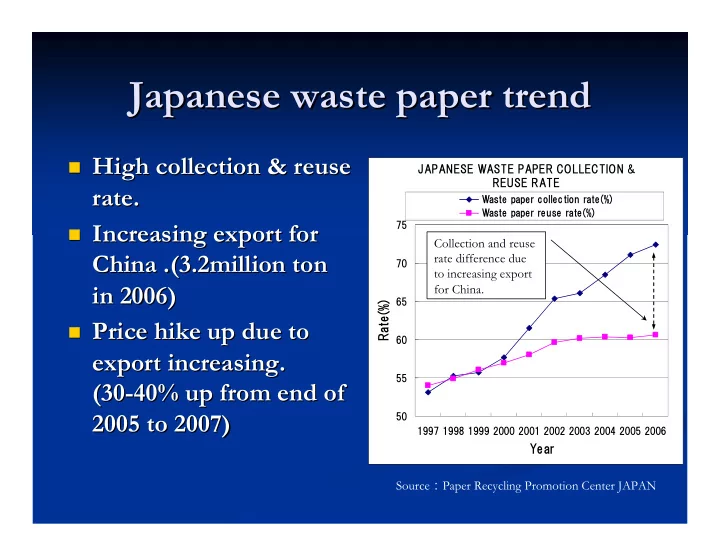
Japanese waste paper trend Japanese waste paper trend High collection & reuse High collection & reuse JAPANESE WASTE PAPER COLLECTION & REUSE RATE rate. rate. Waste paper collection rate(%) Waste paper reuse rate(%)


slide-1
SLIDE 1

JAPANESE WASTE PAPER COLLECTION & REUSE RATE

50 55 60 65 70 75 1997 1998 1999 2000 2001 2002 2003 2004 2005 2006

Year Rate(%)

Waste paper collection rate(%) Waste paper reuse rate(%)

Japanese waste paper trend Japanese waste paper trend

  • High collection & reuse

High collection & reuse rate. rate.

  • Increasing export for

Increasing export for China .(3.2million ton China .(3.2million ton in 2006) in 2006)

  • Price hike up due to

Price hike up due to export increasing. export increasing. (30 (30-

  • 40% up from end of

40% up from end of 2005 to 2007) 2005 to 2007)

Source:Paper Recycling Promotion Center JAPAN Collection and reuse rate difference due to increasing export for China.

slide-2
SLIDE 2

Japanese customer Japanese customer

(Newsprint) (Newsprint)

  • 5 major national dailies account for 60% of

5 major national dailies account for 60% of total circulation. total circulation.

  • National advertisement is expensive.

National advertisement is expensive.

  • Advertiser request high printing quality.

Advertiser request high printing quality.

  • Production schedule is very tight.

Production schedule is very tight.

  • Press room cannot allow sheet break .

Press room cannot allow sheet break .

  • Paper maker should care about sheet break by sticky

Paper maker should care about sheet break by sticky

  • r low sheet strength.
  • r low sheet strength.
slide-3
SLIDE 3

Japanese waste paper quality Japanese waste paper quality

  • Complete sort by

Complete sort by local autonomies, local autonomies, citizens and citizens and companies. companies.

  • There are many

There are many categories of categories of industrial (pre industrial (pre-

  • consume) waste

consume) waste papers. papers.

Price Grade

Name

Main Quality(possible contamination) use Glue

Groundwood CCP

Thermal

UV

Colored Shavings

White Blank News

× ○ × × × × ○

White Ledge

× × × × × × ○

Publication Blanks

× ○ × × × × ○

"KENTO"(3)

Paperboard

△ △ △ △ △ △ ○

Sorted Office Mix

○ ○ △ △ △ △ ○

Household Colored Ledge

○ ○ ○ ○ ○ ○ ○

Magazine Shavings

○ ○ × × △ △ ○

Office Mix

○ ○ ○ ○ ○ ○ ○

○Allowed contamination by paper company. △Not allowed contamination, but small contamination may allow by paper company. ×Not allowed contamination. source:NIPPON PAPER INDUSTRIES CO., LTD. Recycled Fibers Dept.

High Low Low Household paper

Colored Ledge

Coated paper High White Blanks Paperboard (surface)

Household White Ledge Shavings

○ ○ × × △ △ ○

"KENTO"(2)

Coated paper

○ △ × × × × ○ △

"KENTO"(1)

Paperboard (surface)

△ △ × × × × × × × × × △ × ○ × × × × ×

Industrial waste paper category

slide-4
SLIDE 4

Japanese recycling situation Japanese recycling situation

  • Waste paper export amount is increasing.

Waste paper export amount is increasing.

  • Waste paper recycling rate is quite high.

Waste paper recycling rate is quite high.

  • Certain grades of waste paper are short.

Certain grades of waste paper are short.

  • Have to use lower quality waste paper as

Have to use lower quality waste paper as higher grade paper material. higher grade paper material. (e.g. newsprint, coated paper) (e.g. newsprint, coated paper)

slide-5
SLIDE 5

Japanese industry Japanese industry’ ’s concern s concern

  • How to handle lower quality waste paper for

How to handle lower quality waste paper for higher grade paper material? higher grade paper material?

  • Reduce sticky contamination.

Reduce sticky contamination.

  • New detergents or chemicals.

New detergents or chemicals.

  • Micro sticky cohesion.

Micro sticky cohesion.

  • Useful measure systems. (methods, facilities)

Useful measure systems. (methods, facilities)

  • Remove

Remove “ “difficult de difficult de-

  • ink

ink” ” ink. (e.g. UV ink)

  • ink. (e.g. UV ink)
  • New chemicals.

New chemicals.

  • New facilities.

New facilities.

  • Maintain paper strength.

Maintain paper strength.