Japanese EGS experience and Japanese EGS experience and modeling - - PowerPoint PPT Presentation

japanese egs experience and japanese egs experience and
SMART_READER_LITE
LIVE PREVIEW

Japanese EGS experience and Japanese EGS experience and modeling - - PowerPoint PPT Presentation

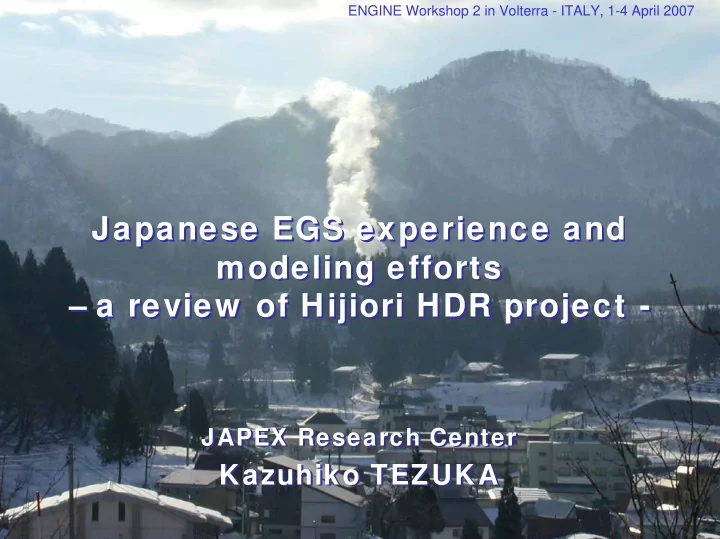
ENGINE Workshop 2 in Volterra - ITALY, 1-4 April 2007 Japanese EGS experience and Japanese EGS experience and modeling efforts modeling efforts a review of Hijiori HDR project - a review of Hijiori HDR project - JAPEX Research


slide-1
SLIDE 1

Research Center

Japanese EGS experience and modeling efforts – a review of Hijiori HDR project - Japanese EGS experience and modeling efforts – a review of Hijiori HDR project -

JAPEX Research Center

Kazuhiko TEZUKA

JAPEX Research Center

Kazuhiko TEZUKA

ENGINE Workshop 2 in Volterra - ITALY, 1-4 April 2007

slide-2
SLIDE 2

Research Center

Hijiori:肘折 Hijiori:肘折

elbow broken

slide-3
SLIDE 3

Research Center

Outlines Outlines

Introduction of Hijiori Field Review of Hijiori HDR Project Fracture Network Modeling (DFN) Application of DFN to Oil/Gas Reservoir Conclusions

slide-4
SLIDE 4

Research Center

Location of Location of Hijiori Hijiori HDR Test Site HDR Test Site

Hijiori Test Site

Tohoku University Tokyo

Hijiori Spa

D

  • u

z a n R i v e r

Nigamizu River

Test Site

slide-5
SLIDE 5

Research Center

Geology Geology

Granodiorite

Gassan Formation Ohkura, Aosawa Tachiyazawa Formation (Siliceous tuff) Kusanagi (Sandstone) Kusanagi (Mudstone) Lake Deposit Cretaceous

白亜紀

Neogene

新第三紀

Quaternary

第四紀

S N

Reservoir is in Cretaceous granodiorite (>1500m) which is covered by Neogene sediments.

slide-6
SLIDE 6

Research Center

Temperature Distribution Temperature Distribution

S N 200℃ surface 270℃ @ 2300m

High temperature anomaly was formed along fault. Temperature exceeds 270degC.

slide-7
SLIDE 7

Research Center

Position of Position of Hijiori Hijiori HDR project HDR project

short Well Intervallong Temperature

Hijiori 270℃,~130m Ogachi 250℃,~80m Fenton Hill (PhaseII) 232℃,150~300m Rosemanowes 80℃,180~270m Soultz (Deep) 200℃,600m Cooper Basin 250℃, 500m Soultz (Shallow) 170℃,450m

slide-8
SLIDE 8

Research Center

History of Hijiori HDR Project History of Hijiori HDR Project

1992 : Deep Reservoir Creation 1995-1996: Short Term Circulation 1984-1986: Shallow Reservoir Creation 1997-1999: Preparation 2000-2002: Long Term Circulation 1991 : Shallow Reservoir Circulation 1993-1994: Drilling Deeper HDR-2a, HDR-3

HDR-1

1987-1990: Drilling HDR-1, HDR-2, HDR-3

HDR-3 HDR-2 SKG-2

  • 2300m
  • 1800m

Hijiori project was carried out by NEDO and five companies (GERD, Mitsui Mining, JAPEX and CRIEPI) with a funding of government.

slide-9
SLIDE 9

Research Center

Reservoir Creation and Fracture Characterization Reservoir Creation and Fracture Characterization

Shallow Reservoir Creation Injection Well: SKG-1 Injection Depth: 1790-1800m

  • Max. Inj. Rate:

6.0m3/min Max.W.H.P: 16MPa Total Inj. Vol.: 1080m3 *using 7” casing *calibration shooting at 1800m Deep Reservoir Creation Injection Well: HDR-1 Injection Depth: 2151-2205m

  • Max. Inj. Rate:

4.3m3/min Max.W.H.P: 22MPa Total Inj. Vol.: 2115m3 *using PBR *calibration shooting at 2200m

MS distribution shows east-west trending highly dipping structure

slide-10
SLIDE 10

Research Center

HDR-1 HDR-2 HDR-3 Separator Silencer Water Supply Pit Turbine Pump

Preparation for the Long Term Circulation Test

slide-11
SLIDE 11

Research Center

Experiment in the Snow Country Experiment in the Snow Country

PTS Logging Access to the Site Surface Facility Binary System

slide-12
SLIDE 12

Research Center

Schedule of Long Term Circulation Test Schedule of Long Term Circulation Test

10 11 12 1 2 3 4 5 6 7 8 9 10 11 12 1 2 3 4 5 6 7 8 9 10 11 12 Deep Reservoir Injection Dual Reservoir Injection Electric Generation W

  • rkover

PTS log Geochemical Sampling W eekly Tracer Test AE monitoring Continuous Environmental monitoring Monthly FY2001 FY2000 FY2002

The final stage of the Hijiori project is a long term circulation test of 2 years. The circulation test had three phases. The first phase is the deep reservoir injection with constant injection rate, the second phase is dual reservoir injection and the third phase is a power generation using the binary system. During the two year-test period, we continue microseismics monitor, geochemical sampling and environmental monitoring. In addition to these monitoring, we ran PTS logging once every six weeks and also did tracer tests in time with PTS logging.

slide-13
SLIDE 13

Research Center

Injection and Production Rate during LTCT Injection and Production Rate during LTCT

5 10 15 20 25 2000/11/27 2001/1/26 2001/3/27 2001/5/26 2001/7/25 2001/9/23 2001/11/22

Elapsed Time, day F lo w R a te , k g /s

HDR-1 HDR-2a HDR-3

① ② ③ ④ ⑤ ⑥ ⑦ ⑧

50 100 150 200 250 2000/11/27 2001/1/26 2001/3/27 2001/5/26 2001/7/25 2001/9/23 2001/11/22

Elapsed Time, day W e llh e a d T e m p e r a tu r e ,

  • C

HDR-1 HDR-2a HDR-3

① ② ③ ④ ⑤ ⑥ ⑦ ⑧

P

HDR-2a HDR-3

Flash Point Flash Point

P

HDR-2a HDR-3

Flash Point Flash Point

: PTS logging and Tracer Test

slide-14
SLIDE 14

Research Center

F2a- 7

2300 2200 2100 2000 1900 1800 1700 1600 1500

Dept h( m )

50 100 150 200 250 300 350

Pr es s ur e ( 01/ 11/ 12) Tem per at ur e ( 01/ 11/ 12) Tem per at ur e ( 01/ 07/ 14) Pr es s ur e ( 01/ 07/ 14) Tem per at ur e ( 01/ 05/ 30) Pr es s ur e ( 01/ 05/ 30) Pr es s ur e ( 01/ 02/ 22)

← F2 a- 1 0 ← F2a - 9 F2a - 8 → F2a - 6

Tem per at ur e ( 00/ 12/ 20)

F2a- 5→ F2 a- 4 → F2 a- 3 F2 a- 2 b F2 a- 2

Tem per at ur e ( 01/ 02/ 22) Pr es s ur e ( 01/ 04/ 14) Tem per at ur e ( St at i c ) Tem per at ur e ( 01/ 04/ 14)

Tem per at ur e( ℃ ) 5 10 15 20 25 30

Pr es s ur e ( 01/ 09/ 22) Tem per at ur e ( 01/ 09/ 23) Pr es s ur e ( 01/ 08/ 25) Tem per at ur e ( 01/ 08/ 25)

Pr es s ur e( M PaG)

2300 2200 2100 2000 1900 1800 1700 1600 1500

Dept h( m )

50 100 150 200 250 300 350 Tem per at ur e( ℃ ) 5 10 15 20 25 30 Pr es s ur e( M PaG)

22 days after

2300 2200 2100 2000 1900 1800 1700 1600 1500

Dept h( m )

50 100 150 200 250 300 350 Tem per at ur e( ℃ ) 5 10 15 20 25 30 Pr es s ur e( M PaG)

86 days after

2300 2200 2100 2000 1900 1800 1700 1600 1500

Dept h( m )

50 100 150 200 250 300 350 Tem per at ur e( ℃ ) 5 10 15 20 25 30 Pr es s ur e( M PaG)

138 days after

2300 2200 2100 2000 1900 1800 1700 1600 1500

Dept h( m )

50 100 150 200 250 300 350 Tem per at ur e( ℃ ) 5 10 15 20 25 30 Pr es s ur e( M PaG)

184 days after

2300 2200 2100 2000 1900 1800 1700 1600 1500

Dept h( m )

50 100 150 200 250 300 350 Tem per at ur e( ℃ ) 5 10 15 20 25 30 Pr es s ur e( M PaG)

228 days after

2300 2200 2100 2000 1900 1800 1700 1600 1500

Dept h( m )

50 100 150 200 250 300 350 Tem per at ur e( ℃ ) 5 10 15 20 25 30 Pr es s ur e( M PaG)

271 days after

2300 2200 2100 2000 1900 1800 1700 1600 1500

Dept h( m )

50 100 150 200 250 300 350 Tem per at ur e( ℃ ) 5 10 15 20 25 30 Pr es s ur e( M PaG)

300 days after

2300 2200 2100 2000 1900 1800 1700 1600 1500

Dept h( m )

50 100 150 200 250 300 350 Tem per at ur e( ℃ ) 5 10 15 20 25 30 Pr es s ur e( M PaG)

350 days after

  • Temp. and Press. @

1500m (measured by PTS)

50 100 150 200 250 300 100 200 300 400 500

Elapsed Time (days)

Temperature (degC 4 8 12 16 20 24

Pressure (MPa)

HDR- 3 Temp HDR- 2a Temp HDR- 2a Press HDR- 3 Press

  • Temp. and Press. @

1900m (measured by PTS)

50 100 150 200 250 300 100 200 300 400 500 Elapsed Time (days) Temperature (degC 4 8 12 16 20 24 pressure (MPa HDR- 3 Temp HDR- 2a Temp HDR- 2 Press HDR- 3 Press

HDR-2a

Circulation and Heat Extraction
slide-15
SLIDE 15

Research Center

2300 2200 2100 2000 1900 1800 1700 1600 1500

Dept h(m )

180 200 220 240 260 280 300 Tem per at ur e( ℃ ) 5 10 15 20 25 30 Pr es s ur e( M PaG)

22 days after

2300 2200 2100 2000 1900 1800 1700 1600 1500

Dept h(m )

180 200 220 240 260 280 300 Tem per at ur e( ℃ ) 5 10 15 20 25 30 Pr es s ur e( M PaG)

86 days after

2300 2200 2100 2000 1900 1800 1700 1600 1500

Dept h(m )

180 200 220 240 260 280 300 Tem per at ur e( ℃ ) 5 10 15 20 25 30 Pr es s ur e( M PaG)

138 days after

2300 2200 2100 2000 1900 1800 1700 1600 1500

Dept h(m )

180 200 220 240 260 280 300 Tem per at ur e( ℃ ) 5 10 15 20 25 30 Pr es s ur e( M PaG)

184 days after

2300 2200 2100 2000 1900 1800 1700 1600 1500

Dept h(m )

180 200 220 240 260 280 300 Tem per at ur e( ℃ ) 5 10 15 20 25 30 Pr es s ur e( M PaG)

228 days after

2300 2200 2100 2000 1900 1800 1700 1600 1500

Dept h(m )

180 200 220 240 260 280 300 Tem per at ur e( ℃ ) 5 10 15 20 25 30 Pr es s ur e( M PaG)

271 days after

2300 2200 2100 2000 1900 1800 1700 1600 1500

Dept h(m )

180 200 220 240 260 280 300 Tem per at ur e( ℃ ) 5 10 15 20 25 30 Pr es s ur e( M PaG)

300 days after

2300 2200 2100 2000 1900 1800 1700 1600 1500

Dept h(m )

180 200 220 240 260 280 300 Tem per at ur e( ℃ ) 5 10 15 20 25 30 Pr es s ur e( M PaG)

350 days after

  • Temp. and Press. @

1500m (measured by PTS)

50 100 150 200 250 300 100 200 300 400 500

Elapsed Time (days)

Temperature (degC 4 8 12 16 20 24

Pressure (MPa)

HDR- 3 Temp HDR- 2a Temp HDR- 2a Press HDR- 3 Press

2300 2200 2100 2000 1900 1800 1700 1600 1500

Tem per at ur e ( 01/ 02/ 23) Pr es s ur e ( 01/ 02/ 23) Tem per at ur e ( 00/ 12/ 21)

Dept h(m )

180 200 220 240 260 280 300

Pr es s ur e ( 01/ 11/ 13) Tem per at ur e ( 01/ 11/ 13) Tem per at ur e ( 01/ 09/ 24) Pr es s ur e ( 01/ 09/ 24) Tem per at ur e ( 01/ 08/ 26) Pr es s ur e ( 01/ 08/ 26) Tem per at ur e ( 01/ 07/ 15) Pr es s ur e ( 01/ 07/ 15) Pr es s ur e ( 01/ 05/ 31) Tem per at ur e ( 01/ 05/ 31) Pr es s ur e ( 01/ 04/ 14) Tem per at ur e ( St at i c ) Tem per at ur e ( 01/ 04/ 14)

Tem per at ur e( ℃ ) 5 10 15 20 25 30

← F3- 1 ← F3 - 2 ← F3- 3 , 4 ← F3- 5 ← F3 - 6 ← F3- 7 ← F3- 8 ← F3- 9

Pr es s ur e( M PaG)

  • Temp. and Press. @

1900m (measured by PTS)

50 100 150 200 250 300 100 200 300 400 500 Elapsed Time (days) Temperature (degC 4 8 12 16 20 24 pressure (MPa HDR- 3 Temp HDR- 2a Temp HDR- 2 Press HDR- 3 Press

HDR-3

slide-16
SLIDE 16

Research Center

Summary of Long Term Circulation Test Summary of Long Term Circulation Test Total Circulation Term 550 days (Deep Circulation) (333 days) (Dual Circulation) (125 days) (Power Generation) (92 days) Injection Rate 1.0 m3/min Total Injection Volume 793,288 m3 Total Recovery 47.3% Thermal Output 4 – 10MWt Electrical Output 50 kWe

slide-17
SLIDE 17

Research Center

Fracture Characterization and Modeling

is an integrated technology that bridges

Key Technologies for HDR development Key Technologies for HDR development

Reservoir Creation

is in the second stage and quit a unique technology in HDR program, which requires various kind of engineering and mostly affect the success of the program.

Circulation and Heat Extraction

is the final stage which requires an optimal strategy to output energy and to maintain the reservoir for sustainable use.

Field Characterization

is in the first stage of a HDR program and has a significant impact to the total system.

Monitoring

measures physical properties to characterize and maintain the HDR system.

slide-18
SLIDE 18

Research Center

Reservoir Creation and Fracture Characterization Reservoir Creation and Fracture Characterization

HDR system is strongly controlled by fractures. We commonly make efforts to develop a heat exchange system in deep seated rock by drilling and stimulation. During these operations, we can get various kind of information about fractures. The information includes

Oriented cores BHTV PTS log Openhole log

Neutron/Density Resistivity Sonic GR

Microseismics (AE)

slide-19
SLIDE 19

a = α・ r 0.5 Fracture Network CORE Microseismics Aperture Distribution Size Distribution α Neutron / Density Minimum Size Averaged Porosity Matrix Permeability BHTV Orientation Distribution Maximum Size rmax Stochastic Fractures PTS Deterministic Fractures BHTV Spactial Distribution (Vermilye and Scholz, 1995)

Fracture Network Fracture Network Builder Builder – – D/SC D/SC -

slide-20
SLIDE 20

Research Center

Modeling Flowchart Modeling Flowchart

Build a Fracture Network Model Field Data Stochastic Features Deterministic Features Convert the Fracture Network to Equivalent Pearmeable cells Flow Simulation Statistical Processing Change the randuom series Output ( Pressure, Flow, Temperature) INPUT BUILDER SOLVER OUTPUT

D/SC

Deterministic / Stochastic Crack network modeling

The next is a modeling stage. In the Hijiori project, we made a DFN modeli by integrating

slide-21
SLIDE 21

Research Center

Define the deterministic fractures Define the deterministic fractures

2300 2200 2100 2000 1900 1800 1700 1600 1500

Dept h( m )

50 100 150 200 250 300 350 Tem per at ur e( ℃ )

HDR-3 HDR-2a HDR-2a HDR-3 Deterministic Fracture crossing the wells

slide-22
SLIDE 22

Research Center

Define the Stochastic fractures Define the Stochastic fractures

Fracture Orientation from BHTV (Pole Plot) Fracture Aperture from Core Samples (Fractal Rule)

slide-23
SLIDE 23

Research Center

Hijiori Hijiori Fracture Network Model Fracture Network Model

Permeability distribution Flow flux distribution

We put several deterministic fractures along the borehole and permeable faults representing the caldera walls.

slide-24
SLIDE 24

Research Center

Simulated Temperature Distribution Simulated Temperature Distribution

slide-25
SLIDE 25

Research Center

Comparisons between Prediction and Observation Comparisons between Prediction and Observation (Temperature at 1900m depth) (Temperature at 1900m depth)

P

HDR-2a HDR-3

Flash Point Flash Point

P

HDR-2a HDR-3

Flash Point Flash Point

Temperature @ 1900m (Simulated by D/ SC)

50 100 150 200 250 300 100 200 300 400 500 600 700 80 Elapsed Time (days)

Temperature (degC

HDR-2a HDR-3

+2σ mean

+2σ mean

slide-26
SLIDE 26

Research Center

Prediction of the next well (Recovery rate) Prediction of the next well (Recovery rate)

  • 150
  • 50

50 150

  • 150
  • 50

50 150

A B C D E F

HDR-3 HDR-2a

N

10 20 30 40 50 1 2 3 4 5 6 7 8 9 1 Recovery Rate N HDR- A 10 20 30 40 50 10 20 30 40 50 60 70 80 90 100 Recovery Rate N HDR- B 10 20 30 40 50 1 2 3 4 5 6 7 8 9 1 Recovery Rate N HDR- F 10 20 30 40 50 1 2 3 4 5 6 7 8 9 1 Recovery Rate N HDR- C 10 20 30 40 50 1 2 3 4 5 6 7 8 9 1 Recovery Rate N HDR- D 10 20 30 40 50 1 2 3 4 5 6 7 8 9 1 Recovery Rate N HDR- E

10 20 30 40 50 60 70 80 90 100 5 10 15 20 25 30 35 40 45 50 55 60 65 70 75 80 85 90 95 100 Random Seeds# N HDR- 2A 10 20 30 40 50 60 70 80 90 100 10 20 30 40 50 60 70 80 90 100 Random Seeds# N HDR- 3

Ave:3.1% Ave:9.9% Ave:18% Ave:8.2% Ave:5.6% Ave:25.8% Ave:36% Ave:3.0%

slide-27
SLIDE 27

Research Center

Prediction of the next well (Temperature) Prediction of the next well (Temperature)

50 100 150 200 250 300 100 200 300 400 500 600 700 800 Time (days) Temperature (degC) T HDR3
  • 150
  • 50

50 150

  • 150
  • 50

50 150

A B C D E F

HDR-3 HDR-2a

N

50 100 150 200 250 300 200 400 600 800 Time (days) Temperature (degC) HDR- A 50 100 150 200 250 300 200 400 600 800 Time (days) Temperature (degC) HDR- F 50 100 150 200 250 300 200 400 600 800 Time (days) Temperature (degC) HDR- C 50 100 150 200 250 300 200 400 600 800 Time (days) Temperature (degC) HDR- D 50 100 150 200 250 300 200 400 600 800 Time (days) Temperature (degC) HDR- E

50 100 150 200 250 300 100 200 300 400 500 600 700 800 Time (days) Temperature (degC) T HDR2A

50 100 150 200 250 300 200 400 600 800 Time (days) Temperature (degC) HDR- B

slide-28
SLIDE 28

Research Center

  • Upgrading D/SC SHIFT
  • Application to Oil/Gas Field
slide-29
SLIDE 29

Research Center

D/SC D/SC SHIFT SHIFT

S Simulator for imulator for H Hydraulic ydraulic I Injection and njection and F Fracture racture T Treatment reatment

Input of DFN (Discrete Fracture Network) model t = 0 Conversion of DFN to Continua with equivalent permeability End t = t +Δt Fluid Flow Analysis t < tend

Permeability Changed?

  • Two components (gas & water)
  • Compressive Fluid
  • Double-porosity & permeability

Model

Permeability Enhancement Analysis no yes no yes

Both the flow analysis and the enhancement analysis are coupled together at every time step in the calculation so as to reflect permeability enhancement instantaneously due to changing pore pressure.

slide-30
SLIDE 30

Research Center

Complex Permeability Enhancement Mechanisms Complex Permeability Enhancement Mechanisms by elevated pore pressure by elevated pore pressure

  • Opening mode due to reductions of effective normal stress

(reversible process)

  • Shearing mode accompanied with dilation

(irreversible process)

Pp τ Sn Sn τ

( )

p n

P S − ≥ µ τ

Pp τ Sn Sn τ

昇圧

increase

昇圧 減圧

Pp τ Sn Sn τ Pp τ Sn Sn τ

increase decrease

slide-31
SLIDE 31

Research Center

Fracture Aperture as a Function of Fracture Aperture as a Function of Effective Normal Stress Effective Normal Stress

10 20 30 40 0.0 0.5 1.0 1.5 2.0

せ ん 断 滑 り前 せ ん 断 滑 り後

Effective Normal Stress[MPa] Fracture Aperture

Initial Aperture Aperture after shearing

Before shearing After shearing

Shearing

( )

p n

P S − ≥ µ τ

slide-32
SLIDE 32

Research Center

Application to Oil/Gas Reservoir Application to Oil/Gas Reservoir

  • Although the reservoir geology is not complex and the magnitude of the gas column height has been confirmed

by drillings, the production in wells varies from highly productive to non-productive.

  • There are no clear correlation between productivity and either locations or orientations of the wells.

10km 1 5 k m

General Structure:

N-S trending horst complex

Depth Range:

4,000m – 5,000m

Reservoir Rocks:

Cretaceous granite, Eocene conglomerate

Reservoir Type:

Fractured reservoir

Hydraulic Fracturing

  • Stimulate the low productive well
  • Delineate fracture system by MS monitoring
slide-33
SLIDE 33

Research Center

  • 3200m
  • 3550m

AE sensors AE sensor HT-400 Injection Pump Measurement House

  • 4220m
  • 4078m
  • 3700m
  • 3200m

PS3

PT memory gauge QMS-2000

Monitor-B Monitor-C Injector Monitor-A

Massive Hydraulic Injection and MS monitoring in Massive Hydraulic Injection and MS monitoring in Oil/Gas Field Oil/Gas Field

slide-34
SLIDE 34

Research Center

slide-35
SLIDE 35

Research Center

Simulation Simulation vs vs Observation Observation

Pressure Matching Observation

Plan view S-N section W-E section

Initial Simulation

slide-36
SLIDE 36

Research Center

Conclusions Conclusions Hijiori Hijiori HDR project finished its long life (18years) HDR project finished its long life (18years) research activity with 550 research activity with 550-

  • day long term circulation

day long term circulation test showing the feasibility of five key technologies. test showing the feasibility of five key technologies. Fracture characterization and modeling is one of the Fracture characterization and modeling is one of the most important technologies, which integrate all key most important technologies, which integrate all key technologies in all development stages. technologies in all development stages. The outcomes of this project will be utilized by The outcomes of this project will be utilized by successive projects and will become valuable data to successive projects and will become valuable data to initiate a new project. initiate a new project.

slide-37
SLIDE 37

Research Center

Acknowledgment Acknowledgment

This talk refers to the report “Current status and the future of next- generation technology for geothermal development – Follow-up of Hijiori HDR Project”

Thanks! Grazie! Thanks! Grazie! ありがとう ありがとう

slide-38
SLIDE 38

Research Center