
SLIDE 1
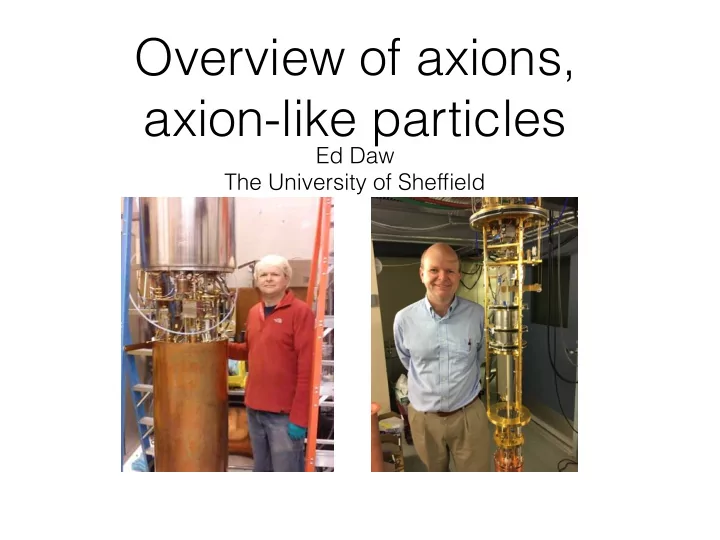
Overview of axions, axion-like particles
Ed Daw The University of Sheffield
Overview of axions, axion-like particles Ed Daw The University of - - PowerPoint PPT Presentation
Overview of axions, axion-like particles Ed Daw The University of Sheffield The Strong CP problem Standard model symmetry group is SU (3) SU (2) U (1) NON-ABELIAN NON-ABELIAN ABELIAN L CPV = ( + arg det M ) CP CP CP E QCD ~ ~
Ed Daw The University of Sheffield
Standard model symmetry group is SU(3) × SU(2) × U(1)
CP VIOLATING CP CONSERVING! CP CONSERVING ABELIAN NON-ABELIAN NON-ABELIAN
Evidence for CP conservation in the SU(3) strong interactions from multiple measurements of neutron and nuclear electric dipole moments. For example, neutron EDM < 10-26 e-cm. Even simple dimensional arguments show that this is unexpected. Why do the intricate SU(3) QCD interactions conserve CP when the less intricate SU(2) QED interactions do not? This is the strong CP problem.
10−13 cm
−2e 3
+e 3 +e 3
NEUTRON LCPV = (Θ + arg det M) 32⇡2 ~ EQCD · ~ BQCD
Re φ
( )
Im φ
( )
V φ
( )
θ
About Minimum: small curvature (hence small mass) with respect to large curvature (hence large mass) with respect to ¯ θ = arg(φ) Re(φ)
Axion DOF ALP DOF fPQ
gaγγ ∝ ma
The axion is a pseudoscalar; has the same quantum numbers as the , and the same interactions, but with strengths scaled to the axion mass π0
7 6
a
LAB HALO SUN ADMX* ALPS/ALPS2*
CAST IAXO* FUNKY MADMAX X3* OSQAR PVLAS CASCADE* CASPER ARIADNE* CAPP/CULTASK*
Axion Coupling |GAγγ | (GeV-1) Axion Mass mA (eV) 10-16 10-14 10-12 10-10 10-8 10-6 10-10 10-8 10-6 10-4 10-2 100
LSW (OSQAR) Helioscopes (CAST) Haloscopes (ADMX) Telescopes
Horizontal Branch Stars KSVZ DFSZ
VMB (PVLAS)
SN 1987A HESS
[1] K.A. Olive et al. (Particle Data Group), Chin. Phys. C, 38, 090001 (2014) and 2015 update 2016 revision by A. Ringwald, L. Rosenberg, G. Rybka,
[1]
10-10 10-8 10-6 10-4 10-2 100 102
ma (eV)
0.1 0.2
+a h2
ANTHROPIC - AXIONS LINKED TO INFLATION POST-INFLATION PQ RESTORATION
QUANTITY IN BRACKETS IS
Y1
Axion Coupling |GAγγ | (GeV-1) Axion Mass mA (eV) 10-16 10-14 10-12 10-10 10-8 10-6 10-10 10-8 10-6 10-4 10-2 100
LSW (OSQAR) Helioscopes (CAST) Haloscopes (ADMX) Telescopes
Horizontal Branch Stars KSVZ DFSZVMB (PVLAS)
SN 1987A HESSCavity top plate 1K plate LHe reservoir 1K pot Mixing chamber Still
ADMX Dilution Fridge at Janis
SQUIDs (at lower frequencies) “JPAs” (at higher frequencies)
10-10 10-16 10-15 10-14 10-13 10 100 1000 1 10 100 Axion Coupling |gaγγ | (GeV-1) Axion Mass (µeV) Gen 2 ADMX Projected Sensitivity Cavity Frequency (GHz)
" H a d r
i c " C
p l i n g M i n i m u m C
p l i n g
Axion Cold Dark Matter Warm Dark Matter
ADMX Published Limits
Non RF-cavity Techniques
Too Much Dark Matter White Dwarf and Supernova Bounds
Photonic bandgap cavities (1st half of 2019)
Y1: 1 cavity, 2 tuning rods Y2: 1 cavity, more rods Y3: 4 cavity array Y4/5: novel cavity designs
Y1 Y2 Y3 Y4/5
(20-100 meV) axion mass region.
refrigerator.
9 T magnet.
Parametric Amplifiers (JPAs)
10
[From a talk by Tim Shokair for X3 collaboration, 2015.]
spherical reflecting dish
The Ea-field excites surface electrons coherently EM radiation from a reflecting surface
P ∼ |Ea|2Adish ∼ 10−26 ✓ B 5T Caγ 2 ◆2 Adish 1 m2 Watt
From talk by Javier Redondo, Bela Majorovits, Warsaw Workshop on Non-Standard Dark Matter, June 2016
Disc reflector idea employed by proposed MADMAX, FUNKY
CASPER is a search for axion to nucleon coupling generating an
SQUID pickup loop
ARIADNE is a search for short-range axion mediated forces between a source mass and an NMR sample.
ma ≤ 10−9 eV
See Talk by Igor Irastorza TODAY (Tuesday), Elisa Ruiz-Choliz on Thursday
A proposed large scale axion haloscope, with a greatly increased axion conversion volume, new electronics, and a very large high-field magnet. Projected sensitivity to DFSZ/KSVZ axions above 0.01eV.
Axion Coupling |GAγγ | (GeV-1) Axion Mass mA (eV) 10-16 10-14 10-12 10-10 10-8 10-6 10-10 10-8 10-6 10-4 10-2 100
LSW (OSQAR) Helioscopes (CAST) Haloscopes (ADMX) Telescopes
Horizontal Branch Stars KSVZ DFSZ
VMB (PVLAS)
SN 1987A HESS
Axion Coupling |GAγγ | (GeV-1) Axion Mass mA (eV) 10-16 10-14 10-12 10-10 10-8 10-6 10-10 10-8 10-6 10-4 10-2 100
LSW (OSQAR) Helioscopes (CAST) Haloscopes (ADMX) Telescopes
Horizontal Branch Stars KSVZ DFSZ
VMB (PVLAS)
SN 1987A HESS
Axion Coupling |GAγγ | (GeV-1) Axion Mass mA (eV) 10-16 10-14 10-12 10-10 10-8 10-6 10-10 10-8 10-6 10-4 10-2 100
LSW (OSQAR) Helioscopes (CAST) Haloscopes (ADMX) Telescopes
Horizontal Branch Stars KSVZ DFSZ
VMB (PVLAS)
SN 1987A HESS
X3-3 years ADMX
Axion Coupling |GAγγ | (GeV-1) Axion Mass mA (eV) 10-16 10-14 10-12 10-10 10-8 10-6 10-10 10-8 10-6 10-4 10-2 100
LSW (OSQAR) Helioscopes (CAST) Haloscopes (ADMX) Telescopes
Horizontal Branch Stars KSVZ DFSZ
VMB (PVLAS)
SN 1987A HESS
X3 - 3 years MADMAX (preliminary proposed) ADMX
Axion Coupling |GAγγ | (GeV-1) Axion Mass mA (eV) 10-16 10-14 10-12 10-10 10-8 10-6 10-10 10-8 10-6 10-4 10-2 100
LSW (OSQAR) Helioscopes (CAST) Haloscopes (ADMX) Telescopes
Horizontal Branch Stars KSVZ DFSZ
VMB (PVLAS)
SN 1987A HESS
X3 - 3 years MADMAX (preliminary proposed) CAPP (preliminary proposed) IAXO reach ADMX