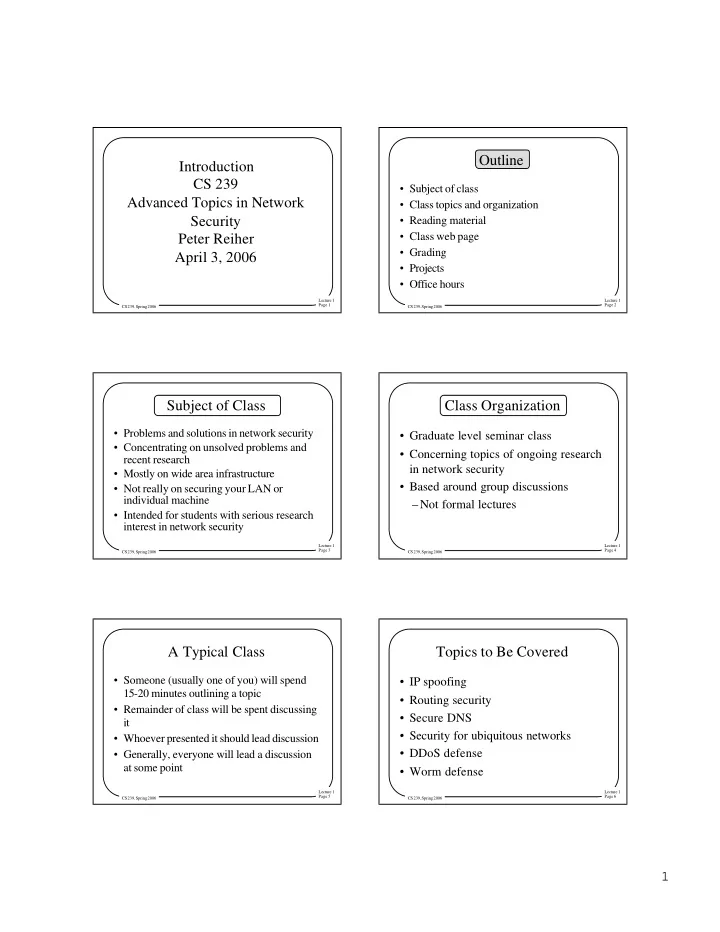
Outline Introduction CS 239 Subject of class Advanced Topics in - - PDF document

outline introduction cs 239
SMART_READER_LITE
LIVE PREVIEW

Outline Introduction CS 239 Subject of class Advanced Topics in - - PDF document

Outline Introduction CS 239 Subject of class Advanced Topics in Network Class topics and organization Security Reading material Class web page Peter Reiher Grading April 3, 2006 Projects Office hours Lecture


slide-1
SLIDE 1

1

Lecture 1 Page 1 CS 239, Spring 2006

Introduction CS 239 Advanced Topics in Network Security Peter Reiher April 3, 2006

Lecture 1 Page 2 CS 239, Spring 2006

Outline

  • Subject of class
  • Class topics and organization
  • Reading material
  • Class web page
  • Grading
  • Projects
  • Office hours

Lecture 1 Page 3 CS 239, Spring 2006

Subject of Class

  • Problems and solutions in network security
  • Concentrating on unsolved problems and

recent research

  • Mostly on wide area infrastructure
  • Not really on securing your LAN or

individual machine

  • Intended for students with serious research

interest in network security

Lecture 1 Page 4 CS 239, Spring 2006

Class Organization

  • Graduate level seminar class
  • Concerning topics of ongoing research

in network security

  • Based around group discussions

–Not formal lectures

Lecture 1 Page 5 CS 239, Spring 2006

A Typical Class

  • Someone (usually one of you) will spend

15-20 minutes outlining a topic

  • Remainder of class will be spent discussing

it

  • Whoever presented it should lead discussion
  • Generally, everyone will lead a discussion

at some point

Lecture 1 Page 6 CS 239, Spring 2006

Topics to Be Covered

  • IP spoofing
  • Routing security
  • Secure DNS
  • Security for ubiquitous networks
  • DDoS defense
  • Worm defense
slide-2
SLIDE 2

2

Lecture 1 Page 7 CS 239, Spring 2006

More Topics

  • Evaluating network defenses
  • Handling spam
  • Anonymization and privacy
  • Security alert systems
  • Phishing and pharming
  • Legal and political issues related to

these topics

Lecture 1 Page 8 CS 239, Spring 2006

Assigning Topics

  • I’ll take the first class (on IP spoofing)
  • A few will have guest lecturers
  • Each of you should volunteer to take
  • ne of the others
  • To be decided at the end of second

class

  • First come, first served

Lecture 1 Page 9 CS 239, Spring 2006

Reading Material

  • No textbook
  • 2-4 papers for each class

– Some selected by me – Some by class leader

  • Papers will be made available on class web

page

  • In some cases, web pages may be used

instead of papers

Lecture 1 Page 10 CS 239, Spring 2006

Class Web Page

  • http://www.lasr.cs.ucla.edu/classes/239_3.spring06
  • Will show class schedule
  • And list papers for each class

–With links to them

  • Other useful information also there

Lecture 1 Page 11 CS 239, Spring 2006

Grading

  • 20% midterm
  • 40% class participation
  • 40% project
  • No final exam

Lecture 1 Page 12 CS 239, Spring 2006

Midterm Exam

  • Essay questions based on material in

first half of class

  • Probably three questions
  • Open notes

–Including papers

slide-3
SLIDE 3

3

Lecture 1 Page 13 CS 239, Spring 2006

Class Participation

  • Covers both class you lead (15%) and

participation in other classes (25%)

  • Not graded on brilliance
  • But on involvement and ability to

contribute to discussion

  • If you can’t regularly attend this class,

you won’t do well in it

Lecture 1 Page 14 CS 239, Spring 2006

Leading a Class Discussion

  • Should focus on:

– Analysis of the problem – Critiques of existing solutions – Suggested improvements to those

  • Or new solution approaches
  • Think of it as being part of a research team

looking at this problem

  • Goal is to spark a discussion

– Not to spend two hours reviewing the papers that were assigned

Lecture 1 Page 15 CS 239, Spring 2006

Slides for Presentations

  • Not required, but a good idea
  • If possible, send them to me ahead of

time –So I can post them on the web page

  • I’ll bring a projector to every class

Lecture 1 Page 16 CS 239, Spring 2006

Class Projects

  • Half of your grade
  • Group projects (2-4 people)
  • On some topic involving network

security

  • Must be a research topic

–Not just implementing known stuff

Lecture 1 Page 17 CS 239, Spring 2006

Project Proposals

  • Project proposals due at end of 4

th

week of class (April 28)

  • 1-page summary of what you want to

do

  • Can be submitted as hard copy or

email

  • Not graded, but required

Lecture 1 Page 18 CS 239, Spring 2006

Project Status Reports

  • Due at end of 7th week of classes (May

19)

  • 1-3 page summaries of the progress

you’ve made to that date –Hint: there should be some

  • Hard copy or email OK
  • Not graded, but required
slide-4
SLIDE 4

4

Lecture 1 Page 19 CS 239, Spring 2006

Project Presentation

  • Last two class days reserved for project

presentations

  • In-class presentation of your project

–Demo, if feasible

  • Graded as part of project itself

Lecture 1 Page 20 CS 239, Spring 2006

Project Demonstration

  • If not feasible to demo in class, arrange

a separate demo with me

  • Projects should (usually) produce

something demonstrable

  • Important that demo shows off

something interesting about project

  • Graded as part of project

Lecture 1 Page 21 CS 239, Spring 2006

Project Reports

  • Written reports on project
  • Due Monday of finals week (June 12)
  • 15 pages is typical length
  • Should:

– Describe problem and approach – Cover difficulties and interesting points – Describe implementation – Show that you’ve learned something from it!

Lecture 1 Page 22 CS 239, Spring 2006

What Makes a Good Project?

  • Probably requires coding

– Hardware OK, if you can do it – Theoretical work acceptable, but you’ll need real results

  • Probably requires testing and/or measurement
  • Should be research

– Original work no one else has already done – Based on a promising idea – Ideally, this should be capable of being converted to a publishable research paper

Lecture 1 Page 23 CS 239, Spring 2006

Office Hours

  • MW 2-3
  • In 3532F Boelter Hall
  • I’m around a lot, so other times can be

arranged by appointment

  • But I’ll be away April 17-28

–Guest lecturers most of those days

Lecture 1 Page 24 CS 239, Spring 2006

Prerequisites

  • Probably should have taken CS 218
  • Should have taken my CS 239 on Computer

Security – Or similar class elsewhere

  • I’m not going to check on this
  • But I’ll assume you know this material

– I won’t be presenting reviews of this material

slide-5
SLIDE 5

5

Lecture 1 Page 25 CS 239, Spring 2006

Kinds of Security Things You Should Know About

  • IPsec
  • Security protocols
  • Key exchange, certificates, certification

hierarchies

  • Basics of security threats and mechanisms
  • Use of cryptography for authentication, privacy,

and other purposes

  • Basics of firewalls and virus protection systems
  • Basics of viruses and worms

Lecture 1 Page 26 CS 239, Spring 2006

Kinds of Networking Things You Should Know About

  • TCP/IP
  • Routing protocols
  • How DNS works
  • Multicast protocols
  • Basic ad hoc networking
  • Basics of wireless networks
  • Basic design and architecture of the Internet

Lecture 1 Page 27 CS 239, Spring 2006

A Short Introduction

  • What is this class really about?
  • Protecting computer networks and the

machines attached to them

  • Focusing on the network threats

–Bad things that can happen due to networking –Attacks on network components

Lecture 1 Page 28 CS 239, Spring 2006

What’s In

  • Security of routing protocols, DNS,

multicast protocols, resource reservation protocols

  • Network-wide attacks (DDoS, Worms)
  • Security of specialized networks (sensor

networks, ad hoc networks)

  • Related topics (measurement issues,

privacy, legal issues)

Lecture 1 Page 29 CS 239, Spring 2006

What’s Out

  • Cryptography (except as a tool)
  • Securing LANs (firewalls, intrusion

detection systems, etc.)

  • Securing individual computers (e.g,

hardening against buffer overflow attacks)

  • Security policy issues
  • Auditing, logging, formal methods, VPNs

Lecture 1 Page 30 CS 239, Spring 2006

Types of Networks Covered

  • The Internet
  • Ad hoc networks
  • Sensor networks
  • Ubiquitous environments
  • Peer overlay networks
slide-6
SLIDE 6

6

Lecture 1 Page 31 CS 239, Spring 2006

The Internet and Security

  • The original Internet design did not

consider security

  • Not surprisingly, the resulting network

has security problems

  • What are the threats?
  • How do we handle them?

Lecture 1 Page 32 CS 239, Spring 2006

Does the Internet Need Security?

  • Absolutely
  • Successful network attacks every day
  • Some network attacks have cut whole

countries off from the network

  • Some attacks have been made on the

infrastructure that whole Internet relies on

  • The value of what’s done on the Internet

keeps growing

  • So the value of stopping it also grows

Lecture 1 Page 33 CS 239, Spring 2006

Example Problems

  • Routing update security
  • DNS security
  • Router compromise
  • IP spoofing
  • Distributed denial of service attacks
  • Worms

Lecture 1 Page 34 CS 239, Spring 2006

Internet Realities

ISP ISP Autonomous Systems (ASs) The scope is worldwide

Lecture 1 Page 35 CS 239, Spring 2006

Illustrating Some Security Problems

Routing Attacks Eventually, the packets will be dropped

Lecture 1 Page 36 CS 239, Spring 2006

DNS Security

lasr.cs.ucla.edu

DNS Server

131.179.192.6 127.64.12.174

Which happens to be the hacker’s address . . . http://lasr.cs.ucla.edu

lasr.cs.ucla.edu

slide-7
SLIDE 7

7

Lecture 1 Page 37 CS 239, Spring 2006

Router Compromise

Now the attacker can do anything with the packets Drop them Misroute them Alter them

Lecture 1 Page 38 CS 239, Spring 2006

IP Spoofing

Who sent you the fatal packet? IP header IP payload Source address Destination address Now we’ll capture the desperate criminal! So has someone hacked Granny’s machine? No, somebody forged Granny’s IP address

Lecture 1 Page 39 CS 239, Spring 2006

Distributed Denial of Service

Lecture 1 Page 40 CS 239, Spring 2006

Worms

Pretty soon the Internet has a serious problem The infection traffic alone can be crippling

Lecture 1 Page 41 CS 239, Spring 2006

Internet Security Realities

  • 1. No one is in charge
  • 2. Different parties have different goals
  • 3. Cooperation only likely when it’s in

each party’s own interests

  • 4. It’s hard to change things
  • 5. It’s hard to get a global view of

what’s happening

Lecture 1 Page 42 CS 239, Spring 2006

The Security Implications

  • Attackers can leverage lack of

cooperation

  • Attackers can hide behind complexity
  • Hard to deploy new security solutions
  • You can’t count on other parties

helping you –Even if they aren’t attackers

slide-8
SLIDE 8

8

Lecture 1 Page 43 CS 239, Spring 2006

Problems for Other Types

  • f Networks
  • Power-draining attacks in sensor

networks

  • Compromise of location privacy in

ubiquitous environments

  • Sybil attacks in peer networks
  • Wormhole attacks in ad hoc networks

Lecture 1 Page 44 CS 239, Spring 2006

Characteristics of These Problems

  • Basic problems with network behavior
  • Assaults on networking infrastructure
  • Leveraging failure of network to check

for proper behavior

  • Overloading network
  • Attacking special requirements of

particular network types

Lecture 1 Page 45 CS 239, Spring 2006

Realities for Other Types of Networks

  • Many have inherent characteristics that

mitigate against security

  • Usually operating with limited resources
  • Often necessary to support many different

users

  • Often necessary to handle unknown users
  • What you’re trying to protect might be

different in nature than Internet cases

Lecture 1 Page 46 CS 239, Spring 2006

Implications of Those Realities

  • Many existing security solutions don’t work

here

  • Each special network type might be its own

special case

  • Generally can’t rely on closed communities
  • Must think in different ways related to the

characteristics of this network