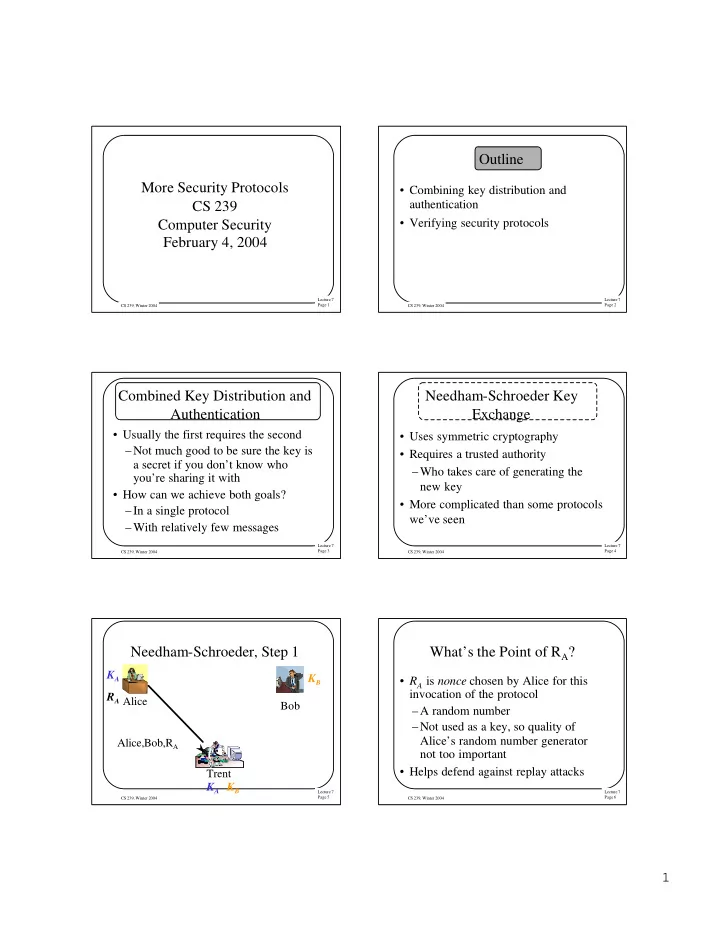
Outline More Security Protocols Combining key distribution and - - PDF document

outline more security protocols
SMART_READER_LITE
LIVE PREVIEW

Outline More Security Protocols Combining key distribution and - - PDF document

Outline More Security Protocols Combining key distribution and authentication CS 239 Verifying security protocols Computer Security February 4, 2004 Lecture 7 Lecture 7 Page 1 Page 2 CS 239, Winter 2004 CS 239, Winter 2004


slide-1
SLIDE 1

1

Lecture 7 Page 1 CS 239, Winter 2004

More Security Protocols CS 239 Computer Security February 4, 2004

Lecture 7 Page 2 CS 239, Winter 2004

Outline

  • Combining key distribution and

authentication

  • Verifying security protocols

Lecture 7 Page 3 CS 239, Winter 2004

Combined Key Distribution and Authentication

  • Usually the first requires the second

–Not much good to be sure the key is a secret if you don’t know who you’re sharing it with

  • How can we achieve both goals?

–In a single protocol –With relatively few messages

Lecture 7 Page 4 CS 239, Winter 2004

Needham-Schroeder Key Exchange

  • Uses symmetric cryptography
  • Requires a trusted authority

–Who takes care of generating the new key

  • More complicated than some protocols

we’ve seen

Lecture 7 Page 5 CS 239, Winter 2004

Needham-Schroeder, Step 1

Alice Bob Trent KA KA KB KB RA Alice,Bob,RA

Lecture 7 Page 6 CS 239, Winter 2004

What’s the Point of RA?

  • RA is nonce chosen by Alice for this

invocation of the protocol –A random number –Not used as a key, so quality of Alice’s random number generator not too important

  • Helps defend against replay attacks
slide-2
SLIDE 2

2

Lecture 7 Page 7 CS 239, Winter 2004

Needham-Schroeder, Step 2

Alice Bob Trent KA KA KB KB EKA(RA,Bob,KS, EKB(KS,Alice)) KS

What’s all this stuff for?

Including RA prevents replay Including Bob prevents attacker from replacing Bob’s identity

RA

Including the encrypted message for Bob ensures that message can’t be replaced

Lecture 7 Page 8 CS 239, Winter 2004

Needham-Schroeder, Step 3

Alice Bob Trent KA KA KB KB EKB(KS,Alice) KS KS So we’re done, right? Wrong!

Lecture 7 Page 9 CS 239, Winter 2004

Needham-Schroeder, Step 4

Alice Bob Trent KA KA KB KB EKS(RB) RB KS KS RB

Lecture 7 Page 10 CS 239, Winter 2004

Needham-Schroeder, Step 5

Alice Bob Trent KA KA KB KB RB KS KS RB EKS(RB-1) RB-1 Now we’re done!

Lecture 7 Page 11 CS 239, Winter 2004

Alice knows she’s talking to Bob

What’s All This Extra Stuff For?

Alice Bob Trent KA KA KB KB KS EKA(RA,Bob,KS, EKB(KS,Alice)) Trent said she was Can Mallory jump in later? No, only Bob could read the key package Trent created

Lecture 7 Page 12 CS 239, Winter 2004

Bob knows he’s talking to Alice

What’s All This Extra Stuff For?

Alice Bob Trent KA KA KB KB EKB(KS,Alice) KS Trent said he was Can Mallory jump in later? No, all later messages will use KS, which Mallory doesn’t know

W h a t a b

  • u

t t h

  • s

e r a n d

  • m

n u m b e r s ?

slide-3
SLIDE 3

3

Lecture 7 Page 13 CS 239, Winter 2004

Mallory Causes Problems

  • Alice and Bob do something Mallory likes
  • Mallory watches the messages they send to

do so

  • Mallory wants to make them do it again
  • Can Mallory replay the conversation?

– Let’s try it without the random numbers

Lecture 7 Page 14 CS 239, Winter 2004

Mallory Waits For His Chance

Alice Bob KA KA KB KB Mallory Alice,Bob

EKA(Bob,K S, EKB(KS,Alice))

Trent

Lecture 7 Page 15 CS 239, Winter 2004

What Will Alice Do Now?

  • The message could only have been

created by Trent

  • It properly indicates she wants to talk

to Bob

  • It contains a perfectly plausible key
  • Alice will probably go ahead with the

protocol

Lecture 7 Page 16 CS 239, Winter 2004

The Protocol Continues

Alice Bob KA KA KB KB Trent KS KS Mallory Mallory steps aside for a bit EKB(KS,Alice) With no random keys, we’re done

Lecture 7 Page 17 CS 239, Winter 2004

So What’s the Problem

  • Alice and Bob agree KS is their key

–They both know the key –Trent definitely created the key for them –Nobody else has the key

  • But . . .

Lecture 7 Page 18 CS 239, Winter 2004

Mallory Steps Back Into the Picture

Alice Bob KA KA KB KB Mallory Trent KS KS

EKS(Old message 1) EKS(Old message 2)

Mallory can replay Alice and Bob’s old conversation It’s using the current key, so Alice and Bob will accept it

slide-4
SLIDE 4

4

Lecture 7 Page 19 CS 239, Winter 2004

How Do the Random Numbers Help?

  • Alice’s random number assures her

that the reply from Trent is fresh

  • But why does Bob need another

random number?

Lecture 7 Page 20 CS 239, Winter 2004

Why Bob Also Needs a Random Number

Alice Bob KA KA KB KB Mallory Trent Let’s say Alice doesn’t want to talk to Bob But Mallory wants Bob to think Alice wants to talk

EKB(KS,Alice)

KS

Lecture 7 Page 21 CS 239, Winter 2004

So What?

Bob KB Mallory KS

EKS(Old message 1)

Mallory can now play back an old message from Alice to Bob And Bob will have no reason to be suspicious Bob’s random number exchange assured him that Alice really wanted to talk

Lecture 7 Page 22 CS 239, Winter 2004

So, Everything’s Fine, Right?

  • Not if any key K

S ever gets divulged

  • Once K

S is divulged, Mallory can forge

Alice’s response to Bob’s challenge

  • And convince Bob that he’s talking to

Alice when he’s really talking to Mallory

Lecture 7 Page 23 CS 239, Winter 2004

Mallory Cracks an Old Key

Bob KB Mallory

EKB(KS,Alice)

Mallory enlists 10,000 computers belonging to 10,000 grandmothers to crack KS KS KS RB

EKS(RB)

Unfortunately, Mallory knows KS So Mallory can answer Bob’s challenge

EKS(RB - 1)

RB - 1

Lecture 7 Page 24 CS 239, Winter 2004

Timestamps in Security Protocols

  • One method of handling this kind of

problem is timestamps

  • Proper use of timestamps can limit the

time during which an exposed key is dangerous

  • But timestamps have their own

problems

slide-5
SLIDE 5

5

Lecture 7 Page 25 CS 239, Winter 2004

Using Timestamps in the Needham-Schroeder Protocol

  • The trusted authority includes

timestamps in his encrypted messages to Alice and Bob

  • Based on a global clock
  • When Alice or Bob decrypts, if the

timestamp is too old, abort the protocol

Lecture 7 Page 26 CS 239, Winter 2004

Using Timestamps to Defeat Mallory

Bob KB Mallory

EKB(KS,Alice,T X)

KS

EKB(KS,Alice,T X)

Now Bob checks TX against his clock KS TX Tnow TX << Tnow So Bob, fearing replay, discards KS And Mallory’s attack is foiled

Lecture 7 Page 27 CS 239, Winter 2004

Problems With Using Timestamps

  • They require a globally synchronized

set of clocks –Hard to obtain, often –Attacks on clocks become important

  • They leave a window of vulnerability

Lecture 7 Page 28 CS 239, Winter 2004

The Suppress-Replay Attack

  • Assume two participants in a security

protocol – Using timestamps to avoid replay problems

  • If the sender’s clock is ahead of the

receiver’s, attacker can intercept message – And replay later, when receiver’s clock still allows it

Lecture 7 Page 29 CS 239, Winter 2004

Handling Clock Problems

1). Rely on clocks that are fairly synchronized and hard to tamper –Perhaps GPS signals 2). Make all comparisons against the same clock –So no two clocks need to be synchronized

Lecture 7 Page 30 CS 239, Winter 2004

Neuman-Stubblebine Protocol, Step 1

Alice Bob Trent KA KA KB KB RA Alice, RA What does Bob know? Someone claiming to be Alice wants to talk securely RA

slide-6
SLIDE 6

6

Lecture 7 Page 31 CS 239, Winter 2004

Neuman-Stubblebine Protocol, Step 2

Alice Bob Trent KA KA KB KB RA TB Bob,RB, EKB(Alice,RA,TB) RA RB Alice,RA,TB Trent knows Bob thinks Alice wants to talk to him But does she really?

Lecture 7 Page 32 CS 239, Winter 2004

Neuman-Stubblebine Protocol, Step 3

Alice Bob Trent KA KA KB KB RA TB RB Alice,RA,TB KS EKA(Bob,RA,KS,TB), EKB(Alice,KS,TB),RB Bob,RA,KS,TB Alice knows:

  • 1. Bob heard

her message

  • 2. Trent created

a new key

Lecture 7 Page 33 CS 239, Winter 2004

Neuman-Stubblebine Protocol, Step 4

Alice Bob Trent KA KA KB KB TB RB EKB(Alice,KS,TB),RB EKB(Alice,KS,TB), E

KS(RB)

KS KS TB RB Bob checks RB and TB RB guarantees Alice knows KS TB guarantees it’s a fresh session

Lecture 7 Page 34 CS 239, Winter 2004

What Has the Protocol Achieved?

  • Alice and Bob share a key
  • They know the key was generated by

Trent

  • Alice knows this key matches her

recent request for a key

  • Bob knows this key matches Alice’s

recent request and Bob’s agreement

Lecture 7 Page 35 CS 239, Winter 2004

What Has the Timestamp Done For Bob and Alice?

  • Bob knows that the whole agreement is

timely

  • Since the only timestamp originated

with his clock, no danger of suppress- replay attacks

Lecture 7 Page 36 CS 239, Winter 2004

What Else Can You Do With Security Protocols?

  • Secret splitting and secret sharing
  • Fair coin flips and other games
  • Simultaneous contract signing
  • Secure elections
  • Zero knowledge proofs off-line
  • Lots of other neat stuff
slide-7
SLIDE 7

7

Lecture 7 Page 37 CS 239, Winter 2004

Secret Splitting and Secret Sharing

  • What if we have a secret that we need

to recover later?

  • We need to have it in other people’s

hands

  • But we don’t want anyone to be able to

tell the secret

Lecture 7 Page 38 CS 239, Winter 2004

Secret Splitting

  • Divide the secret among two or more

people

  • They can combine to retrieve the secret
  • But neither can guess the secret

themselves

Lecture 7 Page 39 CS 239, Winter 2004

Secret Splitting Example

Alice Bob Trent Trent wants to share secret M R S= R? M R S R S

Lecture 7 Page 40 CS 239, Winter 2004

Recovering the Secret

Alice Bob Trent R S R R ? S M`

Lecture 7 Page 41 CS 239, Winter 2004

What If We Want To Do This Securely?

  • What cryptographic steps would we

perform to ensure security?

  • That only Alice and Bob have secret

components

  • That they have components of the real

secret

  • What about ensuring that Alice and Bob

both learn the secret if either does?

Lecture 7 Page 42 CS 239, Winter 2004

Secret Sharing

  • Say we have three participants

– Alice, Bob, Carol

  • Can we arrange that:

– None of them know the secret alone – Any pair of them can produce the secret

  • Yes, using various secret sharing protocols
slide-8
SLIDE 8

8

Lecture 7 Page 43 CS 239, Winter 2004

Bit Commitment

  • Alice wants to make a choice now
  • And prove to Bob what that choice was
  • Without telling him the choice now
  • How can Bob be sure that Alice isn’t

cheating?

Lecture 7 Page 44 CS 239, Winter 2004

Basic Bit Commitment

Alice Bob R R EKS(R,b) EKS R EKS(R,b) EKS(R,b) b Bob can’t tell yet what bit Alice chose Since Bob doesn’t have EKS

Lecture 7 Page 45 CS 239, Winter 2004

Now Alice Claims the Bit Was 1

Alice Bob EKS(R,b) EKS R EKS(R,b) b b == 1 How does Alice prove it? EKS R EKS R,b If b == 1, Alice told the truth

Lecture 7 Page 46 CS 239, Winter 2004

Why Does This Work?

  • Bob can’t learn what bwas until Alice

tells him KS

  • Alice gives Bob a cryptographic

package that she can’t change

  • Since the package includes R, Alice

can’t generate two keys, one for 0 and the other for 1

Lecture 7 Page 47 CS 239, Winter 2004

Making This Work Over the Network

  • What would we have to do if Mallory was

hanging around trying to screw things up?

  • What if we wanted to keep the value of b

secret from Mallory?

  • What if we wanted to ensure that Mallory

couldn’t replace Alice’s choice?

Lecture 7 Page 48 CS 239, Winter 2004

Fair Coin Flips

  • Two participants cryptographically “flip a

coin”

  • Based on clever use of bit commitment

– “Cut and choose”

  • Basic version assumes no interfering third

party

  • And no need for secrecy
  • Similar approaches can work for other

games of chance

slide-9
SLIDE 9

9

Lecture 7 Page 49 CS 239, Winter 2004

Simultaneous Contract Signing

  • Alice and Bob want to sign a contract

–But only if each is sure the other also signs

  • Basic method uses an arbitrator
  • Non-arbitrated cryptographic method

uses probabilistic outcome

Lecture 7 Page 50 CS 239, Winter 2004

Verifying Security Protocols

  • Security protocols are obviously very

complicated

  • And any flaw in the protocol can be

very expensive

  • Thus, verifying their correctness is of

great value

  • How to do it?

Lecture 7 Page 51 CS 239, Winter 2004

Basic Approaches to Verifying Protocols

  • Use standard specification and verification

languages and tools

  • Use expert systems
  • Use logics for the analysis of knowledge

and beliefs

  • Use formal methods based on algebraic

term-rewriting properties of cryptography

Lecture 7 Page 52 CS 239, Winter 2004

Using Standard Specification and Verification Tools

  • Treat protocol as a computer program

and prove its correctness

  • The oldest approach
  • Using

–Finite state machines –First-order predicate calculus –Specification languages

Lecture 7 Page 53 CS 239, Winter 2004

Problems With the Approach

  • Very laborious
  • Worse, correctness isn’t the same as

security – The correctness you prove may not have even considered the possibility of certain attacks

  • Too many protocols that have been

“proven” have had security problems

Lecture 7 Page 54 CS 239, Winter 2004

Using Expert Systems

  • Develop an expert system that knows a

lot about security protocols

  • Run it against proposed protocols
  • In particular, use the expert system to

determine if the protocol can reach an undesirable state –Such as exposing a secret key

slide-10
SLIDE 10

10

Lecture 7 Page 55 CS 239, Winter 2004

Problems With the Expert System Approach

  • Good at identifying flaws

–Provided they are based on already known problems

  • Not so good at proving correctness or

security

  • Or at uncovering flaws based on new

attacks

Lecture 7 Page 56 CS 239, Winter 2004

Using Belief and Knowledge Logics

  • An increasingly popular approach
  • Describe certain properties that a

security protocol should have

  • Use logic to demonstrate the presence

(or absence) of those properties

Lecture 7 Page 57 CS 239, Winter 2004

BAN Logic

  • Named for its creators (Burrows,

Abadi, and Needham)

  • The most popular method of this kind
  • Used to reason about authentication

–Not other aspects of security

  • Allows reasoning about beliefs in

protocols

Lecture 7 Page 58 CS 239, Winter 2004

Sample BAN Logic Statements

  • Alice believes X.
  • Alice sees X.
  • Alice said X.
  • X is fresh.

Lecture 7 Page 59 CS 239, Winter 2004

Steps in Applying BAN Logic

  • Convert protocol to an idealized form
  • Add all assumptions about initial state
  • Attach logical formulae to the

statements

  • Apply logical postulates to the

assertions and assumptions to discover the beliefs of protocol parties

Lecture 7 Page 60 CS 239, Winter 2004

What Can BAN Logic Do?

  • Discover flaws in protocols

–Found flaws in Needham-Schroeder

  • Discover redundancies

–In Needham-Schroeder, Kerberos, etc.

slide-11
SLIDE 11

11

Lecture 7 Page 61 CS 239, Winter 2004

Critiques of BAN Logic

  • Translations into idealized protocols

may not reflect the real protocol

  • Doesn’t address all important security

issues for protocols

  • Some feel that BAN logic can deduce

characteristics that are obviously false

Lecture 7 Page 62 CS 239, Winter 2004

Using Algebraic Term-Rewriting Modeling Methods

  • Model the protocol as an algebraic

system

  • Express the state of the participants’

knowledge about the protocol

  • Analyze the attainability of certain

states

Lecture 7 Page 63 CS 239, Winter 2004

Use of These Methods

  • NRL Protocol Analyzer

–Has discovered flaws in several protocols

  • A relatively new method
  • Weakest link seems to be formalizing

protocol into an algebraic system

Lecture 7 Page 64 CS 239, Winter 2004

Specialized Approaches

  • Stubblebine & Gligor’s method of modeling

weak crypto checksums – Found problems in Kerberos and Privacy- Enhanced Mail – Not useful for other types of analysis

  • Woo-Lam’s approach for key distribution

protocols

  • Pfitzmann’s method for digital signatures
  • There are others

Lecture 7 Page 65 CS 239, Winter 2004

An Entirely Different Approach

  • Instead of using formal methods to

verify security protocols,

  • Use them to develop such protocols
  • Some early work done using this

approach

  • Not clear if it will be fruitful

Lecture 7 Page 66 CS 239, Winter 2004

Bottom Line on Security Protocol Analysis

  • Has been successful in finding some

problems

  • No one believes existing methods can find

all problems

  • Some knowledgeable observers think no

method will ever be able to find all problems

  • So, a useful tool, but not a panacea
  • Research in this area continues