Outline Cryptography and Encryption Uses of cryptography - - PDF document

outline cryptography and encryption
SMART_READER_LITE
LIVE PREVIEW

Outline Cryptography and Encryption Uses of cryptography - - PDF document

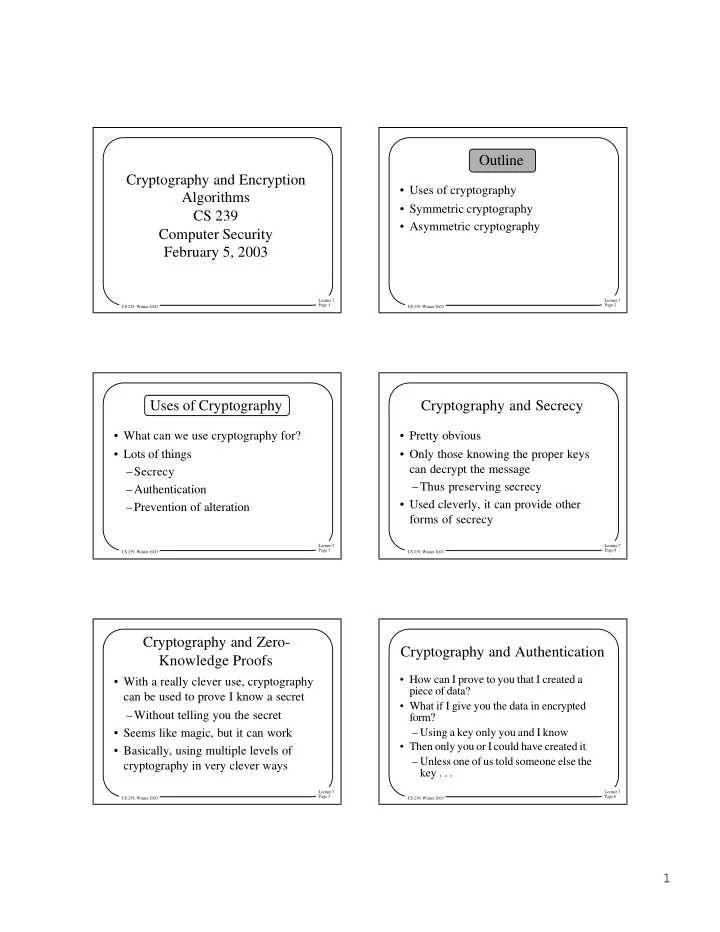
Outline Cryptography and Encryption Uses of cryptography Algorithms Symmetric cryptography CS 239 Asymmetric cryptography Computer Security February 5, 2003 Lecture 7 Lecture 7 Page 1 Page 2 CS 239, Winter 2003 CS 239,


slide-1
SLIDE 1

1

Lecture 7 Page 1 CS 239, Winter 2003

Cryptography and Encryption Algorithms CS 239 Computer Security February 5, 2003

Lecture 7 Page 2 CS 239, Winter 2003

Outline

  • Uses of cryptography
  • Symmetric cryptography
  • Asymmetric cryptography

Lecture 7 Page 3 CS 239, Winter 2003

Uses of Cryptography

  • What can we use cryptography for?
  • Lots of things

–Secrecy –Authentication –Prevention of alteration

Lecture 7 Page 4 CS 239, Winter 2003

Cryptography and Secrecy

  • Pretty obvious
  • Only those knowing the proper keys

can decrypt the message –Thus preserving secrecy

  • Used cleverly, it can provide other

forms of secrecy

Lecture 7 Page 5 CS 239, Winter 2003

Cryptography and Zero- Knowledge Proofs

  • With a really clever use, cryptography

can be used to prove I know a secret –Without telling you the secret

  • Seems like magic, but it can work
  • Basically, using multiple levels of

cryptography in very clever ways

Lecture 7 Page 6 CS 239, Winter 2003

Cryptography and Authentication

  • How can I prove to you that I created a

piece of data?

  • What if I give you the data in encrypted

form? – Using a key only you and I know

  • Then only you or I could have created it

– Unless one of us told someone else the key . . .

slide-2
SLIDE 2

2

Lecture 7 Page 7 CS 239, Winter 2003

Some Limitations on Cryptography and Authentication

  • If both parties cooperative, cryptography

can authenticate – Problems with non-repudiation, though

  • What if three parties want to share a key?

– No longer certain who created anything – Public key cryptography can solve this problem, too

  • What if I want to prove authenticity without

secrecy?

Lecture 7 Page 8 CS 239, Winter 2003

Cryptography and Non- Alterability

  • Changing one bit of an encrypted

message completely garbles it

  • If a checksum is part of encrypted data,

that’s detectable

  • If you don’t need secrecy, can get the

same effect –By just encrypting the checksum

Lecture 7 Page 9 CS 239, Winter 2003

Symmetric and Asymmetric Cryptosystems

  • Symmetric - the encrypter and

decrypter share a secret key –Used for both encrypting and decrypting

  • Asymmetric – encrypter has different

key than decrypter

Lecture 7 Page 10 CS 239, Winter 2003

Description of Symmetric Systems

  • C = E(K,P)
  • P = D(K,C)
  • E() and D() are not necessarily

symmetric operations

Lecture 7 Page 11 CS 239, Winter 2003

Advantages of Symmetric Key Systems

+ Encryption and authentication performed in a single operation + Well-known (and trusted) ones perform faster than asymmetric key systems + Doesn’t require any centralized authority

  • Though key servers help a lot

Lecture 7 Page 12 CS 239, Winter 2003

Disadvantage of Symmetric Key Systems

– Encryption and authentication performed in a single operation

  • Makes signature more difficult

– Key distribution can be a problem – Scaling

slide-3
SLIDE 3

3

Lecture 7 Page 13 CS 239, Winter 2003

Scaling Problems of Symmetric Cryptography

K1 K1 K2 K2 K3 K3 K4 K4 K5 K5 K6 K6

How many keys am I going to need to handle the entire Internet????

Lecture 7 Page 14 CS 239, Winter 2003

Sample Symmetric Key Ciphers

  • The Data Encryption Standard
  • The Advanced Encryption Standard
  • There are many others

Lecture 7 Page 15 CS 239, Winter 2003

The Data Encryption Standard

  • Probably the best known symmetric

key cryptosystem

  • Developed in 1977
  • Still in wide use

–Which implies no one has seriously broken it, yet

  • But showing its age

Lecture 7 Page 16 CS 239, Winter 2003

History of DES

  • Developed in response to National Bureau
  • f Standards studies
  • Developed by IBM
  • Analyzed , altered, and approved by the

National Security Agency

  • Adopted as a federal standard
  • One of the most widely used encryption

algorithms

Lecture 7 Page 17 CS 239, Winter 2003

Overview of DES Algorithm

  • A block encryption algorithm

– 64 bit blocks

  • Uses substitution and permutation

– Repeated applications

  • 16 cycles worth
  • 64 bit key

– Only 56 bits really used, though

Lecture 7 Page 18 CS 239, Winter 2003

More On DES Algorithm

  • Uses substitutions to provide confusion

– To hide the set of characters sent

  • Uses transpositions to provide diffusion

– To spread the effects of one plaintext bit into other bits

  • Uses only standard arithmetic and logic

functions and table lookup

slide-4
SLIDE 4

4

Lecture 7 Page 19 CS 239, Winter 2003

Description of DES Algorithm

  • Alternate applications of two different

ciphers –A product cipher

  • Starts by breaking block in half
  • The algorithm goes through 16 rounds
  • Each round consists of a substitution

followed by a permutation

Lecture 7 Page 20 CS 239, Winter 2003

One DES Round

  • Select 48 bits from the key
  • Expand right half of block to 48 bits
  • XOR with key bits
  • Look up result in an S-box

– Resulting in 32 bits

  • XOR with left half of block
  • Result is new right half
  • Old right half becomes new left half

Lecture 7 Page 21 CS 239, Winter 2003

DES Round Diagram

Left Right Key

Shift Shift

Compress Expand + Substitution Permutation + Left Right Key

Lecture 7 Page 22 CS 239, Winter 2003

S-Boxes

  • Table lookups to perform substitutions
  • Permanently defined for DES
  • Eight different S-boxes

–Six bits out of 48 bits go to each –Four bits come out of each

  • Choice of contents of S-boxes believed

to strongly impact security of DES

Lecture 7 Page 23 CS 239, Winter 2003

P-Box

  • Maps 32 input bits to 32 output bits
  • A single, straight permutation

–Unlike S-boxes, which are table lookups

Lecture 7 Page 24 CS 239, Winter 2003

Decrypting DES

  • For DES, D() is the same as E()
  • You decrypt with exactly the same

algorithm

  • If you feed ciphertext and the same key

into DES, the original plaintext pops

  • ut
slide-5
SLIDE 5

5

Lecture 7 Page 25 CS 239, Winter 2003

Is DES Secure?

  • Apparently, reasonably
  • No evidence NSA put a trapdoor in
  • Some keys are known to be weak with

DES –So good implementations reject them

  • Initially, only brute force attacks have

cracked DES

Lecture 7 Page 26 CS 239, Winter 2003

Key Length and DES

  • Easiest brute force attack is to try all

keys –Looking for a meaningful output

  • Cost of attack proportional to number
  • f possible keys
  • Is 2

56 enough keys?

Lecture 7 Page 27 CS 239, Winter 2003

DES Cracking Experiments

  • RSA Data Security issued challenge to

crack a DES-encrypted message

  • Various people got together to do so

–Harnessing computers across the Internet –Using a brute-force approach

  • Did it in 1998

Lecture 7 Page 28 CS 239, Winter 2003

How the DES Message Was Cracked

  • Required use of tens of thousands of

computers

  • Took four months
  • The searchers “got lucky”

– Only one quarter of key space searched – On average, brute force requires searching one half of key space

  • Done over four years ago

– So it would presumably take 1/4 time today

Lecture 7 Page 29 CS 239, Winter 2003

Does This Mean DES is Unsafe?

  • Depends on what you use it for
  • In how many cases will tens of thousands of

machines apply spare cycles for several days to break one message?

  • On the other hand, computers will continue to get

faster

  • And motivated opponents can harness vast

resources

  • Those who care seriously about security don’t

tend to use DES any more

Lecture 7 Page 30 CS 239, Winter 2003

Triple DES

  • Simple way of increasing security of DES
  • Apply DES three times iteratively to each

block – Thus, 1/3 as fast as DES

  • Use different key for each encryption
  • Effectively doubles the key length of DES
  • Approved by NIST

– Which recommends using in in preference to DES

slide-6
SLIDE 6

6

Lecture 7 Page 31 CS 239, Winter 2003

The Advanced Encryption Standard

  • A relatively new cryptographic algorithm
  • Intended to be the replacement for DES
  • Chosen by NIST

– Through an open competition

  • Chosen cipher was originally called

Rijndael – Developed by Dutch researchers – Uses combination of permutation and substitution

Lecture 7 Page 32 CS 239, Winter 2003

Public Key Encryption Systems

  • The encrypter and decrypter have

different keys C = E(KE,P) P = D(KD,C)

  • Often, works the other way, too

?? C E K P

D

( , )

P D K C

E

? ? ( , )

Lecture 7 Page 33 CS 239, Winter 2003

History of Public Key Cryptography

  • Invented by Diffie and Hellman in

1976

  • Merkle and Hellman developed

Knapsack algorithm in 1978

  • Rivest-Shamir-Adelman developed

RSA in 1978 –Most popular public key algorithm

Lecture 7 Page 34 CS 239, Winter 2003

Practical Use of Public Key Cryptography

  • Keys are created in pairs
  • One key is kept secret by the owner
  • The other is made public to the world
  • If you want to send an encrypted

message to someone, encrypt with his public key –Only he has private key to decrypt

Lecture 7 Page 35 CS 239, Winter 2003

Authentication With Shared Keys

  • If only two people know the key, and I

didn’t create a properly encrypted message - –The other guy must have

  • But what if he claims he didn’t?
  • Or what if there are more than two?
  • Requires authentication servers

Lecture 7 Page 36 CS 239, Winter 2003

Authentication With Public Keys

  • If I want to “sign” a message, encrypt

it with my private key

  • Only I know private key, so no one

else could create that message

  • Everyone knows my public key, so

everyone can check my claim directly

slide-7
SLIDE 7

7

Lecture 7 Page 37 CS 239, Winter 2003

Scaling of Public Key Cryptography

Ke Kd Ke Kd Ke Kd Ke Kd Ke Kd Ke Kd Ke Kd Ke Kd Ke Kd Ke Kd Ke Kd Ke Kd Ke Kd

Lecture 7 Page 38 CS 239, Winter 2003

Key Management Issues

  • To communicate via shared key

cryptography, key must be distributed –In trusted fashion

  • To communicate via public key

cryptography, need to find out each

  • ther’s public key

–“Simply publish public keys”

Lecture 7 Page 39 CS 239, Winter 2003

Issues of Key Publication

  • Security of public key cryptography

depends on using the right public key

  • If I am fooled into using the wrong one, that

key’s owner reads my message

  • Need high assurance that a given key

belongs to a particular person

  • Which requires key distribution

infrastructure

Lecture 7 Page 40 CS 239, Winter 2003

RSA Algorithm

  • Most popular public key cryptographic

algorithm

  • In wide use
  • Has withstood much cryptanalysis
  • Based on hard problem of factoring

large numbers

Lecture 7 Page 41 CS 239, Winter 2003

RSA Keys

  • Keys are functions of a pair of 100-200

digit prime numbers

  • Relationship between public and

private key is complex

  • Recovering plaintext without private

key (even knowing public key) is supposedly equivalent to factoring product of the prime numbers

Lecture 7 Page 42 CS 239, Winter 2003

Comparison of DES and RSA

  • DES is much more complex
  • However, DES uses only simple arithmetic,

logic, and table lookup

  • RSA uses exponentiation to very large

powers – Computationally 1000 times more expensive in hardware – 100 times in software

  • Key selection also more expensive
slide-8
SLIDE 8

8

Lecture 7 Page 43 CS 239, Winter 2003

A Downside To RSA

  • It’s patented
  • By the inventor’s company
  • Thus, you need a license to use it
  • Company has had some criticism on

licensing policies

  • But very widely used today

Lecture 7 Page 44 CS 239, Winter 2003

Security of RSA

  • Conjectured that security depends on

factoring large numbers –But never proven –Some variants proven equivalent to factoring problem

  • Probably the conjecture is correct

Lecture 7 Page 45 CS 239, Winter 2003

Attacks on Factoring RSA Keys

  • In 1994, a 129 bit RSA key was

successfully factored – 1600 computers, several months

  • Recent paper (fall 2001) on integer

factorization suggests keys up to 2048 bits may be insecure

  • Size will keep increasing
  • The longer the key, the more expensive the

encryption and decryption

Lecture 7 Page 46 CS 239, Winter 2003

Combined Use of Symmetric and Asymmetric Cryptography

  • Very common to use both in a single

session

  • Asymmetric cryptography essentially used

to “bootstrap” symmetric crypto

  • Use RSA (or other algorithm like PGP) to

authenticate and establish a session key

  • Use DES/Triple DES/AES using session

key for the rest of the transmission

Lecture 7 Page 47 CS 239, Winter 2003

Digital Signature Algorithms

  • In some cases, secrecy isn’t required
  • But authentication is
  • The data must be guaranteed to be that

which was originally sent

  • Especially important for data that is

long-lived

Lecture 7 Page 48 CS 239, Winter 2003

Desirable Properties of Digital Signatures

  • Unforgeable
  • Verifiable
  • Non-repudiable
  • Cheap to compute and verify
  • Non-reusable
  • No reliance on trusted authority
  • Signed document is unchangeable
slide-9
SLIDE 9

9

Lecture 7 Page 49 CS 239, Winter 2003

Encryption and Digital Signatures

  • Digital signature methods are based on

encryption

  • Encryption can be used as a signature

Lecture 7 Page 50 CS 239, Winter 2003

Signatures With Shared Key Encryption

  • Requires a trusted third party
  • Signer encrypts document with secret

key shared with third party

  • Receiver checks validity of signature

by consulting with trusted third party

  • Third party required so receiver can’t

forge the signature

Lecture 7 Page 51 CS 239, Winter 2003

Signatures With Public Key Cryptography

  • Signer encrypts document with his private

key

  • Receiver checks validity by decrypting with

signer’s public key

  • Only signer has the private key

– So no trusted third party required

  • But receiver must be certain that he has the

right public key

Lecture 7 Page 52 CS 239, Winter 2003

Problems With Simple Encryption Approach

  • Computationally expensive

–Especially with public key approach

  • Document is encrypted

–Must be decrypted for use –If in regular use, must store encrypted and decrypted versions

Lecture 7 Page 53 CS 239, Winter 2003

Secure Hash Algorithms

  • A method of protecting data from

modification

  • Doesn’t actually prevent modification
  • But gives strong evidence that

modification did or didn’t occur

  • Typically used with digital signatures

Lecture 7 Page 54 CS 239, Winter 2003

Idea Behind Secure Hashes

  • Apply a one-way cryptographic

function to data in question

  • Producing a much shorter result
  • Attach the cryptographic hash to the

data before sending

  • When necessary, repeat the function on

the data and compare to the hash value

slide-10
SLIDE 10

10

Lecture 7 Page 55 CS 239, Winter 2003

Secure Hash Algorithm (SHA)

  • Endorsed by NIST
  • But produced by the NSA . . .
  • Reduces input data of up to 264 bits to

160 bit digest

  • Doesn’t require secret key
  • Generally felt to be reasonably secure

Lecture 7 Page 56 CS 239, Winter 2003

Use of Cryptographic Hashes

  • Must assume opponent also has hashing

function

  • And it doesn’t use secret key
  • So opponent can substitute a different

message with a different hash

  • How to prevent this?
  • And what (if anything) would secure hashes

actually be useful for?

Lecture 7 Page 57 CS 239, Winter 2003

Hashing and Signatures

  • Use a digital signature algorithm to sign the

hash

  • But why not just sign the whole message,

instead?

  • Computing the hash and signing it may be

faster than signing the document

  • Receiver need only store document plus

hash

Lecture 7 Page 58 CS 239, Winter 2003

Checking a Document With a Signed Hash

1. The party of the first part will hereafter be referred to as the party of the first part. 2. The party of the second part will hereafter be referred to as the party of the second part.

. . .

  • 1000. The sanity clause.

01101110010101011011 101011110 . . . 11101010010011010101

  • 100010100. . .

Ks Hash Encrypt

1. The party of the first part will hereafter be referred to as the party of the first part. 2. The party of the second part will hereafter be referred to as the party of the second part.

. . .

  • 1000. The sanity clause.

11101010010011010101

  • 100010100. . .

11101010010011010101

  • 100010100. . .

11101010010011010101

  • 100010100. . .

Hash

01101110010101011011 101011110 . . .

Decrypt Kp

01101110010101011011 101011110 . . .

Lecture 7 Page 59 CS 239, Winter 2003

The Birthday Attack

  • How many people must be in a room

for the chances to be greater than even that two of them share a birthday?

  • Answer is 23
  • The same principle can be used to

attack hash algorithms

Lecture 7 Page 60 CS 239, Winter 2003

Using the Birthday Attack on Hashes

  • For a given document, find a different

document that has the effect you want

  • Trivially alter the second document so

that it hashes to the same value as the target document –Using an exhaustive attack

slide-11
SLIDE 11

11

Lecture 7 Page 61 CS 239, Winter 2003

How Hard Is the Birthday Attack?

  • Depends on the length of the hash

–And the quality of the hashing algorithm

  • Essentially, looking for hashing

collisions

  • So long hashes are good

–SHA produces 2

80 random hashes