OUT OF AUTOCLAVE MATERIAL SEMI-PREG / TECHNICAL DEVELOPMENT OF RESIN - - PDF document

out of autoclave material semi preg technical development
SMART_READER_LITE
LIVE PREVIEW

OUT OF AUTOCLAVE MATERIAL SEMI-PREG / TECHNICAL DEVELOPMENT OF RESIN - - PDF document

18 TH INTERNATIONAL CONFERENCE ON COMPOSITE MATERIALS OUT OF AUTOCLAVE MATERIAL SEMI-PREG / TECHNICAL DEVELOPMENT OF RESIN TRANSFER MOLDING Y. Umemoto 1* , M. Gouke 2 Y. Mashima 3 1 Advanced Composite Marketing & Business Development


slide-1
SLIDE 1

18TH INTERNATIONAL CONFERENCE ON COMPOSITE MATERIALS

OUT OF AUTOCLAVE MATERIAL “SEMI-PREG” / TECHNICAL DEVELOPMENT OF RESIN TRANSFER MOLDING

  • Y. Umemoto1*, M. Gouke2 Y. Mashima3

1 Advanced Composite Marketing & Business Development Department, Toho Tenax Co., Ltd.,

Tokyo, Japan, 2 Mobility Sales Section, Toho Tenax Co., Ltd. , Tokyo, Japan, 3 Composite Technology Center, Toho Tenax Co., Ltd., Gifu, Japan

* Corresponding author (umemotoy@tohotenax.com) Keywords: RFI, RTM, NCF, out of autoclave, binder, automobile

  • 1. Abstract

Autoclave molding method using prepreg had been used to make CFRP for long time. This is because high quality and reliable process has been chosen for the needs to introduce in the primary structure of aircraft, main application of CFRP. Recently, aircraft market is growing for global economic growth, and for the expansion of small and medium sized plane market such as regional jets, CFRP molding technology with low cost and high productivity is highly required. On the other hands, in automotive applications, CFRP had been limited to be used for luxury sporty

  • cars. But recently even for mass production cars, car

bodies need to be lighter by CFRP as the environmental regulations become stronger. In order to realize mass productive CFRP bodies, technological developments are accelerated for lower cost and higher productivity. Today, we would like to introduce achievement of developing “Semi-Preg (RFI)” and “Resin Transfer Molding (RTM)” in Toho Tenax, the key technologies in thermoset composites.

  • 2. RFI Technology Development

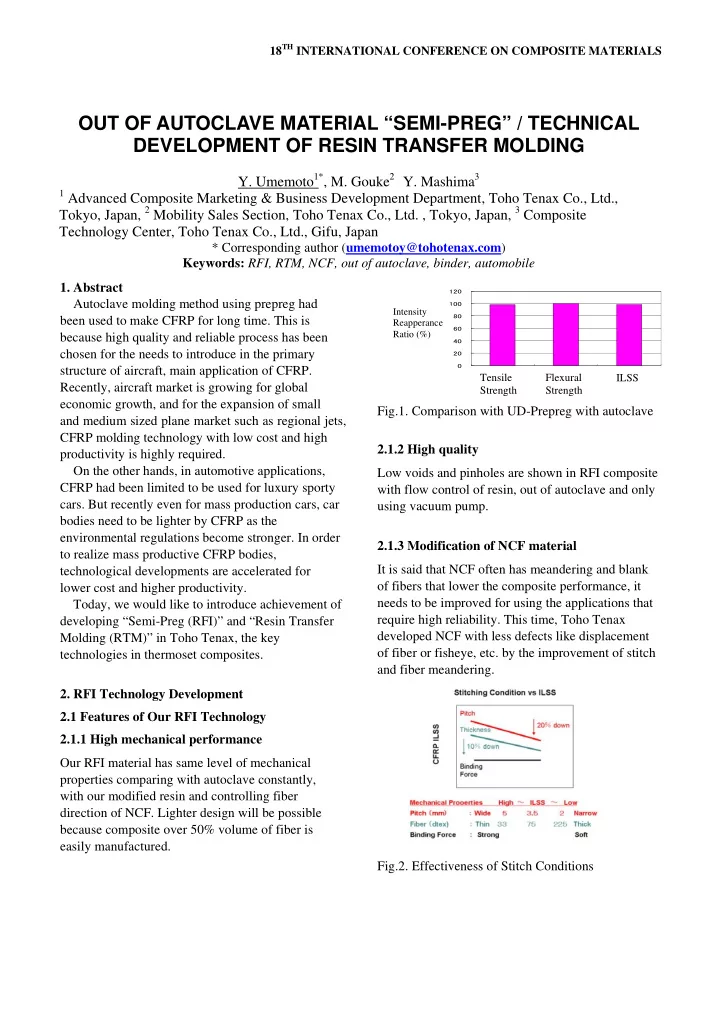
2.1 Features of Our RFI Technology 2.1.1 High mechanical performance Our RFI material has same level of mechanical properties comparing with autoclave constantly, with our modified resin and controlling fiber direction of NCF. Lighter design will be possible because composite over 50% volume of fiber is easily manufactured.

20 40 60 80 100 120

Fig.1. Comparison with UD-Prepreg with autoclave 2.1.2 High quality Low voids and pinholes are shown in RFI composite with flow control of resin, out of autoclave and only using vacuum pump. 2.1.3 Modification of NCF material It is said that NCF often has meandering and blank

  • f fibers that lower the composite performance, it

needs to be improved for using the applications that require high reliability. This time, Toho Tenax developed NCF with less defects like displacement

  • f fiber or fisheye, etc. by the improvement of stitch

and fiber meandering. Fig.2. Effectiveness of Stitch Conditions

引張強度 曲げ強度 層間せん断強度 物 性 発 現 率 %

Intensity Reapperance Ratio (%)

Tensile Strength Flexural Strength ILSS

slide-2
SLIDE 2

2.2.3 Laminating Cost Density of prepreg is, in general, under 300 g/㎡ for aircraft, which needs high performance. The reason why it is difficult to manufacture thick prepreg is for impregnating process; it is difficult to impregnate resin to thick fabric. So prepreg had been usually manufactured density under 600g/㎡, there is a problem increasing labor cost of lay-up. This RFI technology allows us to use heavy density NCF at most 2,000 g/㎡ because good resin flow is enough to impregnate resin into NCF in vacuum process, and leads to decrease labor work of lay-up. 2.3 Applications This Time, we could prove the reliability of material, through the adoption of LEXUS LFA’s body structure parts. We are promoting RFI to be adopted for luxury cars, aircrafts, and applications using autoclave now, with lower cost. And also, we are expected to accelerate the CFRP development for large-sized structural parts that is not yet started, thanks to reasonable investment cost. Moreover we can propose for a light weight composite solution manufactured by the other process like wind turbine blades.

  • 3. RTM Technology Development

3.1 Features of Our RTM Technology 3.1.1 High Performance RTM, we developed, is the material with same level

  • f mechanical properties comparing with autoclave.

Interfacial adhesion of modified vinyl-ester resin developed by ourselves with fiber can be same as epoxy for prepreg. No special finish on fiber surface is necessary, so ordinary epoxy sized fiber is enough to be used. Fig.3 Comparison with UD-Prepreg with autoclave 3.1.2 Resin for High Productivity In RTM process, high cycle cured resin was developed for high composite productivity. This resin keeps low viscosity in ordinary temperature and has features, 3 minutes of using time, and 5 minutes of cured time on 100℃ of tool temperature. This means we can have enough time for resin infusion and spreading, and makes the resin impregnation easy.

10 20 30 40 50 60 70 80 90 100 5 10 15 20 Time (min) Curing Index(%)

Development resin conventional Epoxy

Target Target

Fig.4 Resin cure-carve

3.1.3 Light Weight Design It is possible to keep dispersion of composite thickness within σ=0.08mm, for parts 1.0t × 800mm ×1800mm; comparatively large-sized parts, by integrated tool design. Moreover, composite over 50% of Vf is easily manufactured by compression RTM, and lighter parts design can be possible.

Develo

3.1.4 Good Appearance Parts reflecting tool surface well can be manufactured through finding molding conditions preventing resin shrinkage by curing, and developing low density fabric with plain surface. And, as explained above, deficits of surface and voids by lack of resin impregnation are significantly decreased, so we could find the road to Class A parts.

Fig.5 Appearance

pment Prepreg Autoclave Curing condition 100℃×5 min 130℃×120 min CFRP Properties (RT) Flexural Strength MPa 970 980 ILSS MPa 61 64 (80℃ Hot Condition) Flexural Strength MPa 725 720 ILSS MPa 45 44 Tg (E') ℃ 144 121

slide-3
SLIDE 3

PAPER TITLE

3.2 Preform Development As one of the merits of RTM, various kinds of preform can be applied for each parts, it is possible for us to utilize better solution than autoclave. Toho Tenax group is now developing 2D-type and 3D- type sheet preforms. 3.2.1 2D-preform For fabric and NCF preforms, it is possible to coat low volume binder uniformly by powder through new process. Maximum width of fabric is 2m, and quantity is controlled within 2g±0.5. 3.2.2 3D-near net preform We have already been developed “Binder Yarn”, unique carbon fiber yarn for using automated lay-up. For 3D-shape, it is possible to lay-up automated by robot, and to place carbon fibers of necessary amount at necessary location and direction. Fig.6 Automatically near Net Preform Process 3.3 Cost Merit 3.3.1 Investment for Facility Large-sized composite comparatively can be manufactured within 10min curing cycle time, so it can mold large-sized structure like car body in 1 shot, and decreases the number of tools. And high pressure injection and press are not necessary because the resin has low viscosity, tools will be lighter and no large-scale press machine is necessary. 3.3.2 Material Cost The amount of carbon fiber will be decreased, because we can choose from various types of preforms and design adequately. And in near net preform and random mat, recycling of trimmed fiber in preform decreases the waste loss of carbon fiber. 3.3.3 Manufacturing Cost Cost cut for manufacturing process is proceeding, such as higher molding cycle, automation in preforming, cutting primer cost for pre- painting surface quality improvement, etc. 3.4 Applications This time it was adopted in preform material of white body and outer panel in LEXUS LFA, and regarded as material having enough performance. We will proceed development for mass-production car by improving technology of 10mm curing cycle. And, we will also expand the applications to the

  • ther mobility, train and aircraft etc. by improving

perform technology higher. 4 Plan for Future

This time we have already introduced 2 thermoset composite technologies, RFI and RTM. We will proceed CFRP technologies like RTM, proceeding body parts for luxury cars, and try to achieve the composite adoption for automobile, by solving technological problems such as productivity, quality, and safety, etc. Teijin Group also accelerates the development

  • f thermoplastic composite for compact cars,

that have more potential, and tries to follow CFRP or CFRTP needs in automobile applications.

3

slide-4
SLIDE 4

Fig.7 Distinction between thermoset and thermoplastic

:TS composite :TP composite

B Bo

  • d

dy y F Fr ra am me e M Ma ai in n P Pa ar rt ts s