SLIDE 1
Osteoporosis 1 Nutritional Aspects of Osteoporosis Care and - - PDF document
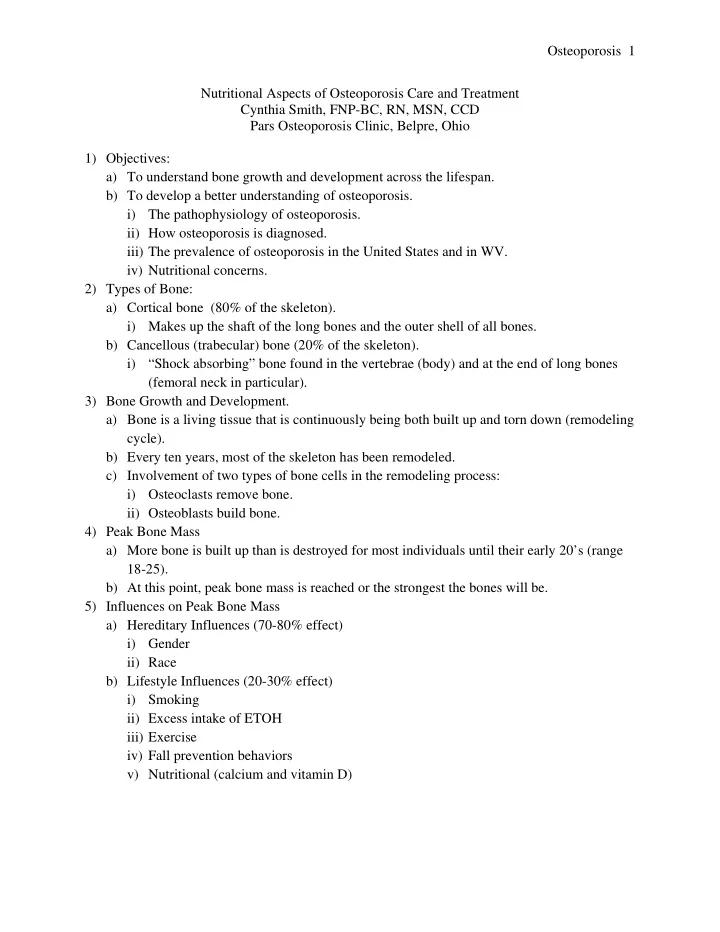
Osteoporosis 1 Nutritional Aspects of Osteoporosis Care and Treatment Cynthia Smith, FNP-BC, RN, MSN, CCD Pars Osteoporosis Clinic, Belpre, Ohio 1) Objectives: a) To understand bone growth and development across the lifespan. b) To develop a
SLIDE 2
SLIDE 3
Osteoporosis 3 11) T-Score. a) Obtained through DXA testing. b) The T-score compares an individual’s bone mineral density to the mean of a young normal reference group. The difference is expressed as a standard deviation score. 12) WHO Classification for Postmenopausal Osteoporosis (1994). a) Normal: T-score -1.0 and above. b) Low bone mass (osteopenia): T-score of -1.1 to -2.4. c) Osteoporosis: T-score of -2.5 and below. d) Severe osteoporosis: T-score -2.5 and below with fragility fractures. 13) Acceptance of WHO Classification Guidelines: a) Osteoporosis Society of Canada b) International Society for Clinical Densitometry c) National Osteoporosis Foundation d) U. S. Preventative Services Task Force e) Bone Health and Osteoporosis: A Report of the Surgeon General (2004). 14) Fracture Risk: a) Osteopenia increase the risk of a fracture two-fold while osteoporosis increases the fracture risk four-to-five fold. 15) The Most Common Osteoporotic Fracture Sites a) Vertebral (most common) b) Hip (second most common) c) Forearm (Third most common) 16) Fracture Estimates: a) After the age of 50, one in two women and one in four men will have a fracture due to
- steoporosis.
17) Fracture Consequences: a) 20% of patients with a hip fracture die within a year of the fracture due to complications from the fracture. b) One year after a fracture, 40% of patients have trouble walking without help. c) 60% have trouble doing necessary activities of daily living. d) 80% have trouble with some type of activity (IE: driving). 18) Prevalence of Osteoporosis: a) Nationally, ten million people have osteoporosis. b) Thirty four million have osteopenia. 19) Prevalence of Osteoporosis/Osteopenia in WV: a) 77% of women aged 50 years old and older had either osteopenia or osteoporosis in 2002. b) 44% of males aged 50 years old and older had either osteopenia or osteoporosis in 2002.
SLIDE 4
Osteoporosis 4 20) Nutritional Influences: a) Crucial Role of: i) Calcium ii) Vitamin D iii) Other micronutrients
- U. S. Department of Health and Human Services. (2004). Bonehealth and osteoporosis:
A report of the Surgeon General. U. S. Department of Health and Human Services: Office of the Surgeon General. 21) During Pregnancy/Lactation:
- a. For those 18 years old and younger: 1300 mg/day.
- b. For those 19-30 years old: 1000 mg/day.
- c. For those 31-50 years old: 1000 mg/day.
SLIDE 5
Osteoporosis 5 22) Calcium
- a. Don’t want to exceed 2000 -2500 mg a day.
- b. If supplementation is needed, the body absorbs about 500-600 mg at a time.
- c. If on an acid suppressing medication, calcium citrate supplementation is a better
choice. 23) Interferences to Calcium Absorption:
- a. Oxalate: Found in foods such as beet greens, spinach, and rhubarb.
- b. Phytate Sodium: Found in legumes, 100% wheat bran.
- c. Excess protein intake.
- d. Excess caffeine intake.
- e. Excess phosphorus intake.
- f. Excess sodium intake.
24) Vitamin D
- a. Ways to obtain:
i) Food ii) Sunlight iii) Supplements/medication
- b. Some cereals and soymilk are fortified with vitamin D.
- c. Cheese, ice cream, butter, and most yogurts are not fortified with vitamin D.
25) Vitamin D Recommendations
- a. Adults under 50 years old: 400-800 IU/day.
- b. Adults aged 50 and older: 800-1000 IU/day.
26) Vitamin D toxicity:
- a. Among experts, the safe upper limit of vitamin D is debatable. Currently, 2000 IU/day
is thought to be safe.
- b. Other than by taking a prescription dose of vitamin D, it is felt to be difficult to get too
much vitamin D if the previous recommendations are followed.
- c. Vitamin D levels can be measured with a 25-hydroxyvitamin D blood test.
27) Other Nutrients:
- a. Fluoride stimulates bone growth.
- b. Iron, Cooper, vitamin C, vitamin K, Zinc, and Manganese seem to help in the
formation of the bone matrix.
- c. Magnesium may help in building bone and with calcium processing.
Helpful Internet Sites National Institute of Health Osteoporosis and Related Bone Diseases-National Reference Center
- www.niams.nih.gov/bone
Best Bones Forever
- http://www.bestbonesforever.gov
National Osteoporosis Foundation
- www.nof.org
West Virginia Osteoporosis and Arthritis Program
- http://www.wvbonenjoint.org/
SLIDE 6
Osteoporosis 6 References Kanis , J., Melton, L., Christiansen, C., Johnston, C., & Khaltaev, N. (1994). The diagnosis of
- steoporosis. Journal of Bone Mineral Research, 9 (8), 1137-1141.
National Osteoporosis Foundation. (2010). Clinician’s guide to prevention and treatment of
- steoporosis. Washington, D. C.: National Osteoporosis Foundation.
Osteoporosis Society of Canada. (1996). Clinical practice guidelines for the diagnosis and management of osteoporosis. Canadian Medical Association Journal, 155, 1113-1133.
- U. S. Census Bureau. (2007). 2005-2007 American Community Survey. Washington,
- D. C.: Author.
- U. S. Department of Health and Human Services. (2000). Osteoporosis prevention, diagnosis,
and therapy. U.S. Department of Health and Human Services: National Institutes of
- Health. NIH Consensus Statement Online
2000 [on-line]. Available: http://consensus.nih.gov/2000/2000Osteoporosis111html.htm
- U. S. Department of Health and Human Services. (2000). NIH consensus statement:
Osteoporosis prevention, diagnosis, and therapy. Bethesda, MD: Author.
- U. S. Department of Health and Human Services. (2004). Bone health and osteoporosis: A
report of the Surgeon General. U. S. Department of Health and Human Services: Office of the Surgeon General.
- U. S. Department of Health and Human Services. (2006). The guide to clinical preventative
services: Recommendations of the U. S. Preventative Services Task Force. (No. 06- 0588). Washington, DC: Agency for Healthcare Research and Quality. West Virginia Department of Health and Human Resources. (2004). The burden of osteoporosis in West Virginia. Charleston, WV: West Virginia Osteoporosis Prevention Education Program.
SLIDE 7