organic solar cells michele.maggini@unipd.it Humanitys core - - PowerPoint PPT Presentation
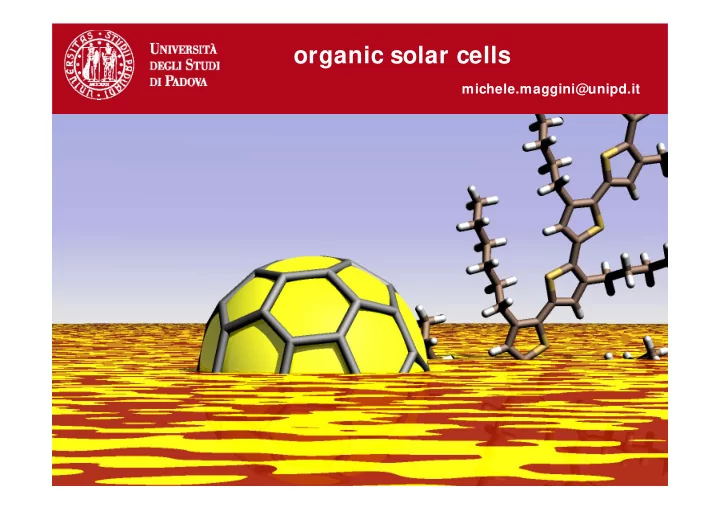
organic solar cells
SMART_READER_LITE
LIVE PREVIEW

organic solar cells michele.maggini@unipd.it Humanitys core - - PowerPoint PPT Presentation

organic solar cells michele.maggini@unipd.it Humanitys core problems in 2050 Energy Water Food Environment Poverty War Disease Education 2009 6.8 billion people Democracy 2050 8-10 billion people


slide-1
SLIDE 1
  • rganic solar cells

michele.maggini@unipd.it

slide-2
SLIDE 2

Humanity’s core problems in 2050

  • Energy
  • Water
  • Food
  • Environment
  • Poverty
  • War
  • Disease
  • Education
  • Democracy
  • Population

2009 6.8 billion people 2050 8-10 billion people

slide-3
SLIDE 3

happy life

slide-4
SLIDE 4

third generation solar cells

DSSC PNSC PFSC

polymer/fullerene solar cells (PFSC) polymer/nanocrystal solar cells (PNSC) photoelectrochemical cells (DSSC)

slide-5
SLIDE 5

5

7.6%, claimed by Solarmer Energy, Inc. on Dec. 2, 2009

efficiency

(Source: NREL)

slide-6
SLIDE 6
slide-7
SLIDE 7

polymer inks

S S S n

n

slide-8
SLIDE 8
  • A. Heeger, A. McDiarmid,
  • H. Shirakawa

semiconducting polymers

slide-9
SLIDE 9

e–

light-absorbing semiconducting polymer (MEH-PPV)

N.S. Sariciftci, L. Smilowitz, A.J. Heeger, F. Wudl Science 258, 1474 (1992)

  • G. Yu, J. Gao, J.C. Hummelen, F. Wudl, A.J. Heeger Science 270, 1789 (1995)

Brabec, Zerza, Cerullo, De Silvestri, Luzzati, Hummelen, Sariciftci

  • Chem. Phys. Lett. 2001 340, 232

Transfer times in the range of 100 fs Quantum efficiency approaching unity

polymer-C60 blends

slide-10
SLIDE 10

synthesis of PCBM

PCBM

  • J. C. Hummelen et al. JOC 1995, 60, 532
  • G. Dennler, C.J. Brabec Adv. Mater. 2009, 21, 1323
slide-11
SLIDE 11

molecular bulk-heterojunction

a material with charge-separating junctions everywhere at nanometer length scale

R.H. Friend et al. Nature 1995, 376, 498 A.J. Heeger et al. Science 1995, 270, 1789

  • J. Roncali Acc. Chem. Res. 2009, 42, 1719

donor absorbs light generating an exciton that must diffuse to the D/A interface to split. Electrons travel to the back electrode. Holes travel to the front electrode.

slide-12
SLIDE 12

light

PEDOT PSS

Glass/plastic Active layer

LiF

Aluminum

+

  • ITO

S.E. Shaheen et al. Appl. Phys. Lett. 2001, 78, 841 (eff = 2.5% ) C.J. Brabec et al. Appl. Phys. Lett. 2002, 80, 1288 (eff = 3.3% )

  • G. Li et al. Nat. Mater. 2005, 4, 864 (eff = 4.4%)
  • W. Ma et al. Adv. Funct. Mater. 2005, 15, 1617 (eff = 5% )
  • J. Y. Kim et al., Science 2007, 317, 222 (eff = 6.5% , multijunction)
  • S. H. Park et al. Nature Photonics 2009, 3, 297 (eff = 6.1% )

H.-Y. Chen et al. Nature Photonics 2009, 3, 649 (eff = 6.77% )

bulk-heterojunction

slide-13
SLIDE 13

motivation

The promise of organic photovoltaics is an ultra- low-cost technology with solar cells that could be fabricated in a continuous processing and implemented on flexible substrates. The actual challenge of OPV is to increase the efficiency and reliability Would a low-cost, lower performance OPV technology be a sustainable solution?

slide-14
SLIDE 14

Balance of system @ 70 €/m2 1000 h of sun a year

Source: G. Dennler et al. Adv. Mater. 2009, 21, 1323

cost

slide-15
SLIDE 15

Source: www.energy.eu

cost

slide-16
SLIDE 16

Source: N. Camaioni, Bologna

slide-17
SLIDE 17

Improve ordering Enhance mobility Extend the absorption

slide-18
SLIDE 18

0.32 0.68 0.19 0.31 0.68 0.59 5.6 8.2 3:1

0.82 2.50

0.28 0.35 0.76 0.63 8.6 2.5

3:2 (%)

FF Voc (V) jsc× 104 (A cm-2)

PHT/3

0,1 1

jsc (mA cm

  • 2)

0,45 0,50 0,55 0,60

Voc (V)

20 30 40 50 60 70 0,25 0,30 0,35 0,40

FF Temperature (°C)

20 30 40 50 60 70 1 2 3

 (%) Temperature (°C)

after cooling to room T after cooling to room T and a further cycle from 22 to 50 °C

before thermal treatment after thermal treatment Pin: 20 mW cm-2. Room T PTH/3, 3:2 WR, 1 °C/min

  • J. Mater. Chem. 2002, 12, 2065; Adv. Mater. 2002, 14, 1735

lock the nanoscale morphology

(N. Camaioni – ISOF-CNR)

slide-19
SLIDE 19

P3HT

P3HT: band-gap too large; missing more than half

  • f solar spectrum

Opportunity for improvement (factor of ca. 2) using polymer with smaller band-gap

absorption

slide-20
SLIDE 20

bandgap engineering

slide-21
SLIDE 21

low bandgap polymers

  • R. Po, M. Maggini, N. Camaioni J. Phys. Chem. C 2010, 114, 695
slide-22
SLIDE 22

jsc: short-circuit current density Voc: open-circuit voltage FF: fill factor : photovoltaic conversion efficiency

 = FF

JSC VOC P0 (holes in the polymer  band, electrons in PCBM LUMO)

Source: A. Heeger – Linz 2008

slide-23
SLIDE 23

polymer-fullerene solar cells present status: 4-6% efficiency with P3HT or PCDTBT

New device architectures (optical spacer) Opportunity: 25%-50% improvement New polymers for matching the solar spectrum (energy gap engineering) Opportunity: 2 improvement Better charge percolation and collection (optimize morphology) Opportunity: 25% improvement Increase open circuit voltage (deeper HOMO for the polymer or raise the fullerene LUMO) Opportunity: 50% improvement Multijunction (tandem) solar cells Opportunity: 50% improvement Achieve all the advances in the same cell: 1.252  1.25  1.5  1.5 = 7

Source: A. Heeger Linz 2008

slide-24
SLIDE 24

the dream

slide-25
SLIDE 25

acknowledgements

acknowledgements

  • E. Menna
  • T. Carofiglio

A.Venturi

  • E. Rossi
  • S. Silvestrini
  • P. Maity

MISCHA

Fabbrica Italiana Sintetici SpA

FIRB RBNE033KMA