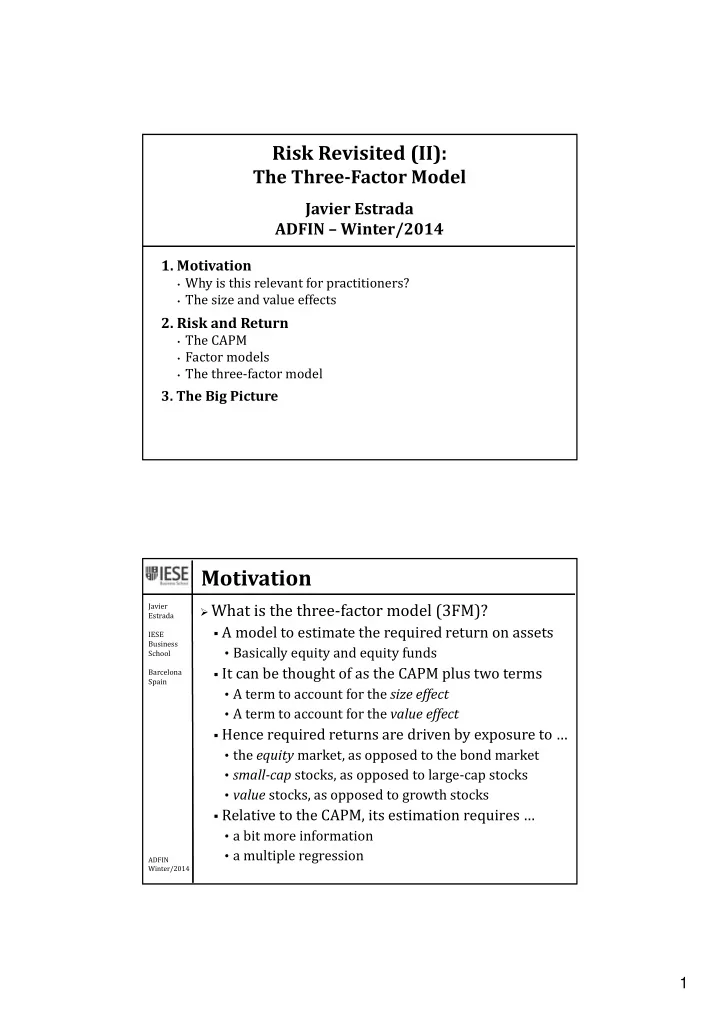
Motivation What is the threefactor model (3FM)? Javier Estrada A - - PDF document

motivation
SMART_READER_LITE
LIVE PREVIEW

Motivation What is the threefactor model (3FM)? Javier Estrada A - - PDF document

Risk Revisited (II): The Three Factor Model Javier Estrada ADFIN Winter/2014 1. Motivation Why is this relevant for practitioners? The size and value effects 2. Risk and Return The CAPM Factor models The threefactor


slide-1
SLIDE 1

1

  • 1. Motivation
  • Why is this relevant for practitioners?
  • The size and value effects
  • 2. Risk and Return
  • The CAPM
  • Factor models
  • The three‐factor model
  • 3. The Big Picture

Risk Revisited (II):

The Three‐Factor Model

Javier Estrada ADFIN – Winter/2014

Javier Estrada IESE Business School Barcelona Spain ADFIN Winter/2014

Motivation

  • What is the three‐factor model (3FM)?
  • A model to estimate the required return on assets
  • Basically equity and equity funds
  • It can be thought of as the CAPM plus two terms
  • A term to account for the size effect
  • A term to account for the value effect
  • Hence required returns are driven by exposure to …
  • the equity market, as opposed to the bond market
  • small‐cap stocks, as opposed to large‐cap stocks
  • value stocks, as opposed to growth stocks
  • Relative to the CAPM, its estimation requires …
  • a bit more information
  • a multiple regression
slide-2
SLIDE 2

2

Javier Estrada IESE Business School Barcelona Spain ADFIN Winter/2014

Motivation

  • Why is the 3FM relevant for practitioners?
  • Corporate Finance applications
  • Estimation of the required return on equity
  • Input in the WACC, which in turn is an input in …

 project evaluation (NPV/IRR)  company valuation (DCF‐WACC model)  capital structure optimization (Min WACC) …

  • This is all about making proper corporate decisions
  • Portfolio Management applications
  • Estimation of the required return on funds

 Accounting for the impact of the size and value effects

  • Used in the estimation of risk‐adjusted return

 Proper ranking and evaluation of portfolio managers

  • This is all about evaluating performance properly

Javier Estrada IESE Business School Barcelona Spain ADFIN Winter/2014

The Size & Value Effects

  • A couple of important things to keep in mind
  • The focus of the discussion will be …
  • today on the model’s intuition and implementation
  • in App3 on the CF applications
  • in the discussion of App3 on the PM applications
  • There are basically three pervasive and global

patterns in Finance: In the medium/long term …

  • stocks outperform bonds
  • small‐cap stocks outperform large‐cap stocks
  • value stocks outperform growth stocks
  • As much as these return differentials are widely

accepted, why they are observed is controversial

  • Some argue in favor of risk‐based explanations
  • Some argue in favor of ‘market inefficiencies’
slide-3
SLIDE 3

3

Javier Estrada IESE Business School Barcelona Spain ADFIN Winter/2014

The Size & Value Effects

  • Definitions
  • Importantly, all definitions are relative and dynamic
  • Relative: Based on a ranking
  • Dynamic: They change over time
  • What is a small‐cap stock?
  • A stock with a ‘small’ market capitalization

 This obviously depends on the country/sector

  • What is a value stock?
  • A ‘cheap’ stock relative to fundamentals

 Low multiple (P/E, P/B, P/CF, …)

  • The two critical things to keep in mind about this
  • A company may change its classification over time

Go

  • You can rely on fund providers for the classification Go

Javier Estrada IESE Business School Barcelona Spain ADFIN Winter/2014

The Size & Value Effects

  • Evidence: Return
  • At this point it is largely beyond discussion that in

the medium/long term small‐caps outperform large‐caps and value outperforms growth

Go

  • Evidence: Risk
  • Here the issue is far more controversial
  • (Behavioral) Market inefficiencies (Imply a free lunch)

 Investors overpay for the ‘safety’ of large/growth stocks and underpay for the ‘dangers’ of small/value stocks

Go

  • Risk differentials (Imply there is no free lunch)

 Small caps are more volatile, less liquid, less diversified, less able to withstand downturns, … than large caps  Value is largely a bet against the market  This is the view implicit in the 3FM

slide-4
SLIDE 4

4

Javier Estrada IESE Business School Barcelona Spain ADFIN Winter/2014

Approaches

  • There are basically three approaches to estimate

required returns

  • The CAPM (The standard)
  • The 3FM (The main competitor)
  • Factor models (Many versions)
  • The CAPM
  • You know
  • Factor models
  • They include ‘whatever’ may help to explain, hence

predict, returns

  • Theory takes a back seat
  • Not trivial to implement (not estimated in house)
  • Some examples

Go Javier Estrada IESE Business School Barcelona Spain ADFIN Winter/2014

The 3FM

slide-5
SLIDE 5

5

Javier Estrada IESE Business School Barcelona Spain ADFIN Winter/2014

The 3FM

Javier Estrada IESE Business School Barcelona Spain ADFIN Winter/2014

The 3FM – Implementation

  • The CAPM
  • Ri = Rf + MRP⋅βi
  • Current Rf
  • Long‐term historical MRP
  • Medium‐term historical βi
  • The 3FM
  • Ri = Rf + MRP⋅βi + SMB⋅βi

S + HML⋅βi V

  • Current Rf
  • Long‐term historical MRP, SMB, and HML
  • Medium‐term historical βi, βi

S, and βi V

  • In short, relative to the CAPM we need …
  • Data on two more explanatory variables
  • A regression with two more variables
slide-6
SLIDE 6

6

Javier Estrada IESE Business School Barcelona Spain ADFIN Winter/2014

The 3FM – Implications

  • What does the 3FM imply?
  • Higher exposures to the equity market, to small

caps, and to value stocks imply higher risk and therefore required returns should increase

  • Corporate Finance

 This translates into an increase in the discount rate

  • Portfolio Management

 This translates into an increase in the return required to fund managers

R = Rf + MRP·β + SMB·βS + HML·βV

Exposure to the market Exposure to small‐caps Exposure to value stocks

Javier Estrada IESE Business School Barcelona Spain ADFIN Winter/2014

The 3FM & and the CAPM

  • So, what does all this mean for the CAPM?
  • Is beta useful? Is it alive and well? Is it dead? Should

the CAPM be used? Should it be discarded?

  • Two approaches

 Fight over the econometrics / Focus on the big picture

  • The big picture
  • Just look around
  • The CAPM is still widely used in CF applications
  • The 3FM is far more widely used in PM applications
  • McKinsey’s view (on the CF side)

Go

  • Three final thoughts
  • Why are these premiums not arbitraged away?

Go

  • A couple of interesting facts

Go

  • Think of the 3FM as just another tool in your toolbox
slide-7
SLIDE 7

7

Javier Estrada IESE Business School Barcelona Spain ADFIN Winter/2014

Appendix

Javier Estrada IESE Business School Barcelona Spain ADFIN Winter/2014

Evidence – USA

Small caps: $100 → $3,045,770 Large caps: $100 → $631,813 Value: $100 → $4,555,683 Growth: $100 → $347,063

slide-8
SLIDE 8

8

Javier Estrada IESE Business School Barcelona Spain ADFIN Winter/2014

Evidence – DMs

Back

Small caps: $100 → $747 Large caps: $100 → $635 Value: $100 → $1,162 Growth: $100 → $376

Javier Estrada IESE Business School Barcelona Spain ADFIN Winter/2014

Definitions

Back

slide-9
SLIDE 9

9

Javier Estrada IESE Business School Barcelona Spain ADFIN Winter/2014

Definitions

Back Javier Estrada IESE Business School Barcelona Spain ADFIN Winter/2014

Behavioral Explanations

Back

slide-10
SLIDE 10

10

Javier Estrada IESE Business School Barcelona Spain ADFIN Winter/2014

Factor Models

Javier Estrada IESE Business School Barcelona Spain ADFIN Winter/2014

Factor Models

Back

slide-11
SLIDE 11

11

Javier Estrada IESE Business School Barcelona Spain ADFIN Winter/2014

McKinsey – ‘Valuation’ Book “What’s the bottom line? It takes a better theory to kill an existing theory, and we have not seen the better theory yet. Therefore, we continue to use the CAPM …, being wary of all the problems with estimating it.”

Is Beta Dead? Criticism of the CAPM

Back Javier Estrada IESE Business School Barcelona Spain ADFIN Winter/2014

Arbitrage v. Patience

Back

slide-12
SLIDE 12

12

Javier Estrada IESE Business School Barcelona Spain ADFIN Winter/2014

‘Smart’ Investing

Javier Estrada IESE Business School Barcelona Spain ADFIN Winter/2014

The Norges Fund

Back