
SLIDE 1
11/26/2014 1
CEE 697z
Organic Compounds in Water and Wastewater
PCBs: Introduction and Properties
CEE 697z - Lecture #33
Print version
Lecture #33
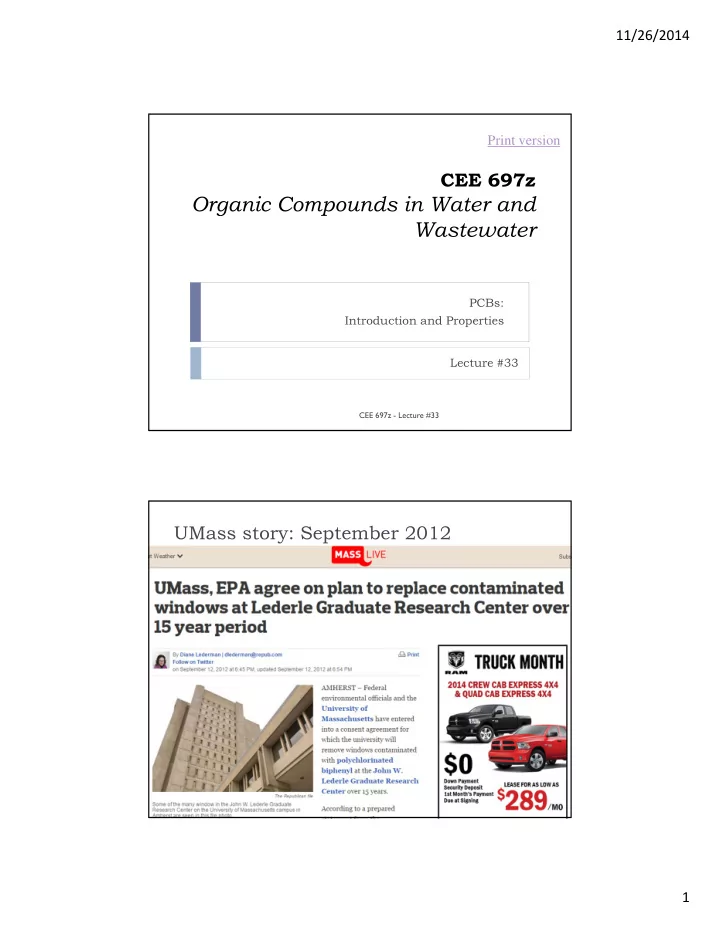
UMass story: September 2012
CEE 697z - Lecture #33
Organic Compounds in Water and Wastewater PCBs: Introduction and - - PDF document
11/26/2014 Print version CEE 697z Organic Compounds in Water and Wastewater PCBs: Introduction and Properties Lecture #33 CEE 697z - Lecture #33 UMass story: September 2012 CEE 697z - Lecture #33 1 11/26/2014 2012 News Story UMass
CEE 697z - Lecture #33
CEE 697z - Lecture #33
UMass discovered that the window glazing at the research center was contaminated with high levels of contaminants after finishing a window-caulking project in 2009.
UMass has agreed to replace and dispose of all 900 PCB-contaminated windows over the next 15 years at a cost of about $3 million.
The university will complete window cleaning, encapsulation, verification and baseline sampling within 24 months, according to the release and to start removing windows in T
floors 3, 7 and 8 by Dec. 31, 2012 according to a UMass statement.
The cost of these interim measures is about $560,000. The settlement agreement also includes a $75,000 civil penalty that will be waived if both the long-term remediation plan and interim encapsulation plan are completed, according to the release.
The window-glazing compound was commonly used in construction from the 1950s through the mid-1970s. The Lederle complex at UMass Amherst was constructed in the early 1970s.
UMass spokesman Edward F. Blaguszewski said “We’re obviously concerned with the issue. We want to protect our employees. We’ve taken steps for an interim plan. This is something that allows for a fairly prompt way to address the exposure,” he said. “We really want to partner with the EPA to address the issue.” He said EPA officials feel that “coming up with a solution such as this is something that could possibly serve as a model” for others with similar issues to follow.
CEE 697z - Lecture #33
CEE 697z - Lecture #33
GE is dredging the Hudson River in Upstate New
Dredging activities began in 2009 and continued from
EPA’s goal for GE is to remove 350,000 cubic yards of
Properties
non-flammability, chemically stabile, high boiling point, and good
Uses:
hundreds of industrial and commercial applications including
Adverse health effects
animal studies, PCBs have been shown to cause cancer as well as
In humans, PCBs are potentially cancer-causing and can cause other
CEE 697z - Lecture #33
PCBs were a common additive to caulk because of their water and
If your building was built between 1950 and 1980, you have several options:
You can assume you have PCB-containing materials but not remove them.
You should renovate with caution however since caulk and surrounding materials may be contaminated with PCB; or
You can proceed to test the air to determine if the PCB-containing materials are
causing a potential public health problem and therefore should be removed.
If you decide to remove the PCB-containing caulk and/or other materials, you
are now doing an abatement project, and should refer to Steps to Safe PCB Abatement Activities.
CEE 697z - Lecture #33
Polychlorinated Biphenyls (PCBs) World production of PCBs since 1930 is estimated at one million tons2. Although the manufacture of PCB ceased in 1979 under TSCA, some 750 million pounds remained in use as of the mid-1980s3, largely in electrical equipment. PCBs enter the environment through effluent discharge, incineration and leakage. General Electric Corporation, a manufacturer of capacitors, discharged PCBs to the Hudson River under a federal permit for over 20 years. Over a half- million pounds of PCBs remain in the Hudson River, with thousands of pounds migrating downstream each year3. Other noteworthy PCB contamination sites include the Fox River at Green Bay (pulping and paper de-inking discharges4) and the Manistique River/Harbor (paper and electric industries5) in the Upper Peninsula. All of these locations have been the focus
Manistique River Site6
CEE 697z - Lecture #33
CEE 697z - Lecture #33
Cl Cl 4 2 3 4’ 5’ 6’ 2 3 5 6 1 1’ Cl Cl Homologs (11) Isomers (1-46) Congeners (209)
CEE 697z - Lecture #33
1221: 50% Cl1, 35% Cl2 1232: 26% Cl1, 29% Cl2, 24% Cl3 1242: 13% Cl2, 45% Cl3, 31% Cl4 1248: 49% Cl4, 27% Cl5 1254: 15% Cl4, 53% Cl5, 26% Cl6 1260: 12% Cl5, 42% Cl6, 38% Cl7 1262: no data 1268: no data
CEE 697z - Lecture #33
Polychlorinated Biphenyls (PCBs) PCBs were typically manufactured as a mixture of congeners, created through the progressive chlorination of biphenyl until a target chlorine content (percentage by weight) was obtained and the mixture has characteristic physical-chemical properties. One of the most common mixtures was Arochlor 1254, which contained 54% chlorine by weight. Once released to the environment, mixtures undergo diagenesis, changing the congener balance and making it difficult to determine their origin.
CEE 697z - Lecture #33
20 40 60 80 100 1 2 3 4 Number of ortho-Chlorine Atoms Dihedral Angle [°]
Cl Cl Cl Cl Cl PCB 126 Cl Cl Cl PCB 153 Cl Cl Cl Cl Cl Cl PCB 118 Cl Cl
Hans-Joachim Lehmler, Univ. of Iowa
Cl Cl Cl Cl Cl PCB 95
Mechanisms of toxicity of PCBs and their metabolites
Congener/metabolite Molecular Target Action non-ortho and mono-
aryl hydrocarbon receptor (AHR) altered gene expression (CYP1A and
di-ortho PCBs
(PCB-95: 2,2’,3,5,6-PCB)
ryanodine receptor altered calcium homeostasis, neurotoxicity? di-ortho PCBs ?? altered neurotransmitter metabolism (dopamine & serotonin)
(PCB-164: 2,3,3’,4’,5’,6-HCB)
constitutive androstane receptor (CAR) induction of CYP2B highly chlorinated PCBs
(PCB-184, -196, -153)
rodent PXR (agonists) human SXR (antagonists) induction of CYP3A; varies by species OH-PCB transthyretin (TTR) inhibition of thyroid hormone transport and retinoid homeostasis (rodents > humans; TTR vs TBG) OH-PCB sulfotransferase, glucuronosyl transferase inhibition of sulfotransferase (E2 and T4 , 3-OH-BaP) PCB and OH-PCB estrogen receptor (ER) ER agonist or antagonist methylSO2-PCB uteroglobin displacement of progesterone?? methylSO2-PCB glucocorticoid receptor GR antagonist
CEE 697z - Lecture #33
PCBs have been demonstrated to cause a variety of adverse health effects, including cancer and disruption of the endocrine, nervous, and reproductive systems1. It has a potency factor for toxicity more than 4 times that of arsenic7. PCBs have a very high bioconcentration factor and are regularly found present in fish tissue. Polychlorinated Biphenyls (PCBs)
fish water
mg chemical C L kg fish BCF mg chemical C kg L water
The BCF has been empirically correlated with Kow, and thus a tendency to partition into the fatty tissue of fish or humans. PCBs have a BCF of 100,000 L/kg, compared with 4 for chloroform and 44 for arsenic7.
CEE 697z - Lecture #33
CEE 697z - Lecture #33
To next lecture