
SLIDE 1
Ore g o n Hig hwa ys Se ismic PL US Re po rt
Pre se nte d b y: Pa ul Ma the r, ODOT Hig hwa y Divisio n Administra to r
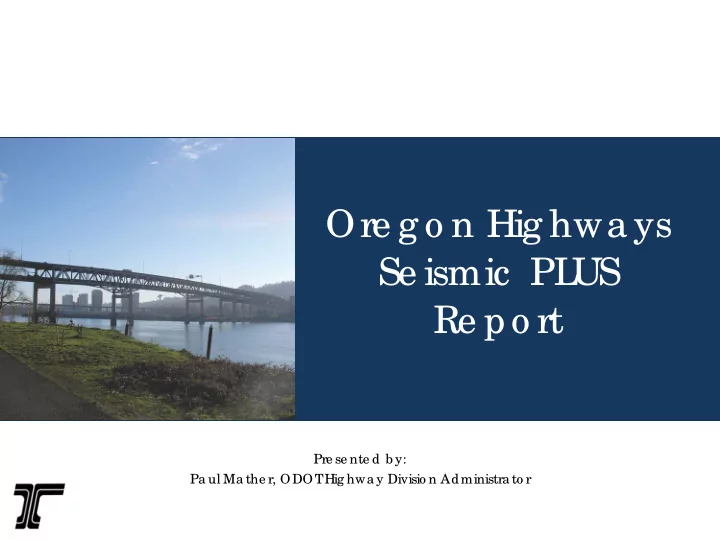
Ore g o n Hig hwa ys Se ismic PL US Re po rt Pre se nte d b y: - - PowerPoint PPT Presentation
Ore g o n Hig hwa ys Se ismic PL US Re po rt Pre se nte d b y: Pa ul Ma the r, ODOT Hig hwa y Divisio n Administra to r Clic k to a dd te xt T he Ore g o n Re silie nc e Pla n Required by the legislature, Transportation is supported
Ore g o n Hig hwa ys Se ismic PL US Re po rt
Pre se nte d b y: Pa ul Ma the r, ODOT Hig hwa y Divisio n Administra to r
Clic k to a dd te xt
T he Ore g o n Re silie nc e Pla n
Required by the legislature, supported by Governor Comprehensive plan, developing a strategic approach Transportation is critical
Co nc e pts
Retrofit increases resiliency if done incrementally & strategically
Secondary loss of life and long term economic losses can be significantly reduced Strategic planning is critical to success and will require widespread consensus
T he so lutio n
RETROFIT
For life safety to prevent collapse For serviceability to keep the bridge functional
Hig hwa y Bridg e L
I-5 Marquam Bridge
I-405 Fremont Bridge
US 26 Ross Island Bridge
Astoria-Megler Bridge
US 30 Longview-Rainier Bridge
I-5 Interstate Bridge
I-205 Glenn Jackson Bridge
Re tr
e ss
F irst 16 ye a rs sinc e vulne ra b ility wa s ide ntifie d
Years Actions 1994/1997 Prioritized total bridge needs 1155 1985-2012 Phase 1 retrofit added to projects (STIP & OTIA III program) bridges addressed 355 Future Bridges still needing retrofitting (About 200 years at current funding) 800
Most br idg e s be yond de sig n life
100 200 300 400 500 600 700 800 900 <1950 1950-1959 1960-1969 1970-1979 1980-1989 1990-1999 2000-2009 2010-2014 Number of Bridges Bridges remaining in service OT IA br idg e inve stme nt ne e ds to c ontinue
Options Report
routes
damage
condition
Ro ute se le c tio n
Survivability
Life Support
Economic Recovery • Critical freight corridors
Re c o mme nde d life line ro ute s
T
US Pro g ra m Co st
Program Phases Total Bridge Cost Landslides/Rockfalls Cost Total Seismic PLUS Program Costs 1 $738 Million $197 Million $935 Million 2 $632 Million $272 Million $904 Million 3 $612 Million $483 Million $1,095 Million 4 $640 Million $126 Million $766 Million 5 $1,432 Million $0 $1,432 Million Total $4.1 Billion $1.0 Billion $5.1 Billion
Ma jo r Se ismic E ve nt: I so la te d Are a s
Total economic loss: $350 B
I so la te d Zo ne s: Pha se 1 & 2 Sc e na rio
Reduce economic loss by: $35 B
I so la te d Zo ne s: F ull Se ismic Pro g ra m
Reduce economic loss by: $84 B
No n-distre sse d b ridg e s with Se ismic PL US funding le ve ls
0% 20% 40% 60% 80% 100% 2010 2020 2030 2040 2050 2060 Percent Non-Distressed Year Predicted Percent of Non-Distressed Bridges with 'Seismic Plus' Funding Levels (2010 - 2060) Seismic Plus Current Funding Level Out of 2681 State Owned NBI Bridges 80% Target Cost = $5.1 Billion Economic Loss Avoided = $250 Billion
We ne e d to sta r t NOW
T ra nspo rta tio n is ke y to the o ve ra ll re spo nse
Seismic Retrofit by State
5147 Bridges $13 Billion 416 Bridges $177 Million 143 Bridges $44 Million
Ore g o n Re silie nc e Pla n Re c o mme nda tio ns
Be g in imme diate ly to pre pare c ritic al state hig hway b ridg e s and the transpo rtatio n syste m to withstand a majo r e arthq uake .
most critical routes.
and efficient methods are applied.
transit, port and rail assets.