Free Bridge Congestion Relief Study: Free Bridge: A Planning - - PowerPoint PPT Presentation

free bridge congestion relief study
SMART_READER_LITE
LIVE PREVIEW

Free Bridge Congestion Relief Study: Free Bridge: A Planning - - PowerPoint PPT Presentation

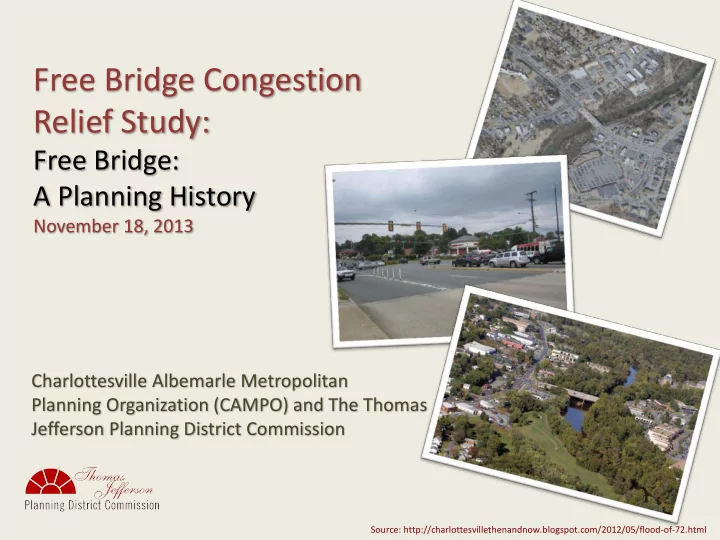
Free Bridge Congestion Relief Study: Free Bridge: A Planning History November 18, 2013 Charlottesville Albemarle Metropolitan Planning Organization (CAMPO) and The Thomas Jefferson Planning District Commission Source:


slide-1
SLIDE 1

Free Bridge Congestion Relief Study:

Free Bridge: A Planning History

November 18, 2013 Charlottesville Albemarle Metropolitan Planning Organization (CAMPO) and The Thomas Jefferson Planning District Commission

Source: http://charlottesvillethenandnow.blogspot.com/2012/05/flood-of-72.html

slide-2
SLIDE 2

History of Free Bridge:

Why is Free Bridge Called Free Bridge?

  • In 1762 the Virginia General Assembly approved construction of a tolled bridge

into Charlottesville. While several bridges were constructed in the interim none were ever tolled.

2

  • Historical Notes
  • 1. Free Bridge was built in 1801 to

replace Moore’s Ford in this location.

  • 2. By 1870, this covered bridge was
  • built. It was the fifth bridge on the site.
  • 3. In the 1950s the bridge was

replaced again with a modern 4-lane bridge as part of the 250 Bypass.

  • 4. In 1993 the bridge was replaced and

expanded to 7 lanes.

Source: http://search.lib.virginia.edu/catalog/uva-lib:2167058

slide-3
SLIDE 3

History of Free Bridge:

3

1) Source: http://fedoraproxy.lib.virginia.edu/fedora/objects/uva-lib:2167057/methods/djatoka:StaticSDef/getStaticImage 2) Source: https://www.readthehook.com/102411/second-glance-free-bridge-design-delight

slide-4
SLIDE 4

Development Pantops

4

When did Pantops become “our” Pantops?

  • Original land grant was executed in 1734.
  • In 1746 Peter Jefferson began purchasing the land, expanding his Shadwell

Property.

  • Thomas Jefferson inherited the property in 1797 and gave it to his daughter Maria.
  • The first structure was built in 1825 by owner James Leitch.
  • The Pantops Academy operated out of the former Leitch from 1879 to 1903.

Source: http://search.lib.virginia.edu/catalog/uva-lib:84347

slide-5
SLIDE 5

Pantops 1957

5

Source: http://earthexplorer.usgs.gov/

slide-6
SLIDE 6

Pantops 1989

6

Source: http://earthexplorer.usgs.gov/

slide-7
SLIDE 7

Pantops 1994

7

Source: Google Earth, Historical Imagery

slide-8
SLIDE 8

Pantops 2003

8

Source: Google Earth, Historical Imagery

slide-9
SLIDE 9

Pantops 2013

9

Source: Google Earth, Historical Imagery

slide-10
SLIDE 10

10

Source: City and County GIS records

SINGLE FAMILY RESIDENTIAL MULTI-FAMILY RESIDENTIAL UNDEVELOPED COMMERCIAL INDUSTRIAL GOVERNMENT RELIGIOUS CHARITABLE EDUCATIONAL OTHER VETERANS

slide-11
SLIDE 11

Planning History

City of Charlottesville

  • 1. 1959, Bartholomew Master Plan
  • First master plan in the region
  • 2. City of Charlottesville

Comprehensive Plans

  • 1979, 1984, 1990, 1995, 2001,

2006, 2013

  • 3. 1988, Urban Design Plan
  • Free Bridge = Entrance Corridor
  • High Street = Commercial Corridor

11

Albemarle County

  • 1. 1971, Comprehensive Plan
  • Commercial along US 250
  • Park Land along river
  • Low/Medium residential

development

  • 2. Mid- 1990s, Neighborhood 3 Study
  • First plan to study Pantops

independently

  • 3. 2008, Pantops Master Plan
  • Most recent study of Pantops
  • 12 principles of the Neighborhood

Model

slide-12
SLIDE 12

Planning History

Regional Plans

  • 1. Early-1990s, Initial Western Bypass

Alignment Study

  • Considered alignments in Pantops
  • 2. Early 2000s, Eastern Planning

Initiative

  • Focused on impact of land

development patterns

  • 3. 2009, Eastern Connector Study
  • Focuses on the development of

transportation alternatives to alleviate congestion issues at Pantops and Free Bridge.

12 Proffit Road Pen Park Road Polo Grounds Road

Source: Eastern Connector Study

slide-13
SLIDE 13

Free Bridge: Congestion and Alternatives

13

Option 1 Option 2 Option 3 Option 4 Option 5 Option 6 S Pantops Connector State Farm Connector 2-lane Eastern Connector 4-lane Eastern Connector Limited Access

  • n US 250

Widening I-64 and US 250/US 29 Volume 52,253 68,569 58,181 61,664 59,393 55,330 65,679 65,583 Eastbound 26,967 34,574 29,211 30,909 29,951 27,740 33,513 33,443 Westbound 25,286 33,995 28,970 30,755 29,443 27,591 32,166 32,140 Capacity 45,600 45,600 45,600 45,600 45,600 45,600 45,600 45,600 v/c Ratio 1.15 1.50 1.28 1.35 1.30 1.21 1.44 1.44 Not enough capacity for 1 of 8 cars 1 of 3 cars 1 of 5 cars 1 of 4 cars 1 of 4 cars 1 of 6 cars 3 of 10 cars 3 of 10 cars S Pantops Eastern Connector Volume 16,558 14,697 17,025 24,734 11,849 15,883 Eastbound 8,465 7,735 8,538 12,624 5,837 8,163 Westbound 8,093 6,962 8,487 12,109 6,012 7,720 Capacity 17,000 17,000 17,000 34,000 17,000 17,000 v/c Ratio 0.97 0.86 1.00 0.73 0.70 0.93 Total Trips 52,253 68,569 74,739 76,361 76,418 80,064 65,679 65,583 Option 7 2010 Base 2040 Base 80,385 Proposed Connector Free Bridge S Pantops Connector & 2-lane Eastern Connector 52,653 26,482 26,171 45,600 1.15 1 of 8 cars

The MPO’s travel demand model is tool that estimates regional travel demand based on existing data and inputs. The analysis provided is a regional approximation and is not meant to represent exactly future traffic patterns.
slide-14
SLIDE 14

Free Bridge: Congestion and Alternatives

14

slide-15
SLIDE 15

Free Bridge: Congestion and Alternatives

15

2010 Base, Free Bridge 2040 Base, Free Bridge

Free Bridge Free Bridge

Source: MPO Travel Demand Model

slide-16
SLIDE 16

Free Bridge: Congestion and Alternatives

16

1) South Pantops Drive, 2040

2) State Farm Blvd, 2040

Free Bridge

  • S. Pantops Drive

Free Bridge State Farm Blvd

Source: MPO Travel Demand Model

slide-17
SLIDE 17

Free Bridge: Congestion and Alternatives

17

3) 2-Lane Eastern Connector, 2040 4) 4-Lane Eastern Connector, 2040

Free Bridge 2-Lane Eastern Connector Free Bridge 4-Lane Eastern Connector

Source: MPO Travel Demand Model

slide-18
SLIDE 18

Free Bridge: Congestion and Alternatives

18

5) Limited Access on 250, 2040 6) Widening US 29/250 and I-64, 2040

Free Bridge Free Bridge

Source: MPO Travel Demand Model

slide-19
SLIDE 19

Free Bridge: Congestion and Alternatives

19

7) S. Pantops Drive AND 2-Lane Eastern Connector, 2040

Free Bridge

  • S. Pantops Drive

2-Lane Eastern Connector

Source: MPO Travel Demand Model

slide-20
SLIDE 20

Free Bridge: Trip Distribution, Area Destinations

20 11,195 trips

  • r 16%

15,483 trips

  • r 23%

14,226 trips

  • r 21%

10,865 trips

  • r 15%

Outside MPO City 29 North Elsewhere in the MPO

Total Trips Crossing Free Bridge 68,569 Trips

Pantops 16,800 trips

  • r 25%

Source: MPO Travel Demand Model

slide-21
SLIDE 21

Free Bridge: Trip Distribution, Network

21

Source: MPO Travel Demand Model

slide-22
SLIDE 22

Modeling Conclusions

  • All alternatives considered will provide temporary congestion relief for Free

Bridge

– With all projects Free Bridge is still filling up and becoming highly congested

  • Free Bridge is too attractive to provide permanent congestion relief

– Free Bridge provides a lot of access and connectivity, making the route extremely attractive for use.

  • Trips on Free Bridge Distribute both locally and regionally

– Key attractions are the City, Pantops and US 29 north

  • Connection location impacts traffic types

– North of Free Bridge: Regional Traffic – South of Free Bridge: Local Traffic

  • There is no “Silver Bullet” solution for dealing with congestion issues at

Free Bridge.

22

slide-23
SLIDE 23

Contact Information:

Sarah Rhodes MPO Program Manager Thomas Jefferson Planning District Commission (434) 979-7310 srhodes@tjpdc.org

Questions?

23