
SLIDE 1
25/03/08 IETF #71 RMT 1
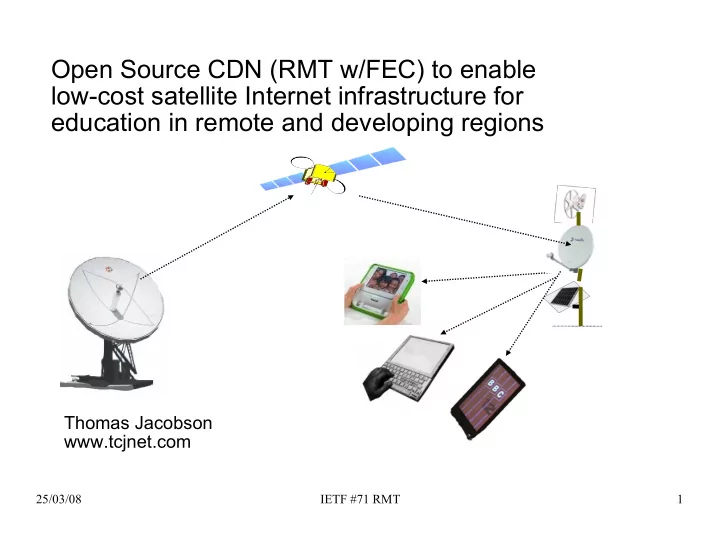
Open Source CDN (RMT w/FEC) to enable low-cost satellite Internet infrastructure for education in remote and developing regions
Thomas Jacobson www.tcjnet.com
Open Source CDN (RMT w/FEC) to enable low-cost satellite Internet - - PowerPoint PPT Presentation
Open Source CDN (RMT w/FEC) to enable low-cost satellite Internet infrastructure for education in remote and developing regions Thomas Jacobson www.tcjnet.com 25/03/08 IETF #71 RMT 1 The Users 25/03/08 IETF #71 RMT 2 Introduction It
25/03/08 IETF #71 RMT 1
Thomas Jacobson www.tcjnet.com
25/03/08 IETF #71 RMT 2
25/03/08 IETF #71 RMT 3
It is axiomatic that ICT facilitates education (and at a minimum
Efforts to provide terrestrial Internet connectivity to remote and
WiMax/WiFi is not well suited to broadcast of large amounts of
GEO satellites are practically the only means of providing
Advanced satellites (with spotbeams and using adaptive coding
25/03/08 IETF #71 RMT 4
OLPC, Classmate, EeePC, etc. deployments have begun. Assumption by many that they somehow implicitly include
Belief that without Internet service, these initiatives will fail. Misinformed statements made by some about the cost and
Need to provide developers with useful design goals that will
25/03/08 IETF #71 RMT 5
Practical school size alternative energy systems (solar,
Most satellites in service today cost around $250M to build
A large amount of Internet bandwidth is consumed with
Ubuntu, OLPC, and others demand open-source solutions
25/03/08 IETF #71 RMT 6
Examples:
− eBooks (pdf) − Wikipedia − Video (mp4) − Software Updates − Web content to be cached
A “Podcast” like model:
− The ability to contribute or co-create empowers and involves
− A “walled garden” based on metadata? − Authenticated content pre-packaged by the source.
25/03/08 IETF #71 RMT 7
Market Price:
−
Sold by the MHz. A Hz usually yields one to two data bits
−
Is a “commodity” with shallow discounts.
−
Ku price varies by power, footprint, market:
Brazil, 52dBW, $3K/MHz
(Sufficient capacity has kept price low)
Africa, 49dBW, $5K/MHz
(Exploding need and scarcity keep price high)
China, India, 49dBW, $2.5K/MHz
(Rain in Asia makes C band preferable for many applications)
Continental US (CONUS), $5K/MHz
Given that radio spectrum is a finite resource, and satellites are so expensive, how can you get “512Kbps” WildBlue sort of service for $50/mo?
−
Almost all satellite Internet service providers overbook and implement “traffic shaping,” in effect blocking or throttling bandwidth hungry services during peak times. (up to 60:1!!)
−
Don't confuse dedicated point-to-point “trunk” bandwidth with shared end-user service.
25/03/08 IETF #71 RMT 8
Alarming statements:
− “we connected the village, brought in satellite... and they use
− “$1 per student per year”
The challenge: Come up with solutions that by some magic
25/03/08 IETF #71 RMT 9
Where possible, interactive Internet service is always preferable.
Leveraging the fundamental point-to-multipoint strength of satellites can deliver many of the benefits of two-way Internet service at a fraction of the cost. It is complementary to two-way services when/where available, is a well developed technology that can be deployed ubiquitously and immediately, and can be solar powered at a reasonable cost, if necessary.
Very simple, robust, low-power Receive Only (RO) technology. Less susceptible to failure because of environmental problems such as unstable power, high temperatures, etc.
Well developed technology that can be deployed ubiquitously and immediately, and can be solar powered at a reasonable cost, if necessary.
Mass-produced, very low cost, simple, reliable receivers, easy to swap, replace when stolen, hold as spare, double up for multiple satellites.
Laws exist in many countries prohibiting restrictions by municipal authorities or housing communes on placement of RO antennas.
Usually no licences (most countries require licenses for any Tx equipment).
Signal coding has reached a high level of development. New DVB-S2 link layer Constant Coding and Modulation (CCM) mode BCH/LDPC FEC yields around 30% improvement.
RO and CDNs can off-load traffic from two-way links
25/03/08 IETF #71 RMT 10
Visiosat SMC consumer RO
Technotrend S2 3600
25/03/08 IETF #71 RMT 11
Wifi Mesh WiMax DSL V.90 T-1/E-1 GPON LMDS GPRS Began DVB-RCS DOCSIS DVB-T ATSC RO Up to 80Mbps of content rains down SCPC Iridum everywhere via $100 USB receivers Wifi Cantenna Orbcomm Surfbeam Data Mule IPStar
25/03/08 IETF #71 RMT 12
(Partial Transponder ~5MHz)
Assumptions XO Laptops/Students in Country 250000 Weather – ML Interactive Multilingual Courseware Students per school 100 MPEG-4, 5mn, on the hour 463 Biology 200 MB/Min Physics & Chemistry 200 Video Resolution (edutainment): MPEG-4, SD, 1Mbps 7.50 Edutainment – ML Math 200 Video Resolution (news): MPEG-4, CIF, 512Kbps 3.84 Science Show, MPEG-4, 1hr 594 Literature 200 Video Resolution (podcasts) MPEG-4 QCIF, 128Kbps 0.96 History Show, MPEG-4, 1hr 594 History 200 Audio Quality: MP3, mono, 64Kbps 0.48 EduQuiz Show, MPEG-4, 30mn 297 Music 200 Art/Music Show, MPEG-4, 1hr 594 FEC & overhead 20% Book Review Show MPEG-4, 1hr 536 Professional & Community Training – ML Turns of carousel 2.5 Story Time, MP3, 30mn. 72 Agriculture MPEG-4, 45mn 281 Space Segment $ per MHz /mo. 5000 Chapter a Day, MP3, 1hr 144 Journalism MPEG-4, 45mn 281 Bits per Hz 1.5 Technology MPEG-4, 45mn 281 Simulatinous languages “ML” 5 Software Distribution & Updates Health MPEG-4, 45mn 281 System 10 Teaching MPEG-4, 45mn 281 Daily Traffic MB/Day Applications 10 eBookmobile Bandwidth Needed 1000 hypertext eBooks of 10MB 10000 Housekeeping Total MB/Day 34598 1000 eReports of 1MB 1000 Activation messages 0.10 Mbps to deliver in 24Hrs 3.20 1000 plain text eBooks of 100K 100 Clean up messages 0.10 Mbps w/FEC overhead 3.84 Retransmissions 0.10 Mbps w/carousel 9.61 News MHz needed 6.41 Local News MPEG-4, 20mn 77 Wikipedia updates BBC MPEG-4, 30mn 115 2000 ea. 3K articles per day 6
$ Per Student Per Month
M6 MPEG-4, 20mn 77 Rolling Refresh (once per month all 5GB) 167
Space Segment 0.1281
Arabic News, MPEG-4, 20mn 77
Uplink CAPEX 5yr @ .02/mo 0.0160
Asia News, MPEG-4, 20mn 77 Best of Web
3 FTE & 10% Maint OPEX 0.0667
UN News MP3 English 30mn 14 Selection of popular content (Google Trends?) 1000
USB Receivers & Ant 5yr @ .02/mo 0.0200
UN News MP3 Spanish 14
TOTAL 0.2308
UN News MP3 French 14 Video Podcasts UN News MP3 Local Language 14 1000 Individually requested, 15min ea. 7200 Local Paper pdf 10 100 Best Video Podcasts, 15mins ea. 1440 NYT pdf 10 LeMonde pdf 10 Audio Podcasts Asia Paper pdf 10 1000 Individually requested, 30min ea. 7200 Arabic Paper pdf 10 100 Best Audio Podcasts, 30min ea. 1440
NB: This is a back-of-the-envelope pro forma budget, and is included to suggest the kind of traffic and bandwidth involved. The actual computation is beyond the scope of this discussion and will be more complex, involving MTU size, fragments, scalable video (SVC), packet loss, multicast grouping, ACK/NACK gains, etc.
25/03/08 IETF #71 RMT 13
(Enabled by low-power satellite receiver)
10 Watt Power controller (to be developed) 1 8 V D C @ 3 W USB USB USB ~100GB 5 V D C @ 3 W 12VDC@3W IFL AES SD card ~65W (peak) Micro turbine Modified DVB-S2 USB Receiver U n r e g D C Unreg DC U n r e g A C Mains or generator (when available) Data Mule for Contribution Mesh Repeaters Student XO Student XO Student XO Server XO CDN NACKs CDN Content 13V or 18V 1W ~50W (peak) Solar
Up to 80Mbps
Emergency manual power Unreg DC 200WHr daily shallow cycle (but several day emergency reserve).
25/03/08 IETF #71 RMT 14
A reliable transport protocol with FEC, together with scheduler
Many commercial examples: Kencast, Fantastic (defunct),
Excellent work already done, such as SAT-RMTP, ALC, NORM,
Support NACK concentrators someday?
25/03/08 IETF #71 RMT 15
Michael Mitzenmacher survey paper, conclusion: “The
EU FP7 Digitalworld project hopes to catalyze some funding for
25/03/08 IETF #71 RMT 16
Solution for concatenated WiFi/WiMax links that suffer high
Tunnel with FEC? FEC enhanced TCP? RMT like transport w/TCP gateway? School server to student laptop streaming.
25/03/08 IETF #71 RMT 17
“Floyd sometimes wondered if the Newspad, and the fantastic technology behind it, was the last word in man's quest for perfect communications. Here he was, far out in space, speeding away from Earth at thousands of miles an hour, yet in a few milliseconds he could see the headlines of any newspaper he pleased. (That very word "newspaper," of course, was an anachronistic hangover into the age of electronics.) The text was updated automatically on every hour; even if one read only the English versions, one could spend an entire lifetime doing nothing but absorbing the ever-changing flow of information from the news satellites.”
From 2001: A Space Odyssey by Aruthr C. Clark