Offshore Platform Fluid Structure Interaction (FSI) Simulation Ali - - PowerPoint PPT Presentation

offshore platform fluid structure interaction fsi
SMART_READER_LITE
LIVE PREVIEW

Offshore Platform Fluid Structure Interaction (FSI) Simulation Ali - - PowerPoint PPT Presentation

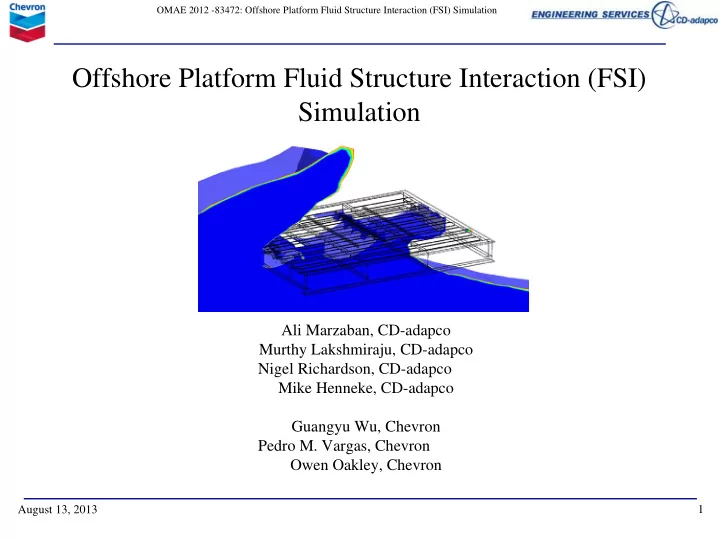
OMAE 2012 -83472: Offshore Platform Fluid Structure Interaction (FSI) Simulation Offshore Platform Fluid Structure Interaction (FSI) Simulation Ali Marzaban, CD-adapco Murthy Lakshmiraju, CD-adapco Nigel Richardson, CD-adapco Mike Henneke,


slide-1
SLIDE 1

OMAE 2012 -83472: Offshore Platform Fluid Structure Interaction (FSI) Simulation

Offshore Platform Fluid Structure Interaction (FSI) Simulation

Ali Marzaban, CD-adapco Murthy Lakshmiraju, CD-adapco Nigel Richardson, CD-adapco Mike Henneke, CD-adapco Guangyu Wu, Chevron Pedro M. Vargas, Chevron Owen Oakley, Chevron

August 13, 2013 1

slide-2
SLIDE 2

OMAE 2012 -83472: Offshore Platform Fluid Structure Interaction (FSI) Simulation

Introduction

  • The main objective of this study was to predict the permanent deformation of an
  • ffshore platform from a large wave incident during a storm using Fluid

Structure Interaction (FSI).

  • A representative sub-modeled 1/8th section of the offshore oil platform that was

deformed permanently during a hurricane is demonstrated.

  • Study was divided into three phases to progressively develop a FSI methodology

to predict the permanent deformation of the platform :

– Phase 1: Static and transient dynamic structural investigation was conducted on a sub-model section of the platform to predict potential wave energy required to cause the field observed deformation (around 40 cm deformation was reported on one of the plate girders).

  • ABAQUS 6.11 was used for Finite Element Analysis (FEA).

– Phase 2: Hurricane waves were simulated using Computational Fluid Dynamics (CFD) to determine wave characteristics required to induce the magnitude of pressure needed to observe same deformation on a structure (Based on Phase 1).

  • STAR-CCM+ 6.06 was used for CFD analysis

– Phase 3: One-way coupled simulations were modeled to study impact analysis on the structure due to wave pressure.

2 August 13, 2013

slide-3
SLIDE 3

OMAE 2012 -83472: Offshore Platform Fluid Structure Interaction (FSI) Simulation

Phase1 – Finite Element Analysis

3

  • A 3D finite element model of an offshore platform was generated from

Chevron provided 2D drawings.

  • The model was investigated for a single wave impact event using ABAQUS

6.11 to study the permanent plastic deformation.

  • The model has been analyzed using both static and transient dynamic (implicit)

approach.

  • Varying pressure loads were applied in the static cases to validate recorded

field data deformation (40 cm on one of the plate girders).

  • Pressures were applied at different periods during the implicit analysis studies.

August 13, 2013

slide-4
SLIDE 4

OMAE 2012 -83472: Offshore Platform Fluid Structure Interaction (FSI) Simulation

Phase2 – Computational Fluid Dynamics

  • A uni-directional wave field was generated based on 60 individual wave

components (provided by Chevron) using a Fortran based user sub-routine code.

  • 2D simulations were performed without the platform to determine the position
  • f the peak wave occurrence to place the structure.
  • 2D simulations also helped in estimating the mesh size and time step for

coupling fluid-structure interaction phase.

  • Platform was situated such that maximum energy would be imparted on the

structure.

4 August 13, 2013

slide-5
SLIDE 5

OMAE 2012 -83472: Offshore Platform Fluid Structure Interaction (FSI) Simulation

Phase3 – One-way Coupled Fluid Structure Interaction

  • One-way coupling scheme: Fluid imparted pressures on the structure will be

transferred to the FE model but the response of the structure to the fluid will be neglected.

– Structure is treated as a rigid body in the CFD model

  • One-way coupling analysis was performed to predict the observed deformation
  • n plate girders using STAR-CCM+ and ABAQUS co-simulation.

5 August 13, 2013

slide-6
SLIDE 6

OMAE 2012 -83472: Offshore Platform Fluid Structure Interaction (FSI) Simulation

Laser Scan Measurement of Plate Girders

6 August 13, 2013

slide-7
SLIDE 7

OMAE 2012 -83472: Offshore Platform Fluid Structure Interaction (FSI) Simulation

Phase 1

7 August 13, 2013

slide-8
SLIDE 8

OMAE 2012 -83472: Offshore Platform Fluid Structure Interaction (FSI) Simulation

Modeling Assumption and Material Properties

8

  • The 3D FEA model was generated from 2D drawings provided by Chevron.
  • C3D20R elements were used to model all solid parts.
  • Local connection details (bolts and welds) were not considered. All joint

were considered to be infinitely stiff.

  • Elastic-plastic material properties was used for plate girders.

August 13, 2013

For plate girders A588 typical material properties was used:

  • Initial Elastic Modulus: 200 GPa
  • Poisson’s ratio: 0.3
  • Density : 7830 kg/m3
  • Yield Stress: 379.2 MPa
  • Ultimate Stress: 530.9 MPa
slide-9
SLIDE 9

OMAE 2012 -83472: Offshore Platform Fluid Structure Interaction (FSI) Simulation

Finite Element Mesh – Full Assembly

9 August 13, 2013

ELEMENTS: 21,114 NODES: 118,200

slide-10
SLIDE 10

OMAE 2012 -83472: Offshore Platform Fluid Structure Interaction (FSI) Simulation

10

Applied Boundary Conditions

August 13, 2013

  • Gravity is applied in negative z-direction.
  • Uniform pressure distribution was applied to the plate girder in positive x-direction.

Fixed in all DOF Fixed in x-direction Applied pressure Uniform Pressure in x-direction

slide-11
SLIDE 11

OMAE 2012 -83472: Offshore Platform Fluid Structure Interaction (FSI) Simulation

Displacement for 300kPa Pressure in Static Analysis

11 August 13, 2013

t=0 s t=0.1 s t=0.2 s t=0.3 s t=0.4 s t=0.5 s t=0.6 s t=0.7 s t=0.8 s t=0.9 s t=1 s

slide-12
SLIDE 12

OMAE 2012 -83472: Offshore Platform Fluid Structure Interaction (FSI) Simulation

Plastic Strain in Static Analysis

12 August 13, 2013

slide-13
SLIDE 13

OMAE 2012 -83472: Offshore Platform Fluid Structure Interaction (FSI) Simulation

Static Analysis

13 August 13, 2013

  • In the static analysis, the load was applied as a uniform pressure.
  • Five different load cases with different maximum pressure of (100, 150, 200, 250 and

300kPa) was considered.

  • The pressure was applied as a ramp from zero to max from t=0 to t=0.5s. Then the

pressure was released as a ramp from the max pressure to zero from t=0.5s to t=1s.

Displacement of node A in x-direction with different pressures Deformed location of node A in x-direction with different pressures

A

43cm deflection Pressure=277kPa

slide-14
SLIDE 14

OMAE 2012 -83472: Offshore Platform Fluid Structure Interaction (FSI) Simulation

Implicit Analysis

14 August 13, 2013

  • In the implicit analysis, the load was applied as a uniform pressure with the

maximum pressure of 300kPa.

  • Four different load cases with different total times of (T=0.01, 0.05, 0.1 and

1 second) was considered.

  • The pressure was applied as a ramp from zero to max (300kPa) from t=0 to

t=0.5T. Then the pressure was released as a ramp from the max pressure (300kPa) to zero from t=0.5T to t=T. A zero pressure was applied from t=T to t=3T.

slide-15
SLIDE 15

OMAE 2012 -83472: Offshore Platform Fluid Structure Interaction (FSI) Simulation

Displacement in x-direction for Different Times in Implicit Analysis

15 August 13, 2013 Displacement of node A in x-direction with different Frequency for 300kPa

A

0.5T T 1.5T 2T 2.5T 3T 0.5T T 1.5T 2T 2.5T 3T

Applied Force vs Time

slide-16
SLIDE 16

OMAE 2012 -83472: Offshore Platform Fluid Structure Interaction (FSI) Simulation

Required Pressure for 43 cm Displacement

16 August 13, 2013

Total Time (s) Pressure (kPa) 0.05 415 0.1 322 0.5 273 1 270 5 275 Static 277

slide-17
SLIDE 17

OMAE 2012 -83472: Offshore Platform Fluid Structure Interaction (FSI) Simulation

Phase 2

17 August 13, 2013

slide-18
SLIDE 18

OMAE 2012 -83472: Offshore Platform Fluid Structure Interaction (FSI) Simulation

Computational Domain, Mesh and Boundary Conditions – Without Structure

18 August 13, 2013 X = 1200m Free surface 534.62 m 500.0 m Top: Pressure Outlet Inlet: User Code Bottom: Wall (No-slip)- Ocean bed Outlet: Pressure Outlet X = 800m X = 2000m Front and Back: Symmetry (One cell thick)

Mesh : 101,600 Delta X is fixed: 3m and Delta Y is fixed: 2m (One cell thick domain) Mesh size near free surface, Refined area 1 (Z= -25m to 25m): Delta Z = 1m Mesh size near free surface, Refined area 2 (Z=-50m to -25m & 50m to 25m): Delta Z = 1.5m In water, Delta Z increases to 10m (at ocean bottom) In air, Delta Z increases to 20m (at Top)
slide-19
SLIDE 19

OMAE 2012 -83472: Offshore Platform Fluid Structure Interaction (FSI) Simulation

CFD Methodology

  • Physical Models used:

– Three dimensional – Implicit unsteady – Gravity – Multiphase mixture – Eulerian multiphase

  • Water: Constant density

– Density: 997.561 Kg/m3 and Dynamic viscosity: 8.887E-4 Pa-s

  • Air: Constant density

– Density: 1.18415 Kg/m3 and Dynamic viscosity: 1.85508E-5 Pa-s

– Volume of Fluid – VOF waves - Flat water condition (for generating mean free surface) – Turbulence:

– SST (Menter) K-Omega turbulence model with High y+ Wall treatment

– Wave Damping

  • Imposed from 400m from outlet

19 August 13, 2013

slide-20
SLIDE 20

OMAE 2012 -83472: Offshore Platform Fluid Structure Interaction (FSI) Simulation

Wave specifications

  • Water depth: 1754 ft (534.6m)
  • Peak wave period: 14.8s
  • Zero crossing (Mean) wave period: 10.2s
  • Maximum wave height: 74 ft ±1.5 ft (22.55m ± 0.457m)
  • Significant wave height: 43.3 ft (13.19m)
  • Surface current (above – 200ft) velocity: 2.1 knots (1.08m/s)
  • Static wind speed: 85 knots (43.72 m/s)

– Direction of surface current and wind speeds are unknown – Assumption: static current and wave speed direction is same as the wave advancing direction.

  • Height of the lower deck to free surface: 56 ft (17.07 m)
  • Wave properties: (provided by Chevron)

– Superposition of 60 waves – Highest crest is 16.92m at 1325.6m and 166.0 s – Velocity, height, volume fraction: calculated on a point-by-point basis from given data using a FORTRAN subroutine

20 August 13, 2013

slide-21
SLIDE 21

OMAE 2012 -83472: Offshore Platform Fluid Structure Interaction (FSI) Simulation

CFD Methodology

  • Initial Conditions:

– Pressure: Hydrostatic Pressure of mean free surface – Velocity: User code

  • Used single wave velocity field at t=130s for wave

– Volume fractions:

  • Air: 0.0
  • Water: User code

21 August 13, 2013

Wave Height at 130.0s From Fortran (Initial condition)

slide-22
SLIDE 22

OMAE 2012 -83472: Offshore Platform Fluid Structure Interaction (FSI) Simulation

Wave Height Monitor

22

adapco Report No. 438-0031-001

July 28, 2011

  • 15
  • 10
  • 5

5 10 15 20 130 135 140 145 150 155 160 165 170 175 180

Wave Height, m Time, s

LinearEstimation CFD

August 13, 2013 22

  • 20
  • 15
  • 10
  • 5

5 10 15 20 130 135 140 145 150 155 160 165 170 175 180

Wave Height, m Time, s

LinearEstimation CFD

  • 20
  • 15
  • 10
  • 5

5 10 15 20 130 135 140 145 150 155 160 165 170 175 180

Wave Height, m Time, s

LinearEstimation CFD

Wave Height at X = 1000m Wave Height at X = 1200m Wave Height at X = 1400m

slide-23
SLIDE 23

OMAE 2012 -83472: Offshore Platform Fluid Structure Interaction (FSI) Simulation

Transparent view

Computational Domain and Boundary Conditions

23 August 13, 2013

Inlet: User Code Outlet: Pressure Outlet Top: Wall (Slip condition) Bottom: Wall (No-slip)- Ocean bed Sides: Symmetry

X=800m X=1150m X=2000m Z=-534.62m Z= 300m Z= 0m X=1600m Damping Zone

Platform: Length along X: 15.7m Depth along Y: 16.1m Height along Z: 1.56m I-Beam 3 at X=1150m Bottom of Structure = 17m X: Wave Advancing Direction Z: Normal to Wave Advancing Direction – Along Gravity

Y= -150m Y= 0m Y= 150m Z= 17m

Platform Model in CFD Analysis

slide-24
SLIDE 24

OMAE 2012 -83472: Offshore Platform Fluid Structure Interaction (FSI) Simulation

Mesh

24 August 13, 2013

Mesh : 7,154,319 Mesh size near free surface, Refined area (Z= -15m to 25m): Delta X & Delta Y = 2.44m, Delta Z = 0.609m Away from free surface: Delta X = 19.5, Delta Y = 9.75m, Delta Z = 19.5m

Plane Y=0m Plane X=1150m

slide-25
SLIDE 25

OMAE 2012 -83472: Offshore Platform Fluid Structure Interaction (FSI) Simulation

Mesh – Plane Y=0m

25 August 13, 2013

slide-26
SLIDE 26

OMAE 2012 -83472: Offshore Platform Fluid Structure Interaction (FSI) Simulation

Surface Elevation

26 August 13, 2013 Wave history plots and surface elevation plot indicates free surface in 3D model is close to that of the free surface from 2D model

slide-27
SLIDE 27

OMAE 2012 -83472: Offshore Platform Fluid Structure Interaction (FSI) Simulation

Phase 3

27 August 13, 2013

slide-28
SLIDE 28

OMAE 2012 -83472: Offshore Platform Fluid Structure Interaction (FSI) Simulation

3D- Domain

28 August 13, 2013

X=800m X=1150m X=2000m Y= -150m Y= 0m Y= 150m Z=-534.62m Z= 300m Z= 0m X=1600m Z= 17m Damping Zone Model: I-Beam 3 at X=1150m Bottom of Structure = 13m

slide-29
SLIDE 29

OMAE 2012 -83472: Offshore Platform Fluid Structure Interaction (FSI) Simulation

Finite Element Mesh – Full Assembly

29 August 13, 2013 269,361 linear hexahedral elements of type C3D8R Total Elements: 269,361 Total Nodes: 408,231 C3D8R: 8-node linear brick, reduced integration with hourglass control Top Plate * The connection details has been ignored. All joint were considered to be infinitely stiff.

slide-30
SLIDE 30

OMAE 2012 -83472: Offshore Platform Fluid Structure Interaction (FSI) Simulation

Applied Boundary Condition

30 August 13, 2013 Fixed in Z-direction (Supports) Fixed in X ,Y and Z Rot Fixed in X, Y-direction (Connected to rest of the deck) Fixed in X, Y-direction

* Top deck was vertically restrained

slide-31
SLIDE 31

OMAE 2012 -83472: Offshore Platform Fluid Structure Interaction (FSI) Simulation

Displacement Magnitude

31 August 13, 2013 47cm 17cm

slide-32
SLIDE 32

OMAE 2012 -83472: Offshore Platform Fluid Structure Interaction (FSI) Simulation

Comparison of Deformation of Plate Girders with Filed Data

32 August 13, 2013

5 10 15 20 25 30 35 40 45 50 2 4 6 8 10 12

Displacement in x-direction (cm) Lentgh of plate girder (m)

Member A - Field Data Member A - Analysis Results Member B - Field Data Member B - Analysis Results

Length = 12.0m Length =0.0m

slide-33
SLIDE 33

OMAE 2012 -83472: Offshore Platform Fluid Structure Interaction (FSI) Simulation

Conclusions

  • A One-way coupled Fluid Structure Interaction was investigated for predicting

permanent deformation on an offshore platform from a large wave incident during a storm.

  • Results are comparable to the actual field measurements
  • The deformation on plate girders can also be due to several wave impacts during

the hurricane and the deformation magnitude of the plate girders will be superimposed due to these multiple impacts

  • Results suggest that sufficiently accurate solution for the design of offshore

platforms can be obtained with this methodology.

33 August 13, 2013