of wind turbines or A journey in Engineering recognizing that The - - PowerPoint PPT Presentation

of wind turbines
SMART_READER_LITE
LIVE PREVIEW

of wind turbines or A journey in Engineering recognizing that The - - PowerPoint PPT Presentation

From the blades of jet engines to the blades of wind turbines or A journey in Engineering recognizing that The best laid schemes of mice and men gang oft agley Robert Burns born Jan 25 th 1759 (For those who are Scottish dialect


slide-1
SLIDE 1

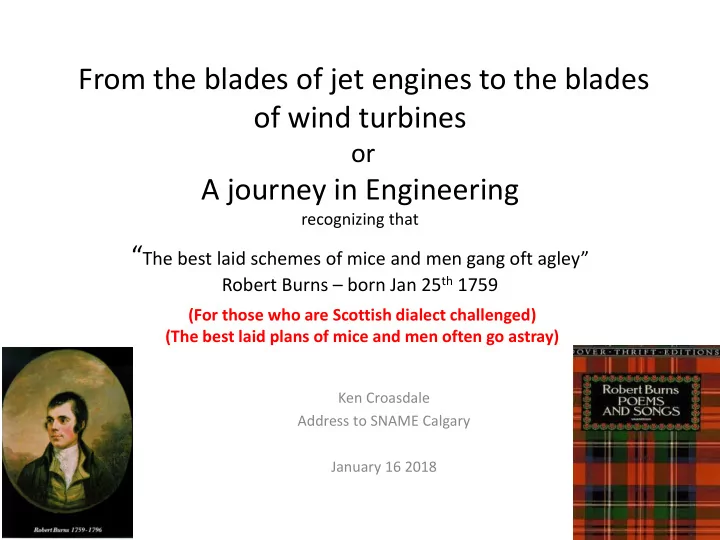
From the blades of jet engines to the blades

  • f wind turbines
  • r

A journey in Engineering

recognizing that

Ken Croasdale Address to SNAME Calgary January 16 2018

“The best laid schemes of mice and men gang oft agley”

Robert Burns – born Jan 25th 1759

(For those who are Scottish dialect challenged) (The best laid plans of mice and men often go astray)

slide-2
SLIDE 2

Robert Burns

Considered by the Scots to be the best poet ever

  • Even as a Sassenach (English) – I tend to

agree !

  • Born Alloway, Ayrshire, on 25th January

1759 (Hence Burns’ Suppers on Jan. 25th)

  • Died Dumfries, Ayrshire, only 37 years

later.

  • He wrote in the Scottish dialect – not

Gaelic – which was limited to The Highlands

  • Even though a form of English it can be

hard to understand !

  • He was a farmer and later an exciseman –

poetry was his passion.

  • He was ploughing his fields one day and

his plough destroyed a mouse nest. He felt sorry for the mouse and wrote “To a Mouse”

  • The message being that well-made plans

sometimes don’t go according to plan ! As we all know !

slide-3
SLIDE 3

My start in Engineering

  • I was pretty good at physics

and math in school – and at that time thought poetry was for sissies

  • I was also passionate about

designing and building model aeroplanes.

  • So I left school as early as

possible and took up an apprenticeship with a local aircraft company (1955).

  • My “best laid plan" was to

be a “Famous Aircraft Designer”

slide-4
SLIDE 4

I became a student Apprentice - for 5 years The Canberra ! The first British jet bomber after WW2. Set several transatlantic records in the 50s. I helped build them in the factory in Preston 1955 - 57

slide-5
SLIDE 5

Aeronautical engineer

  • I studied engineering part

time for 2 years and then full time for another 2 years to obtain a degree in Aeronautical engineering (External) from the University of London (1959)

  • I transitioned into a

structural engineer analyzing aircraft structures.

  • FE methods were just being

pioneered but you were expected to solve stress levels from first principles.

  • Lightning Fighter – I

analyzed parts of this aircraft’s structure

slide-6
SLIDE 6

Early disillusionment & changes

I was one of about a 100 stress engineers working on one aircraft – in a big office – I could not see the big picture ! Also not happy about working on military projects My plan to be aircraft chief designer – went aft agley ! So we came to Canada !

slide-7
SLIDE 7

How did I learn Arctic Engineering

  • I joined Imperial in 1968 – not even to work on Arctic topics –

more on materials and production engineering in their small R&D Lab in Calgary

  • In 1969 Imperial was looking at ways to drill offshore in the

Canadian Beaufort. The geology looked good and there had been a big Arctic oil discovery in adjacent Alaska (at Prudhoe Bay)

  • The specific problem assigned to me was to instrument some

test piles for ice loads (my prior work on aircraft structures was good background)

  • I did literature searches on ice forces to help me figure that
  • ut
slide-8
SLIDE 8

Test pile vs indenter

  • Problems with test piles in the Beaufort

in 1969 were:

  • Little known about the soils (how deep to

drive the pile ?)

  • Ice pressure to design for was unknown
  • In shallow water, the ice was landfast and

might not move very much – no data

  • Going to deeper water required deeper

penetration into the sea floor but with no equipment to drive the piles immediately available

  • I suggested pushing a pile shape through

the ice. The world’s first indenter test for ice crushing research

  • Advantages of an indenter
  • Not dependent on nature to get relative

movement

  • This can be varied (slow and fast)
  • Using hydraulic rams could provide
  • ver-capacity relatively easily
  • Can build quickly in the South
  • No expensive installation equipment

needed

slide-9
SLIDE 9
slide-10
SLIDE 10

Exciting stuff – I think my “best laid plan” now is to become a famous Arctic ice engineer !!

(Arctec ice model basin, Savage, Maryland about 1971)

slide-11
SLIDE 11

The Canadian Golden Years !

  • Halcyon days followed
  • Many of us here today

worked together on pioneer projects

  • Canadian technology was

in the forefront

  • Some of this knowledge

was also applied to non-

  • ils and gas projects such

as Confederation Bridge

  • Artificial islands
  • Caisson islands
  • MODUs (Molikpaq, SDC)
  • Floating drilling in ice
  • Kulluk
  • Icebreakers – Kigoriak, Terry Fox
  • R&D - Hans Island experiments
  • Esso Basin – world’ largest
  • PanArctic off ice drilling
  • Spray ice islands
  • Russia – Sakhalin design criteria

and more

  • Kazahkstan – Kashagan platforms

& pipeline design criteria

  • ISO 19906 – Canadian leadership
  • Iceberg management
slide-12
SLIDE 12
  • Not the greatest geology ! (Despite Jack

Gallagher’s claims !)

  • Environmental & political opposition delays

projects

  • Oil price collapse (several times!)
  • Arctic moratorium by Trudeau and Obama
  • Russian sanctions – cut off significant consulting

business for many of us

  • The political push to a lower carbon world
  • The growth of renewables (for whatever reason !)
slide-13
SLIDE 13

Does that mean our skill-set has “gang agley” ?

  • In our Canadian Academy of Engineering report – we

suggest small Northern LNG for communities and marine fuel.

  • This could also help indigenous employment in those

communities

  • In my opinion, we should continue to work with other

nations who are still developing resources in cold

  • regions. (We should oppose the Canadian Govt.

Russian sanctions - I wrote to my MP about this!)

  • In Canada harbours and vessels for Arctic resources

and tourism will still be needed

  • We can join the “renewables” (turbines in ice regions)

I hope not !

slide-14
SLIDE 14

14

Icebreaker

The Great Lakes – Oceans of Opportunity

Fall 2017 POWER-US Technology Workshop

Technology research challenges

In 2016 we were invited to help with ice design criteria for this project

slide-15
SLIDE 15

15

The Great Lakes, Superior, Michigan, Huron, Erie & Ontario

are the largest surface fresh water system on earth, comprising 20% of the world's fresh water and 90% of the U.S. supply.

The Great Lakes Opportunity

slide-16
SLIDE 16

742 GW

Total Offshore Wind Potential

Source: National Renewable Energy Laboratories

46 GW

In Ohio Waters of Lake Erie Alone

The Lakes Have the Resource

16

Alberta currently produces 1.5 GW of wind power What makes this region unique for turbines in the US ?

slide-17
SLIDE 17

One Word – Ice !

17

KRCA/CMO

slide-18
SLIDE 18

Ice cover has a significant annual variability. But it is prevalent enough to be a technology challenge in wind turbine design and operations Lake Erie usually has the most ice coverage. But all lakes can have ice present. Therefore all turbines in the Great Lakes have to consider ice.

slide-19
SLIDE 19

19

Challenges relating to ice

  • Predicting and designing for Ice loads – global

– cyclic nature – vibrations - fatigue.

  • Ice gouging of lake floor – governs depth of

cable burial ?

  • Effect of turbines on ice environment
  • Atmospheric and spray icing
  • Access to turbines in winter
slide-20
SLIDE 20

20 20

Precedent – PORI Project in Finland – but is in Landfast Ice

slide-21
SLIDE 21

21

X

KRCA/CMO

The project location is in mobile ice ( 10 – 15km from shore)

slide-22
SLIDE 22

Ice features to be assessed for design

22

The 50 year level ice thickness 50 year pressure ridge

Landfast ice (to about 10m water depth) Shear zone (Often with grounded ridges) Mobile pack ice with ridges

50 year ice gouges

Note: The IceBreaker Project is the first to put turbines in a mobile pack ice zone

Cable below

Shore

slide-23
SLIDE 23

Lake Erie Ice

  • Recent study was conducted

by ERDC/CRREL on ice conditions – from this -

  • 50 year ice level ice thickness

is predicted to be 0.6m

  • Pressure ridges can have keels

extending to sea floor in 18m

  • f water.
  • The 50 year ridge is estimated

to be an early-forming ridge having a consolidated layer thickness of 1.1m and a keel depth of 16m (see next slide for definitions)

23

slide-24
SLIDE 24

Morphology of a Pressure Ridge

24

Ridges are idealized as linear features

slide-25
SLIDE 25

Idealized Pressure Ridge – for calculations

Hk Keel – sintered ice blocks about 30% porosity 10X volume of sail Sail loose ice blocks Consolidate layer – solid ice Nominal “50 year” ridges hCL

Case Hk (m) hCL (m) Early ridge 16 1.1 Late ridge 19.5 0.5

slide-26
SLIDE 26

Benchmarking with Confederation Bridge – in Canada. Gulf of St Lawrence – connecting the Mainland to Prince Edward Island

26

12km long – 60 piers

slide-27
SLIDE 27

Parameter Lake Erie Confederation Bridge Ratio Shaft dia. 5 m 10 m 0.5 Cone dia. 8.5 m (this varies see Table 1.3) 13.5 m 0.63 Keel depth 20 m 20 m 1.0 CL thickness 1.1 m 2.2 m 0.5 Ice strength fresh Sea ice 1.0 – 1.3 Friction 0.15 0.3 0.5 Slope angle 60 O 52 O 1.15

Parametric adjustments on design load Case A: keel dominated. Ridge load = 14x0.6 + 2.5x0.28 = 8.4 + 0.7 = 9.1MN Case B: CL dominated. Ridge load = 4.5x0.6 + 12x0.28 = 2.7 + 3.4 = 6.1MN

CONCLUSION: Using this method: Corresponding “100 year load” for Lake Erie would be in range 6 to 9MN (For an upward cone).

Comparison of Confederation Bridge and Lake Erie wind towers

Confederation Bridge 100 year design load is 16.5MN – largest load to date – about 9MN

slide-28
SLIDE 28

Up vs Down

  • No codes or practice give guidance on first year ridge loads for

structures on cones (neither up nor down).

  • From an ice perspective, the main reason to favour an upward cone

is that there is significant full-scale experience in ridged ice (Confederation Bridge).

  • Based on this experience there better confidence in the predicted

design loads with an upward cone.

  • If only level ice was present, the downward cone has advantages of

lower ice loads and would be recommended.

  • A downward breaking collar also provides a better access for

servicing the turbines.

  • For downward cones, the breaking loads of the consolidated layer

as it pushed down into a keel is uncertain – a new method has been developed by KRC but not proven.

  • For wind turbines with conical collars, the actual keel loads (up or

down) are quite similar because the keel is acting mainly on the vertical shaft.

28

slide-29
SLIDE 29

29

Downward cone – Ridge load. New method recognizes that downward breaking of hCl is inhibited by keel rubble – which increases the breaking load

hcl

hk

hk

Vcl Hcl H keel Keel – ice rubble Consolidated layer

HWWL 0.4hk hcl = 1.1m hk = 16m

Htotal = H keel + Hcl = 7.4MN

KRCA/CMO

For comparison: Load from 0.6m level ice is

  • nly 0.73MN.

But this can be more dynamic.

slide-30
SLIDE 30

125m Rotor Dia. +85m

  • 20m

Ice/water line Downward breaking cone Shaft dia. About 5m

A typical offshore wind Turbine in 20m water depth

Sea floor

The base

slide-31
SLIDE 31

125m Rotor Dia.

  • 20m

Ice/water line

Winter Forces

(in summer, waves replace Ice loads)

Sea floor

Blade drag Ice loads

slide-32
SLIDE 32

Wind turbines – challenges in design

  • f base and foundation
  • Wind turbines are slender structures and susceptible to

vibrations and fatigue

  • The frequency and magnitude of the ice loads are

important for design

  • Typical first natural frequencies of the structure can be

in range of 0.5 to 2.5Hz.

  • Ice load frequencies must aim to be below this (by a

margin)

  • Structural designers of wind turbines require the ice

load “signatures” to input into dynamic analyses of the structure (which also include the wind load cycles)

slide-33
SLIDE 33

Ice induced vibrations - history

  • Vibrations induced by ice destroyed the Kemi 1

lightpier (Maattanen (1977)Maattanen & Hoikkanen (1990)).

  • Baltic lightpiers at that time were slender cylinders

with minimal damping.

  • Less dramatic vibrations have been experienced by

vertical-sided bridge piers and Cook Inlet platforms.

  • The Molikpaq platform suffered significant dynamic

excitations during some ice crushing events.(Jeffries and

Wright(1988).

  • Small-scale experiments with vertical faces can easily

produce vibrations (e.g. Sodhi, 1989).

33

slide-34
SLIDE 34

Simple explanation

  • Ice loads are cyclic because of repeated (usually

brittle) failures of the ice as it moves against a platform.

  • At some ice speeds, the cyclic load frequency

coincides with natural periods of the structure.

34

slide-35
SLIDE 35 0.0 0.5 1.0 1.5 2.0 2.5 3.0 3.5 4.0 4.5 5.0 20 40 60 80 100 120 140 160 180 200 Time (sec) Ice Contact Pressure (MPa) 20 40 60 80 100 120 140 160 180 200 Displacement (cm) Test 4 2/2/2003 Level Ice - Total 0.42 m Pressure Displacement Spacer Added

Caspian indentation tests

These load traces are typical of ice crushing Crushing loads are cyclic – troughs are about half the peaks

35

slide-36
SLIDE 36

Simple concept – cyclic loads

  • As ice advances, the crushed

area increases and so does the

  • load. At some value of load

corresponding to peak strength for the failure mode, the ice fails in a global mode (in the case shown it is spalling) and the load drops.

36

d = kt

Frequency = v/kt

For crushing, k has been assessed from full scale and model test data. Typical k values in range 0.05 to 0.2 So for v = 0.1 to 1m/s and 1m ice: Frequency in range of 0.5 to 20 Hz Typical first natural frequencies of a turbine base in range of 0.5 to 2.5Hz.

slide-37
SLIDE 37

37

x Breaking length determines distance between load peaks. This is a function of h x

KRCA/CMO

Distance between peaks about 6m for 0.6m ice k = 10

slide-38
SLIDE 38
slide-39
SLIDE 39

Ds

Downward cone

  • Ridge

hcl

hk

k V hk V H

Consolidated layer has to pushed down into the keel to fail it

k is uncertain – not simple buoyancy

slide-40
SLIDE 40

To Sum up – Re Wind Turbines

  • The additional technological challenge in the Great Lakes
  • ver other US areas is the presence of ice.
  • No precedents exist for wind turbines in pack ice
  • Pori Project in the Baltic – but it is in landfast ice.
  • The LeedCo “IceBreaker” is a pioneer project.
  • New methods have been developed and accepted during

Verification.

  • But continued research on ice issues can help in refining

future projects

  • Will Canada place turbines in offshore ice–covered areas ?
  • Recent costs per kWh are down a lot (3.7c/kWh onshore)
  • But we need some flexible base-load generation or storage
  • Turbines are becoming very large – see additional slides –

being offshore will reduce visual impacts ?

40

slide-41
SLIDE 41

To sum up on “best laid plans” I already implemented my plan to go to Alloway Next week I plan to eat a

slide-42
SLIDE 42

My grandson in Blackpool My home town ! WOW ! – not in Blackpool ! (NIMBY)

slide-43
SLIDE 43

But Paris is OK !!!