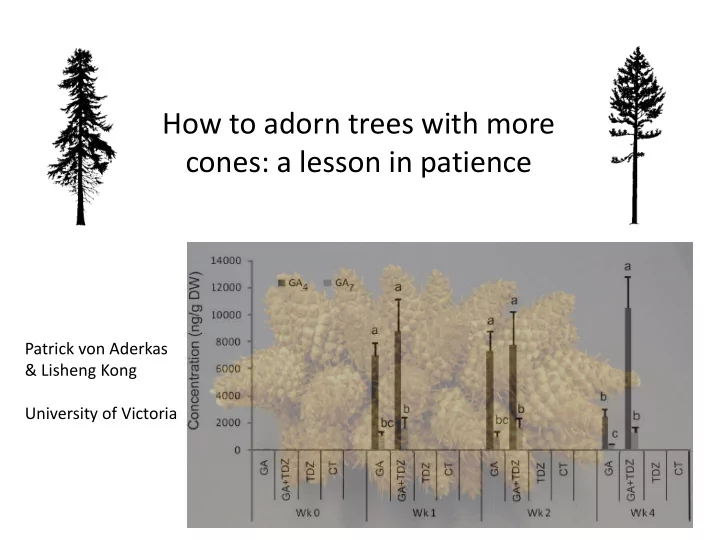
SLIDE 1 How to adorn trees with more cones: a lesson in patience
Patrick von Aderkas & Lisheng Kong University of Victoria
SLIDE 2
Initial screening of hormone levels in apical buds where cone buds are formed Initially, 9 genotypes of coastal Douglas-fir 8 genotypes of lodgepole pine were tested. Over the years, we have measured hormones in at least double this number of genotypes of each species
SLIDE 3
Meiosis Microspores Fertilization
Year 2
Pollination
(pollen enters the ovule) Year 1
♂ cone bud
SLIDE 4
megaspores survives
Megagametophyte Fertilization
Year 2
Pollination
(pollen enters the ovule)
Seed
Year 1
Meiosis ♀ cone bud
SLIDE 6
Microspores Fertilization
Year 2
Pollination
(pollen enters the ovule) Year 3 Year 1
Meiosis ♂ cone bud
SLIDE 7 Meiosis
megaspores survives
Fertilization
Year 2
Pollination
(pollen enters the ovule) Year 3
Seed
Year 1
Megagametophyte ♀ cone bud
SLIDE 8
- A photo of brach with three year cones
Year 1 Year 2 Year 3
SLIDE 9
Do endogenous hormone concentrations change over the course of apical bud flush and the period of male and female cone initiation?
SLIDE 10
Resulted in very large studies with lots of repeated sampling, and lots of chemical analysis
SLIDE 11
SLIDE 12 Rather than take you through dozens and dozens of graphs, we will summarize the overall
- results. For the curious we have listed the
papers in which they appear.
SLIDE 13 Kong, L., P. von Aderkas, Zaharia, L.I. 2016. Effects of exogenously applied gibberellins and thiadiazuron
- n phytohormone profiles of long-shoot buds and cone gender determination in lodgepole pine.
Journal of Plant Growth Regulation 35: 172-182 Kong, L., P. von Aderkas, I. Zaharia, S.R. Abrams, T. Lee and J. Woods. 2012. Analysis of phytohormone profiles during male and female cone initiation and early differentiation in long-shoot buds of lodgepole pine. Journal of Plant Growth Regulation 31: 478-489. DOI 10.1007/s00344-011-9257-1 Kong, L., P. von Aderkas, S.J. Owen, B. Jaquish, J. Woods and S.R. Abrams. 2012. Effects of stem girdling
- n cone yield and endogenous phytohormones and metabolites in developing long shoots of Douglas-
fir (Pseudotsuga menziesii). New Forests 43: 491-503. DOI 10.1007/s11056-011-9294-4 Kong, L., P von Aderkas, SJ Owen, T Wagner and SA Abrams. 2011. Comparison of endogenous cytokinins, ABA and metabolites during female cone bud differentiation in low and high cone-producing genotypes of lodgepole pine. Trees - Structure and Function 25: 1103-1110. DOI 10.1007/ s00468-011- 0585-3 Kong, L., S.R. Abrams, S. J. Owen, A. van Niejenhuis, P. von Aderkas. 2009. Dynamic changes in concentrations of auxin, cytokinin, ABA and selected metabolites in multiple genotypes of Douglas-fir (Pseudotsuga menziesii) during a growing season. Tree Physiology 29: 183-190. Kong, L., S.R. Abrams, S. J. Owen, H. Graham, P. von Aderkas. 2008. Phytohormones and their metabolites during long shoot development in Douglas-fir following cone induction by gibberellin
- injection. Tree Physiology 28: 1357-1364.
Publications (BCSOA folks in bold !)
SLIDE 14
ABA catabolism
SLIDE 15
ABA catabolic changes in growing leader buds: Douglas-fir
SLIDE 16
ABA catabolic changes in growing leader buds: lodgepole pine
SLIDE 17
ABA catabolic pathways lodgepole pine & Doug-fir Doug-fir only
SLIDE 18 Concentration (ng/g DW) of endogenous hormones in lodgepole pine leader buds
np - no peak. L - below limit of quantification/calibration Late Early
Cytokinin t-Z L L dhZ L L t-ZOG L 10 t-ZR 61 + 2 43 + 7 dhZR 37 + 2 27 + 5 iPA 14 + 1 11 + 1 2iP 7 11.4 + 0.5 Auxin IAA 28 + 3 42 + 1 IAAasp L L IAAglu L L
SLIDE 19 Concentration (ng/g DW) of endogenous hormones in Douglas-fir leader buds
np - no peak. L - below limit of quantification/calibration
Cytokinin t-Z L L dhZ L L t-ZOG 11.3 + 0.3 27 + 1 t-ZR 34 + 1 172 + 1 dhZR L 9.5 + 0.5 iPA 56 + 1 31.7 + 0.8 2iP L L Auxin IAA 216 + 15 110 + 18 IAAasp L L IAAglu np np
early late
SLIDE 20 Concentration (ng/g DW) of endogenous hormones in lodgepole pine leader buds
np - no peak. L - below limit of quantification/calibration Late Early
Gibberellin GA1 np np GA3 np np GA4 np np GA7 np np
SLIDE 21 Concentration (ng/g DW) of endogenous hormones in Douglas fir leader buds
np - no peak. L - below limit of quantification/calibration
Gibberellin GA1 np np GA3 np np GA4 22 + 3 np GA7 L np
Late Early
SLIDE 22
Do endogenous hormone concentrations change over the course of apical bud flush and the period of male and female cone initiation? YES, in a quite species-specific manner ! Doug-fir lodgepole pine Cytokinins up down Auxins down up Abscisic acid down up Gibberellins not detectable not detectable
SLIDE 23
Conclusion Cone induction methods need to be designed in accordance with the temporal hormone regimes of a species
SLIDE 24
Conclusion Cone induction methods need to be designed in accordance with the temporal hormone regimes of a species BUT WAIT A MINUTE ! What about girdling and GA induction? How do they affect initiation of cones?
SLIDE 25 Douglas-fir
- 1. Optimization of female cone production
- 2. Induction of cones in cone-poor genotypes
SLIDE 26 Douglas-fir
- 1. Optimization of female cone production
- 2. Induction of cones in cone-poor genotypes
SLIDE 27
Girdling (alone) of 14-year-old Douglas-fir trees and its effect on endogenous hormones from time of treatment to end of initiation period two genotypes gibberellins (GA4,GA7) initial rise, then decline abscisic acid no change auxins no change cytokinins no change
SLIDE 28 Treatment 9550 9137 ♂ cone ♀ cone ♂ cone ♀ cone Control 572 + 143 Girdling 8723 + 1690 10 + 9 8135 + 1356 6 + 5
SLIDE 29
We then looked at the classic hormone injection treatment for Douglas-fir, GA4/7 injection
SLIDE 30 prior to injection, GAs are, if even detectable, in the ng/g DW range – an
magnitude less 4 7 3 1
SLIDE 31 4 7 3 1 prior to injection, GAs are, if even detectable, in the ng/g DW range – an
magnitude less endogenous gibberellins – GA1 & GA3 – are produced
SLIDE 32 ABA cytokinins
control 4 mg GA4/7 /tree 40 mg GA4/7 /tree 400mg GA4/7 /tree control 4 mg GA4/7 /tree 40 mg GA4/7 /tree 400mg GA4/7 /tree
SLIDE 33 IAA - auxin
control 4 mg GA4/7 /tree 40 mg GA4/7 /tree 400mg GA4/7 /tree
SLIDE 34
Do endogenous hormone concentrations change after GA4/7 injection (compared to controls) ? Cytokinins no change Auxins up three weeks after treatment Abscisic acid no change Gibberellins GA3 & GA1 up (endogenous) GA4 & GA7 up (endogenous & exogenous are impossible to separate)
SLIDE 35 GA4/7 (mg/tree) ♂ cone ♀ cone 2994 + 999 124 + 46 4 4367 + 1269 154 + 58 40 4917 + 1143 236 + 32 400 8166 + 1616 256 + 20
SLIDE 36
If you were given a choice of which hormones to play around with to try and improve cone production, the answer is clearly GA and auxins Cytokinins no change Auxins up three weeks after treatment Abscisic acid no change Gibberellins GA3 & GA1 up (endogenous) GA4 & GA7 up (endogenous & exogenous are impossible to separate)
SLIDE 37 Douglas-fir
- 1. Optimization of female cone production
- 2. Induction of cones in cone-poor genotypes
SLIDE 38
After years of trial and error.....
SLIDE 39
After years of trial and error, we came up with a winning combination for female cone induction – GA4/7 with an anti-auxin, 2,3,5-triiodobenzoic acid (TIBA), which we tested on six historically poor-yielding i.e. crap, genotypes of Douglas-fir
SLIDE 40 Female cone yield per ramet in six Douglas-fir genotypes with various cone induction
- treatments. Mean ± SE, n= 3 to 5 for each genotype/treatment. Treatments were applied
to six low yield genotypes by stem-injection. Treatment application was completed in spring 2013 in PRT seed orchard. Data was collected in spring 2014. GA- Gibberellin, MGBG- methylglyoxal bis (guanylhydrazone), TIBA- 2,3,5-triiodobenzoic acid, Put - putrescine
SLIDE 41 Female cone yield per ramet in six Douglas-fir genotypes with various cone induction
- treatments. Mean ± SE, n= 3 to 5 for each genotype/treatment. Treatments were applied
to six low yield genotypes by stem-injection. Treatment application was completed in spring 2013 in PRT seed orchard. Data was collected in spring 2014. GA- Gibberellin, MGBG- methylglyoxal bis (guanylhydrazone), TIBA- 2,3,5-triiodobenzoic acid, Put - putrescine
SLIDE 42 Female cone yield per ramet in six Douglas-fir genotypes with various cone induction
- treatments. Mean ± SE, n= 3 to 5 for each genotype/treatment. Treatments were applied
to six low yield genotypes by stem-injection. Treatment application was completed in spring 2013 in PRT seed orchard. Data was collected in spring 2014. GA- Gibberellin, MGBG- methylglyoxal bis (guanylhydrazone), TIBA- 2,3,5-triiodobenzoic acid, Put - putrescine
* * * * * *
five out of six poor- yielding genotypes did better !
*
SLIDE 43 Lodgepole pine
- 1. Hormone profiles
- 2. Optimization of female cone production
SLIDE 44 Lodgepole pine
- 1. Hormone profiles
- 2. Optimization of female cone production
SLIDE 45 Hormone 233 (low) 299 (high) ABA high low cytokinins low high
A high-yielding genotype has a different hormone profile than a low-yielding genotype
SLIDE 46
- A photo of brach with three year cones
Year 1 Year 2 Year 3
SLIDE 47
SLIDE 48
SLIDE 49
We compared three high yield genotypes with three low yield genotypes, i.e. differing 4-fold in cone yield.
SLIDE 50 cytokinins
☐
good producers apex base apex base base poor good poor producers c-zeatin riboside
SLIDE 51 Conclusion The basal part of long-shoot bud has lower cytokinins (also true for t-zeatin riboside, dh- zeatin riboside) Other hormones (ABA, IAA) show little difference between genotypes. c-zeatin riboside
cytokinins
☐
good producers apex base apex base poor producers
SLIDE 52 Next step Attempt to alter cytokinin metabolism by applying exogenous cytokinins, e.g. benzyl adenine (BA), thidiazuron
cytokinins
☐
good producers apex base apex base poor producers c-zeatin riboside
SLIDE 53 Lodgepole pine
- 1. Hormone profiles
- 2. Optimization of female cone production
SLIDE 54
GA4/7 in combination with BA resulted in higher female cone initiation than control treatment.
SLIDE 55 Response to cone induction in various lodgepole pine genotypes. Effects of the treatment was judged by cone yield using percentage of cone yield of the treated compared to untreated (control). Female cones were induced by stem-injection of GA plus BA in early summer of 2013. Data was collected in late spring 2014. Mean, n ≥ 24 buds of three ramets. Different letters indicate significant difference (P < 0.05). GA4/7 and BA: stem injection
SLIDE 56 Response to cone induction in various lodgepole pine genotypes. Effects of the treatment was judged by cone yield using percentage of cone yield of the treated compared to untreated (control). Female cones were induced by stem-injection of GA plus BA in early summer of 2013. Data was collected in late spring 2014. Mean, n ≥ 24 buds of three ramets. Different letters indicate significant difference (P < 0.05). GA4/7 and BA: stem injection
SLIDE 57 We developed a method to test whether a genotype may be sensitive to GA4/7 and BA. Long-shoot buds are sprayed with a set dosage
- f GA4/7 alone or in combination with BA. If the
needles go brown within two weeks, then the dosage injected into the tree may have to be adjusted downward.
SLIDE 58
SLIDE 59
SLIDE 60
GA4/7 alone GA4/7 + BA
SLIDE 61
Stem injection is better and more practical than application of hormones in bud paste. Both of these methods are better than spray application, which is only effective if it does not rain. GA4/7 in combination with thidiazuron proved to be the most effective for raising endogenous cytokinin levels. This combination also resulted in the highest female cone initiation
SLIDE 62
The noteworthy element of female cone initiation is that it is at the expense of male cone initiation. Female cone buds initiated in high numbers in the basal portion of the long- shoot bud. These numbers are much higher than in the apical portions.
SLIDE 63
GA4/7 + thidiazuron: paste
SLIDE 64 PGR ♀ cone cluster genotypes with ♀ cone clusters long-shoot buds with ♀ cone clusters control no 0 /6 0/60 thidiazuron no 0/6 0/60 GA4/7 yes 2/6 3/20 GA4/7 + thidiazuron yes 4/6 15/40
Effects of exogenously applied GA4/7 and TDZ on initiation of ♀ cone clusters
SLIDE 65
SLIDE 66
SLIDE 67
SLIDE 68 Bract-
scale complex
SLIDE 69 * BOSC = Bract-ovuliferous scale complex
lodgepole pine genotype 2082
individual clustered
SLIDE 70
SLIDE 71 Cones Seeds # cone g DW/cone MC (%) seed/cone mg DW/seed Sinkers (%) Cluster 186 3.039 6.017 6.49 1.767 55.12 Non-cluster 156 3.79 6.647 10.8 2.045 54.42 Germination (%) sinkers floaters cluster 77 1.1 non-cluster 86 0.5
SLIDE 72 Conclusions Cone induction methods can be adapted not only to phenology of individual tree species, but to temporal hormone regimes within long-shoot buds of those species Methods can be customized to
- ptimize particular genotypes for
breeding, or to improve cone production from traditionally lousy genotypes
SLIDE 73
Perspectives Precocious induction of males and/or females As done in containerized Chamaecyparis lawsoniana (Port Orford cedar) in Dorena Lake, Oregon
SLIDE 74 Perspectives Precocious induction of males and/or females Induction of male cone buds would be useful in young lodgepole pine orchards where pollen production is limited
the late great Tim Lee
SLIDE 75
Lodgepole Pine Cone Induction Workshop Skimikin, June 15, 2016
SLIDE 76
SLIDE 77
SLIDE 78
SLIDE 79
SLIDE 80 Tia, can you believe this !?
SLIDE 81 Tia, can you believe this !?
cones are from VSOC.
SLIDE 82
Acknowledgments
FGC
A big thanks to everybody who helped at all of the orchards !