Industrial Wind Turbines and Adverse Health Effects: A Madison - - PDF document

industrial wind turbines and adverse health effects
SMART_READER_LITE
LIVE PREVIEW

Industrial Wind Turbines and Adverse Health Effects: A Madison - - PDF document

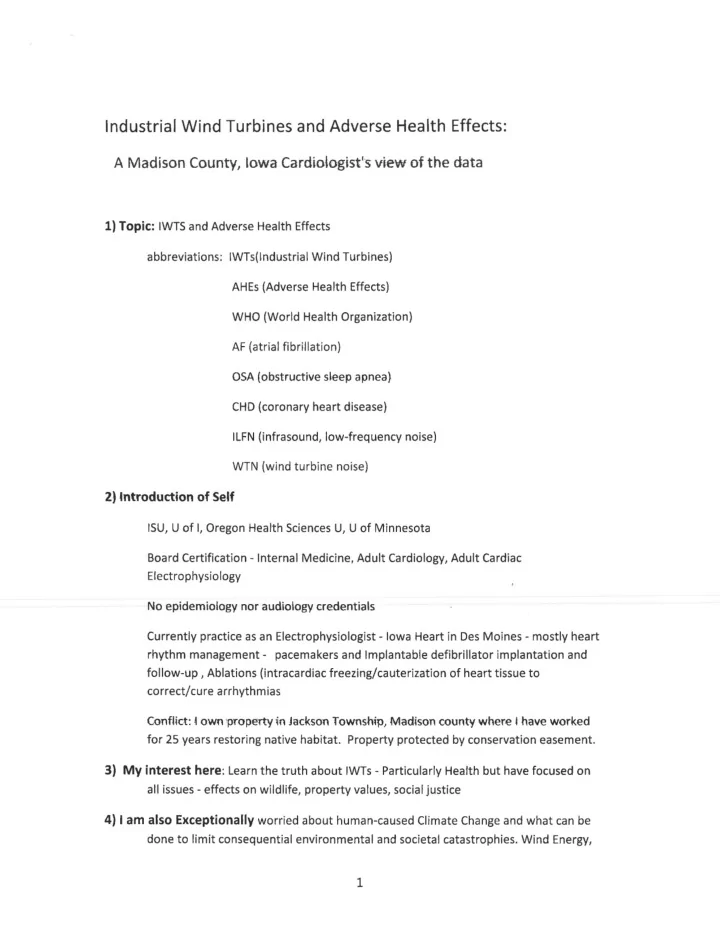
~n Industrial Wind Turbines and Adverse Health Effects: A Madison County, Iowa Cardio!ogist's view of the data 1) Topic: IWTS and Adverse Health Effects abbreviations: IWTs(lndustrial Wind Turbines) AHEs (Adverse Health Effects) WHO (World Health


slide-1
SLIDE 1

Industrial Wind Turbines and Adverse Health Effects:

A Madison County, Iowa Cardio!ogist's view of the data

1) Topic: IWTS and Adverse Health Effects abbreviations: IWTs(lndustrial Wind Turbines) AHEs (Adverse Health Effects) WHO (World Health Organization)

AF (atrial fibrillation) OSA (obstructive sleep apnea) CHO (coronary heart disease) ILFN (infrasound, low-frequency noise) WTN (wind turbine noise)

2) tntroduction of Self

ISU, U of I, Oregon Health Sciences U, U of Minnesota Board Certification - Internal Medicine, Adult Cardiology, Adult Cardiac Electrophysiology No epidemiology nor audiology credentials Currently practice as an Electrophysiologist - Iowa Heart in Des Moines - mostly heart rhythm management - pacemakers and Implantable defibrillator implantation and

follow-up, Ablations (intracardiac freezing/cauterization of heart tissue to correct/cure arrhythmias Conflict: l own property

~n

Jackson Township, Madison county where I have worked for 25 years restoring native habitat. Property protected by conservation easement. 3) My interest here: Learn the truth about IWTs - Particularly Health but have focused on all issues - effects on wildlife, property values, social justice 4) I am also Exceptionally worried about human-caused Climate Change and what can be done to limit consequential environmental and societal catastrophies. Wind Energy,

1

slide-2
SLIDE 2

as currently implemented/proposed is NOT the answer to this huge problem

5} Topic: natUfe of the beast Very polarized opionions. Briefly: Wind Enery Factions vs Anti Wind Factions- health concerns, annoyance, loss of control (highly disruptive intrusion of WTs), etc Complex terminology regarding definitions of annoyance and health and its overlap Consternation about predicting and proving long-term effects Importance of ILFN - largely (likely intentionally) ignored by Wind Energy faction Developing understanding of Noise-creating Sleep Disturbance that creates stress response causing adverse cardiovascular consequences, hypertension, metabolic effects/derangements What is being said and not said about WHO interpretations Careful about how we describe (words used) relationships of WTN and its effects Eventually (my opinion) we have to realize that absolute relationships are decades away from clarification ... (e.g stated as excess mortality related to some defined exposure description). Lo11g-term ihea~th data are :becom~ng available when evaluating noise - enrolling large numbers of people in cross-sectional and longitudinal studies and employing ANOVA statistical analysis. Despite the only very recent advances of our understanding of environmental noise and AH Es, the data specific to IWT sound emission exposure and AH Es are VERY difficult to obtain due to the relatively few people at risk making definitive statements of exposure risk challenging. We need to start with a definition of Health (WHO - 2001 ): Health should be regarded as "a state of complete physicial, mental and social well being and not merely the absence of disease or infirmity" 6) Story of AF and its association with OSA and importantly the time span of defining a relationship, ? providing insight into sleep disordered breathing producing consequences reJevant to

~WJs.

cardiovascular Atrial fibrillation is a rapid, chaotic "upper heart chamber" rhythm disorder that creates palpitations and a generalized "unwell" feeling. It is rapidly becoming more common and may produce many serious consequences including embolic strokes and heart failure. Causes/contributing factors are many ... including advancing age, thyroid disorders hypertension, pulmonary and structural heart disease. rncreasfngly, in the absence

  • f an identifiable single, discrete cause, AF is likely the result of many "colliding"

causes that promote atrial tissue irritability which produce actual atrial tissue

2

slide-3
SLIDE 3

changes that promote more atrial fibrillation. We are a society plagued by increasing obesity (now about 40% of Americans are considered as obese with 7.7% being severely obese). The American Heart Association has now included obesity and severe obesity in children as cardiovascular risk factor. With the recent redefinition of hypertension going from 140/90 to 130/80 now >46% of American are considered hypertensive. The incidence of type II diabetes (the type related to "high" insulin levels due to acquired resistance of insulin action at the cellular level) continues

to increase in incidence. Somewhere in this "modern" health epidemic" is the problem of

sleep quality and quantity. The 2019 Annual statistical update from the American Heart Association included a new section on sleep and cardiovascular health cited data from the Centers for disease Control and Prevention that only 65% of Americans have a healthy sleep duration (at least 7 hours). Returning back to the AF issue, a lot of my patients - at least half - had evidence of deficient s~ep tikely due to obstructive sleep apnea. These have loud snoring with periods of obstruction (as apnea or hypopnea - >30% in breath volume) during both inspiration and expiration. Such transient drops in lung ventilation cause surprisingly rapid and sometimes profound drops in venous oxygen saturations that are associated with activation of the sympathetic (fight or flight) nervous system. This is correlated with longer "standing" levels of "adrenaline" levels and outgoing central nervous system neural traffic (as measured by monitoring specific peripheral nerves). Obesity aggrevates the upper airway patency as those tissues and tongue "relax" as the patient tries to enter sleep. Sleep becomes vry inefficient with the brain not fully being able to "achieve REM stages" where restorative, optimal brain function is

  • achieved. The chronically higher sympathetic tones promotes

hypertension (often labile) and creates insulin resistance that causes higher faster blood sugars and Ale levels causing prediabetes and, eventua.IJy reaching a thresholds where diabetes diagnosis is given. Lipid (cholesterol and triglyceride) levels are raised and atherosclerotic disease becomes more easily initiated with infiltration of fat through the artery wall that promotes cellular inflammation and eventually subintimal (superficial) plaque formation. Eventually plaque rupture with exposure of the lipid- rich core promotes platelet aggregation and may lead to localized artery clotting and myocardial infarctions .f.heart attacks). Question: What was the initial trigger to this arborizing cascade of vascular disease? It is indeed complex. For the AF patients, lifestyle choices causing weight gain, triggering airway patency concerns that then cause the sympathetic "charging" of the body with the above mentioned problems. But not everyone who has AF has OSA ... but do they have inadequate sleep (from other causes) that generates the same (perhaps ress severe} end.point of heightened sympathetk tone 7 Conclusion reached: Sleep Apnea (obstructive) creates disordered sleep which creates stress responses that enhances the development of atrial fibrillation and various other

3

slide-4
SLIDE 4

cardiovascular and metabolic disease states (over relatively long exposure durations). It

is likely sleep disturbance - from whatever cause - may be a

major underlying reason for

cardiovascular disease.

7) Recent recognition that impaired sleep - quantified as total duration of sleep that is "effective" ... - if less than 6 hours has been associated with objective "end-points" of disease progression.

  • Dr. Dominguez noted a "graded response" evident in the PESA (Progression of Early

Subdinica1 A:therosc1erosis') trial. This large trial {3974 middle-aged Madrid bank employees free of known clinical disease or history of stroke who wore a waist band activity monitor for a week to record sleep quantity and quality. They also underwent 3-D vascular ultrasound and measurements of coronary arter calcium (via

CT). The actigraphy confirmed common under-reporting of sleep duration (rep 10.7%

had< 6 hrs via questionaire vs 27.1% via actigraphy. Multivariate analysis adjusting

for smoking, hypertension, physi~I activity, depressLon, OSA, da~Ey ca(orles, alcohol

intake and other confounding variables. Noted that subjects who slept< 6 hrs/night had a 27% greater volume of non-coronary plaque than those who slept 7-8 hours. They also had a 21% more vascular territories laden with subclinical atherosclerosis - women>men in measured effect. The presenter also stated that the more times an individual typically awoke per night, the greater the number of atherosclerotic carotid

  • r femoral artery terdtor:ies we.re <locumente<l on 3:0 vascU:la.r u'ltrasound.

8) Meta-Anlysis (Fountas in Athens) reviewed 11 propective studies correlating daily sleep duration (self-reported) and cardiovascular morbidity and mortality. Collectively 1,000,541 pts without baseline clinical CV disease were followed an average of 9.3 years. Data was adjusted for confounding features. He found that if average sleep was< 6 hrs, they had a statistically significant and dinica!Ly mearuogfiuh lili% mccrease m the dsk of a diagnosis of fatal or non-fatal cardiovascular disease as compared with those sleeping 6-8 hrs. Moreover, those sleeping> 8 hrs had a 32 % increase in those endpoints compared to 6-8 hours. Both investigators highlighted the pathophysiologic changes related to sleep deprivation that likely increased the pathophysiology of the risk - sympathetic activation, increased inflammation and disrupted glucose metabolism. Side comments: It should be noted that central among treatment options for hypertension, angina, Mis (heart attack) and post-Mis states, congestive heart failure, diabetes, vascular disease, atrial fibrillation, ventricular arrhythmias (among others) is the use of beta blockade that blunts the cellular effect of heightened circulating sympathetic stress-response "hormones". Health care is seeing an increasing number of these important developing cardiovascular disease states - prevalence( how widespread the disease is) and incidence (risk of developing). The focus for preventing disease should not only be a better understanding why and how it

4

slide-5
SLIDE 5

develops but to somehow detect - with high sensitivity and specificity - at very early stages. Of note, is recently published data using artifical Intelligence analysis of electrocardiograms to predict the presence of left ventricular dy.sfunction (weakness of main heart pumping chamber) in asymptomatic patients. This is done with extremely precise measurements of EKG voltage and waveform analysis with ongoing artificial intelligence tracking/learning of changes seeking to understand EKG patterns of change associated with early disease presentation. Perhaps these tools could be employed to evaluate IWTs and AHEs. 9) Annoyance: Annoyance is a health issue for many people living near IWTs., It is considered to be an adverse health effect (AHE) by the WHO's definition of health Noise sensitivity is considered to be a stable, partly heritable personality trait. Noise sensitive individuals are more likely to have stress related disorders, anxiety, HAs and poorer sleep than the average. Severar. studies nave conduded that incfividuars do not "get used" to annoyance

  • ver time

... they may become indifferent but not uneffected There is no dispute that psychological factors play a part in any reaction to turbine noise, to suggest that they are the sole explanation is contrary to evidence. Land-owners or neighbors may not respond with complaints as they have entered into agreements with Wind Energy to not complain in exchange for cash payments. Also, a very significant number of land owners who have signed the 58 year total-property easement, no longer live on the property. Whereas the general population tends to value wind energy as an alternative, environmentally sustainable and low-carbon energy source, people LIVING IN THE VICINITY (<5 miles) may evaluate them negatively (describes me). It is astounding how Httle the vast majority of public knows about "living close to an IWT". I would strongly suggest that everyone spend some time being within 1500 feet of a turbine - observing/listening to/attempting parallel activities requiring concentration. Then imagine how YOU might tolerate/adapt OR constantly react/be forcefully asked to coexist with an IWT and its indifferent "presence" and noise - heard and felt with ongoing visually re-acquiring dynamic peripheral vision disruptions and forced resignation

  • f this omni-present alien/non-biologic intrusion with unknown Jong-term health consequences.

The "Nocebo Effect" has been used to explain the development of "annoyance to IWTs based

  • n resident"s generalizes subjective impression of the turbine impact on their senses. The WHO

has completely rejected any relevance of the nocebo effect. Frankly, a person's reaction - is what it is - to the person who has to accept their recognition of an object constantly in the presence of the home environment. Please see the bibliography of articles describing "annoyance". The key - siting of IWTs far enough away from ordinary human interaction that annoyance is rare (<1%). Audiologists suggest siting to human dwelling separations of at least 1.25 miles

5

slide-6
SLIDE 6

(2km). See list of recommendations from variiOus studies on turrnn€ to dweUing siting separation based

  • n distance or sound levels - (Jerry Punch summary)

10) Lets talk about Wind Turbine Noise:

Audible noise 20-approx 15,000Hz Jnfrasound 1-20 Hz Low-frequency sound 20 to 160-200 Hz term "ILFN"combining infrasound and low-frequency noise together.

Disturbed Sleep and the Development of Adverse Health Effects It is all about sleep: 1) quality and quantity.

2) IWT sound emissions - freqency range and sound pressure (loudness) and how they interact with humans as they try to sleep 3) Siting distances and local weather renditions that may effect sound emissions Jerry L Punch, Professor Emeritus from the Department of Communicative Science and Disorders, Michigan State University and Richard R. James, Adjunct professor, Dept of Communication Disorders, Central Michigan Univiersity, published a 2016 comprehensive 72 page review article: Wind Turbine Noise and Human Health: A Four- Decade History of Evidence that Wind Turbines Pose Risks. They thoroughly and directly addressed each of 12 positions held by various wind energy lobbies and wind- power promoting energy companies. I will attach their peer-reviewed paper as it reflects the science behind turbine emissions exposures and they produce conclusions founded on that peer-reviewed data. Although lengthy and detailed, the best "truth approximation" lies in those details. High level summaries of the topics include: 1) Several authors have argued that infrasound is NOT as cause of AH Es, yet their own research has shown conclusively that exposure to modulated ILFN produced by large industrial equipment including heating, ventilating and air-conditioning systems lead to mental fatigue, lack of concentrtion, headaches, reduced performance and work

  • dissatisfaction. Leventhal stated "low frequency noise causes extreme distress to a

number of people who are sensitive to its effects". He later states: "There is no doubt that some humans exposed to infrasound experience abnormal ear, central nervous

6

slide-7
SLIDE 7

system, and resonance induced symptoms that are real and stressful". 2) Important contrrbutrons to our understanding of infrasound perception in addrtion to audible low-frequency noise above 20 Hz has been available since the 1980s. In their seminal research on large-scale wind turbines, which was funded by the U.S. Department of Energy, Kelly et al concluded: " ...

  • ne of major causal agent responsible

for the annoyance of nearby residents by wind turbine noise is the excitation of highly resonant structural and air volume modes by the coherent, low frequency sound radiated by large wind turbines. 'further, there is evidence that the strong resonances found in the acoustic pressure field within rooms actually measured indicates a coupling of subaudible energy to human body resonances at 5,12 and 17-25 Hz, resulting in a sensation of whole body vibration." A page from that publication is included tht graphically shows the display of measure frequencies and their sound pressures. 3) Additional investigation by Kelly, found that turbines radiated their peak sound power in the infrasound range, typically between 1 and 10 Hz. Annoyance was the result of a coupling of the turbine's impulsive low-frequency acoustic energy into the structures into the structures of home and that the annoyance was frequenctly confined to "within the home itself". In Kelly's and other work, the studies report similar findings, namely that perception, generally is non-auditory in character, begins when therms SPLs (loudness) of the modulating tones that are as low as 40 dB rms with increasing impacts as the rms levels rise to 50, 60 and to 70 db and higher. In all these studies the dynamic modulation of the blade-pass tones produce pressure peaks that are often 10 dB or more sometimes much more, than the rms values. 4} Swrnbanks, a hrgh'v respected acou5trda:l'l'. al'lrl scientist with expertise in rnfra- af'l.d low-frequency sound, presented data prepared for a 2015 conference in Glascow, Scotland obtained from analyzing wind projects around the world. He was able to differentiate the pulsations in the test data from at least six separate wind turbines from a wind farm approximately 3 km away as recorded in his basement. From that location, he measured SPLs of the blade-pass frequency and harmonics summing to about 55dB rms. At closer locations, louder SPLs to 87dB were recorded. In separate (2012) investigation of wind turbine complaints at several homes, wind turbine moise was not audible outside the house where infrasound measurements were greatest - supporting the position that infrasound is at the root of at least some of the complaints. 5) Harrison concluded that "IWTs caused annoyance in about 20% of residents living within a distance considered acceptable by most regulatory authorities and that for many of the 20%, the annoyance and sfeep disturbance fead to AHEs" . Thorne noted that human perception of noise is based primarily on sound character rather than

7

slide-8
SLIDE 8

sounds level, and that wind turbines are unique sound sources that exhibit special audible and inaudible modulated and tonal characteristics. He stated that sound levels

  • f 32dB (A) leq outside a residence and/or above an individual's threshold of hearing

inside the home are markers for serious AHEs - especially among susceptible individuals. 6) Wind turbine noise has special acoustic characteristics that distinguish it from other industrial sounds. It varies in amplitude over time, tends to have an intermittent tonal quality and its characteristics vary with distance and direction. It can result in an impulsive sounds - even at long distances. According to Lee et al., the swishing sounds

  • f turbines can be perceived from all direction, but at long distances from a turbine, low

frequency amplitude-modulated sounds can be heard only in particular directions and when the SPL is sufficiently high. This may make the turbine noise seem more impulsive at long distances despite an overall SPL (loudness) that is relatively low. Furthermore, ILFN from any source, including IWTs, is weft known to penetrate walls and other barriers (e.g. Minnesota Depatment of Health); is typically more disruptive indoors than outdoors and is not easily masked by atmospheric sounds, including road traffic and other sources of infrasound. 7) page 15: Punch and James reviewed the widely used American Wind Energy Agency/Canadian Wind Energy Agency Report which has been used by the wind industry as a basis for its denia' of A'HEs from lWTs. Purportedly specially chose, it was never peer-reviewed. That whitepaper concluded that sound from wind turbines, including sub-audible low-frequency sounds, does not pose a risk of hearing loss or any

  • ther AHE in humans. They described annoyance as unrelated to health. (Indeed, there

is no evidence that IWTs causes hearing loss). Several points of serious criticism of the

report were listed. Punch and James went on to say; "Despite widespread denial by wind industry advocates of a causat refatfonshtp between rWTs and AHEs, the vast majority of peer-reviewed papers have shown that IWTs significantly disturb sleep in at least some residents at distances and noise levels that are typical where IWTs are

  • installed. Furthermore, not a single well-designed scientific study has found WTN to

be harmless". 8) Addit;onal factors 1ncrease the probabiHty of s1eep disrupt•on due to wind turbine

  • noise. The noise can be heard especially well in areas with low background noise levels,

which usually occur at nigh. Also lower nighttime wind speeds at ground level increase the nighttime contrast between WTN and background sound levels. For this reason, nighttime guidelines for background wind noise levels should be lower (WHO suggests 30dB for non-turbine background noise sources). 9) pages 18-20 lists health symptoms by different researchers as linked to exposure to

8

slide-9
SLIDE 9

infrasound and low-frequency noise, including exposure to industrial wind turines. Note that are there are not only symptoms noted but many physical complaints with

some tllness and physical disease states - the LATTER NOW BECOMING MORE CLEAR

WITH RECENT RESEARCH ABOUT ENVIRONMENTAL NOISE EXPOSURE AND EVOLVING DISEASE PROCESSES) 10) page 22 reviews some of the ways that low frequency sound can be "sensed" by the vestibular and acoustic organs of the body. Wind turbine noise can increase alerting responses that disturb sfeep, even when people do not recal1 being awakened. This effect is one that clearly disturbs sleep and mental well-being out to 1400m (4600 ft) from turbines with diminishing effects out to 3 km as shown in a cross-sectional study by Nissenbaum. Salt, et al, provided evidence that clearly establish the biological plausibility that infrasound can adversely affect health. That work shows that there are mechanisms in the inner ear that are capable of transducing infrasonic energy into neural signals that can be transmitted to the brain where symptoms, including steep disturbance are registered. Bauer and Krahe demonstrated a significant relationship between EEG reactions under different low-frequency noise exposure and subjective annoyance.

11) Sleep: Sleep disturbance is one of the most common complaints raised by noise-exposed

populations, and it can have a major impact on health and quality of life. Sleep is important for human functioning. Good quality sleep is esssential for optimal human

  • functioning. Why exactly is less evident, but it is clear that disturbed sleep (either from internal
  • r external factors) leads to or is at least associated with fatigue, lower cognitive performance,

depression, viral illness, accidents, diabetes, obesity and cardiovascular diseases. (WHO statement - 2009) During sleep the auditory system remains fully functional. Incoming sounds are processed and evaluated and although physiological changes continue to take place, sleep itself is protected because awakening is a relatively rare occurrence. Frequent awakenings (disruption of sleep leading to cognitive response - often need 20-30 seconds) or arousals (more brief (2-3 seconds) - without recalled memory event) leads to sleep .fragmentation and overall sleep distu.r:bance .. tt has been reported that · intermittent noises with maximum moise levels of 45 dB (A) and above can increase the time taken to fall asleep by a few to 20 minutes. Wind turbines can effect health through DIRECT (noise generated) and INDIRECT (by sleep disturbance) mechanisms. I woutd suggest that OSA is a much more "potent" sleep disrupter, and as such, may be more

9

slide-10
SLIDE 10

likely to trigger/ hasten CV disease, inflammation than would disordered sleep from WTN . 12J The Wo,Jd Health Organization Weighs tn~

We live in a world of accelerating"chaos" - louder, faster, sooner to start/later to finish, more complex, more expensive and more involved ... we are now more divided, contentious and uncertain - all while working harder to "survive". The World Health Organization (WHO) has long recognized this evolving trend, and in its most recent Etw1ronmental Guideline release (Oct, 2018) for the European Region provided strong evidence that noise is one of the top environmental hazards to both physical and mental health and well-being in the European Region. The document identifies levels which noise has signficant health impacts and recommends action to reduce exposure. For the first time, a comprehensive and rigorous methodological framework was applied to develop the reommendations. Compared to previous WHO guidelines on noise, this version contains five significant developments: 1) stronger evidence of the cardiovascular and metabolic effect of environmental noise 2) inclusion of newer noise sources, namely wind turbine noise and leisure noise, in addition to noise from transportation (aircraft, rail and road traffic) 3) Use of standardized approach to assess the evidence 4) a systematic review of evidence, defining the relationship between noise exposure and risk of adverse health outcomes. 5) Use of long-term average noise exposure indicators to better predict advese health outcomes. Targeted at decision-makers and technical experts, the new guidelines aim to support legislation and policy-making at local, national and international levels. Although the guidelines focus on the European Region and provide guidance consistent with the European Union's Environmental Noise Directive they also have global

  • relevance. The large body of evidence was derived not only from European sources but

also from research in other parts of the world, mainly America, Asia and Australia. Two independent groups of experts were created from the environmental noise community who adhered to a new, rigorous, evidence-based met:hodotogy. Eight peer-reviewed systematic reviews of the pertinent literature underpin the guidelines, incorporating significant new research since the last 2009 Who Night Noise Guidelines for Europe in

10

slide-11
SLIDE 11

2009. Reviews were based on several health outcomes - cardiovascular and metabolic effects, annoyance, effects on sleep, cognitive impairment, hearing impairment and tinnitus, adverse birth outcomes and quality of life, mental health and well-being - and the effectiveness of intervention. my comments: The majority of the extensive 2018 WHO noise guidelines for Europe publication reflected on items previously covered - road traffic, railway and aircraft - sources of

  • noise. Wind turbine noise and leisure noise analysis with recommendations were new -

reflecting, in my opinion, the relative recency of these two noise sources and the growing magnitude of the these two concerns in a increasingly densely populated area

  • f Europe. With the escalating threat over climate change triggering rapid

industrialization of wind energy generation, both factions: pro- or con- wind' are now coming to grips of the realities of what these massive machines and their visual impacts, sound emissions and effects on property values and wildlife, etc., NOW mean to future energy security balanced against quality of life. The visual impacts are complex as individuals and communities try to adapt to ITW's "alien" presence. The effects of wind turbines on man are relatively new with one of the earliest papers in 1987 (Kelley) surprisingly indentified what is likely the most important consideration of chronic exposure to IWTs - infrasound and low frequent noise (16). It has only been in the last 15-20 years where we have seriously pursued defining IWT exposure and health impacts. Intensive discussion and data collection leading to publishing that generate acknowledged "experts" that are pulled to friendly factions and then into unfriendly judicial interactions continues for one reason - the enttrety of the health- impact from IWTs - psychologic and physical - remains poorly described. The "conflict" of the siting

  • f these turbines is driven by financial rewards on one side and, on the other,

imposition of enduring unnatural back ground noise and a honest concern for potential serious adverse health effects that most likely worsen through subliminally heightened stress. Effects are hard to measure and they are seemingly wide ranging in scope and variable among people. In the long-term manner in which residents are exposed living close to IWTs, to clarify and quantify a "reasonable approximation" of their long-term health effects will take a long time with carefully designed studies with enough people in both the exposed and "control" groups where confounding variables are recognized and accounted for that will quantifiable and statistically validated conclusions that then can

11

slide-12
SLIDE 12

best forge public policy. The 2018 WHO guidelines for community noise recommends less than 30 dB(A) in bedrooms during the night for a sleep of good quality and less than 35dB(A) in classrooms to allow good teaching and learning conditions. The WHO guidelines for night noise recommend less that 40dB of annual average (Lnight) outside of bedrooms to prevent adverse hea.lth effects from njght noise. 'fhe 45Db :lden is a 24 hour long term level. The 2018 WHO document DID judge that the strength and quality of the available reviewed data to set noise loudness goals 1) throughout the entire 24 hr period of a day, and 2) separately during night time and, in addition, 3) supported the recommendation for policy makers to reduce oor'se to achfeve those goa{s - This appHed to road traffic noise, railway noise and aircraft noise. In contrast, the rating of the quality of evidence in the areas of health measure (cardiovascular disease, annoyance, cognitive impairment and hearing impairment and tinnitus) received no rating because there were no (none existed) studies showed a satistically significant correlation. Only the adverse health feature of annoyance had a study which was judged as providing "low" quality of evidence for inconsistency and imprecision. In that study, efforts to "pool" the results of the 4 studies was felt to be possible due to the "heterogeneity" of the participants. In that report, under the area of "additional contextual factors", they again state that "very little evidence is available about the adverse health effects of continuous exposure to wind turbine noise". They did comment that proper publk involvement, communication and consultation of affected citizens living in the vicinity of wind turbines during the PLANNING state of future installations is expected to be beneficial

as part of health and environmental impact assessments.

my comments: It should be noted that MAE's first notification to residents living in the targeted turbine zone (except for those approached up to two years earlier to obtain easements) was not done until a relatively few weeks before the first of three public hearings - essentially not allowing any education or research on the potential impact of a decision which did not request/involve their input. The 2018 WHO report also states that residents living in the potential areas targeted for IWTs may have greater expectations of the quietness of their surrounds and therefore be more aware of the noise disturbances. They also pointed out, unlike for traffic,

12

slide-13
SLIDE 13

railways or aircraft noise that with wind turbines, noise reduction interventions are more complicated than for other noise sources due to the height of the source and because outdoor disturbance ts a partkufarty farge factor. Importantly, GDG (Guidelines Development Group) that produced the guidelines for the WHO, commented that "noise levels from outdoor sources are generally lower indoors because of noise attentuation from the building structure, closing of window, etc. Nevertheless noise exposure is generally estimated outside, at the most exposed

  • facade. As levels of wind turbine noise are generalty much lower than those of

transportation, noise, the audibility of wind turbines in bedrooms, particularly when the bedrooms are closed, is unknown". The WHO also acknowledges that "wind turbines can generate infrasound or lower frequencies of sound than traffic sources". However1 few studies relating exposure to such noise from wind turbines to health effects are available. rt is also unknown whether lower frequences of sound generated outdoors are audible indoors, particularly when windows are closed". Furthermore, they comment that noise "emitted from wind turbines has other characteristics, including the repetitive nature of the sound of the rotating blades and atmostpheric influence leading to a variability of amplitude modulation, which can be a source of above average annoyance. This "differentiates 'it from noise from other sources and has not always been properly characterized". They acknowledge (which pro-wind factions refuse) that "standard methods of measuring sound, most commonly including A-weighting, may not capture the low-frequency sound and amplitude modulation characteristic of wind turbine noise". These last three points are central considerations to the production of disordered sleep and subsequently in the production of pleomorphic adverse health effects.

In addition, for the first time the WHO put a recommendation for average noise exposure at 45 dB Lden as turbine noise above this level is "associated with adverse health effects". They GDG "stressed" that there might be an increased risk for annoyance below this noise exposure level, but it could not state whether there was an increased risk for the other health outcomes below this level owing to t'he 'lack of evidence. They 'best estimated that 10% of patients with a 45 dB (outdoors) would be annoyed (other investigators suggest 20-30%}. Because the evidence on the adverse effects of wind turbine noise was rate "low quality", the Wind turbine noise review board made the recommendation "Conditional". There were no studies available to assess the incidence of ischemic heart disease, nor incidence

  • f hypertension, nor permanent hearing impairment, nor effects on reading skills and oral

comprehension in children. The studies hadn't been done fooking at those parameters. It DID NOT imply that there were studies that showed NO relation.

13

slide-14
SLIDE 14

In the area of sleep disturbance at 45 dB there were six studies available but they did not reveal results about EFFECTS of wind turbine noise on sleep. The evidence was deemed "low quality" They reiterated that very little evidence is available (currently - my comment) about the AHEs of continuous exposure to wind turbine noise. They did importantly mention that "proper public involvement, communication and consultation of affected citizens living in the vicinity of the IWTs DURING THE PLANNING STAGE OF FUTURE INSTALLATIOl\IS is expected to be beneficial as.part of health and environmental

imp.a<:t assessments". AGAIN, they pointed out that data mostly exists for OUTSIDE sound levels, and hence the audibility of wind turbines in bedrooms - especially with the windows close - is UNKNOWN.

13) Other observations:

They also mentioned that acoustical descrrption of wind turbfne noise by means of L den or Lnight may be a poor characterization of wind turbine noise and may limit the ability to observe associations between wind turbine noise and health outcomes. They also noted that wind turbines are not a recent phenomenon but their QUANTITY, SIZE AND

TYPE have increased significantly over recent years.

my comment: Thorough evaluation of biophysical effects/responses that are inherently MUCH more as the size/power of newer IWTs increases has NOT been done

.. apparently they are assumed to be

the same risk at 70 feet or 550 feet, at 2.5kw or >2 MEGA watt). Nearly all testing is being "after the fact" with conscious avoidance by WE in areas of ILFN evaluations. I have seen a "complete unwillingness" site turbines beyond where those effected by their emission would be beyond the range or au.dibiHty or sensing ... that sound generation wolild be at or less than background (about 30 dB). My review of the recommendations (again) strongly suggest IWT siting at at least 1.25 miles or 2 km. At that distance, the concern of true AH Es is likely gone but there will be still some persistent (minimal) visual annoyance, bird killing and other adverse effects on wildlife besides negative effects on property values.

Human Rights and Social Justice

What allows a wind energy company to decide they can study a wind map and begin planning a wind farm without the acceptance of all parties who might be involved? Was it the transition from small early farms turbines that were of essentially no consequence to health or scenery considerations to a slightly larger (but still not

  • btrusive and annoying) but more sophisticated mode~
  • f the eady 1970s that

suddenly (because of a natural progression - "alway bigger") produced the current, massive scale turbines that we see today? Have we lost sight of the consequences of

14

slide-15
SLIDE 15

that transition ... in terms of annoyance, sound generation and being unaware of the previously unknown biophysical ramifications? What was initially a image of a closely spaced turbines dustered in a remote canyon in California became a sudden, uninvited rush literally into our backyards. What may have been an easily accepted small structure a century ago became a forced placement of "dominating eyesore" with potentially seriously harmful health consequences and otherwise, completely

  • unwanted. When did we stop considering the impact of these massive structures; when

did we stop being considerate and respectful of our neighbors? Canada has ratified international convention which recognize the individual's right to the enjoyment of the highest attainable standard of health. The deployment of IWTs in Canada presents a contemporary example of the individual's right to health in conflict with competing interests as described in a May, 2017 article by Krogh and Horner. (17). Through the review of government publications, documents and websites they confirmed the folrowing heafth prrndples that have been adopted and supported by

  • Canada. 1) Health is a state of complete physical, mental and social well-being and not

merely the absence of disease or infirmity. 2) Individuals have a fundamental human right to the highest attainable standard of health. 3) Governments have a fundamental human right to the highest attainable standard of health. 4) Governments have a .shared right responsibility to help Canadians maintain and improve their health, while respecting individual choices and circumstances. 5) A primary role and responsibility of government is to generate effective responses for the prevention and control of non- communicable diseases. 6) No one shall be subjected without their free consent to medical or scientific experimentation. They quoted Health Canada's "broad mandate to protect and maintain the health of Canadians - including protecting people from risks in the environment where they work, live and play .... " and the "

.. public expects government to mitrgate these risks

..... " The main health risks of noise identified by the WHO were listed and exposure to IWTs were described as a plausible cause of reported health effects. Among many, the important

  • nes identified were annoyance, sleep disturbances and all its consequences on a long

and short term basis, cardiovascular effects, hormonal responses and ther possible consequences on human metabolism and the immune system. Despite these risks, the Canadian government has approved deployment of lWTs despite municipal governments having declared their jurisdictions to be unwilling hosts of wind energy projects. The authors concluded, through review of government documents, peer reviewed literature and other references, "that wind energy deployment in Canada can be expected to result in harm to human health. The resulting harm is deemed avoidable

15

slide-16
SLIDE 16

and conflicts with the individual's fundamental human to the highest attainable standard of health". Furthermore, they stated that "governments have a responsibility to help Canadians maintain and improve their hearth by generating effective responses for the prevention of avoidable harm. Individuals have a right to make informed decisions about their health. IWT knowledge gaps and potential risks to health should be fully disclosed". Individual should not be exposed to IWTs without their informed consent. The same set of protections .shouJd apply to residents of this county. The owners of the wind turbine and/or local government do NOT fully know the full extent of adverse health consequences of chronic explosure to wind turbines. If, upon completing informed consent of the unknown risks, the resident decides not to accept the risks, then it should not permissible that wind turbines be permitted to be placed within a distance where AHEs are potentially deemed possible given our current understanding (approximately 1.25 miles to avoid sleep disturbance due to ILFN - see below In Table where various investigators have submitted their recommendations). The real question: Why is it the responsibility of the potential sufferer (some would say likely) to prove the proposed adverse health effects rather than the Initiator of the risk to adequately demonstrate the absence of health consequences prior to initiating the risk. 14) Big picture: At least 48% or 121.5 million, of all adults in the United States had some form

  • f CVD from 2013 to 2016 (AHA newest's stats) The number of U.S. adult with cardiovascular

disease - defined as CHD, stroke or hypertension is an increase from previous years. Eliminating high blood pressure could have a larger impact on CVD than the elimination of all other risk factors among women with the exception of smoking among men. Hypertenslon is generally acquired from lifestyle behaviors but the potential contribution of environmental noise is surging with neew data. But in addition, we are now recognizing the importance of noise in our environment and the increasingly powerful effect of sleep disorders that produces stress responses that facilitates the development of cardiovascular disease. We need to be pur.suing heaJthy behaviors - no smoking, physical activity - starting as children and young adults, pursue high quality nutrition, avoid being overweight or obese and what your cholesterol and treat it by dietary chaises, activity and medication to guidelines-directed levels. For a century or more, mothers and wives have told their family about trying to reduce stress in their lives .... now we are seeing evidence of environmental stress that disturbs sleep that produces elevated adrenergic tone and inflammatory responses that all can incrementally increase our individual and as a nation "summed" burden of cardiovascular disease. The WHO has critically review the data from traffic noise, railway noise, and aircraft noise and real data is being generated that AH Es are being generated. That data is strong. The data for

16

slide-17
SLIDE 17

WTN and Leisure noise is "conditional" - mostly due to the absence of clear data LINKING those exposures directly to disease states. Annoyance seems supported as real and may have less severe health consequences. Through my reading, I have seen that cancer and deafness have been attributed to IWT noise/ sound emissions. The noise levels generated by IWT is not high enough to cause permanent

  • harm. Vestibular effects causing dizziness may be possible but is not commonly mentioned.

Cancer usually results DIRECTLY from inheritable or environmental disruption of the genetic code <DNA sequendn,g~

  • r

mrnRECJlY

.from immunosul)pression of the body's seAf-repairing abilities to correct spontaneous "codon disruptions" occurring during gene reading and subsequent protein synthesis. Although "chronic stress" causing immunosuppression has been linked, a subsequence plausible outcome of higher cancer rates has not been seen and importantly has not been reported with the WHO comprehensive data reviews and subsequent recommendations.

15) Conclusions

I view the data as compelling that exposure to IWT noise LIKELY insidiously contributes to this bottom line of disease process progression till being recognized as a disease state. ("Directly", "Causes" words were not used). AGREED: Data i:S VERY difficult to obtain. But the data does indicate and support that WTN exposure and resultant AHEs are very likely

connected.

Jerry Punch, Professor emeritus from Michigan State University (audiology), who wrote a phenomenal review of wind Turbine Noise and Human Health: A Four-decade History of Evidence that Wind Turbines Pose Risks. In this 72 page Peer-reviewed article that addressed each of twelve wind industry claims and positions, responded to

the WE's assertion that

0 there is no evrdence in the ~iterature

to support a causative

link between wind turbine noise and adverse effects" with the following: The available literature, which includes research reported by scientists and other reputable professionals in peer-reviewed journals, government documents, print and web-based media, and in scientific and professional papers presented at society meeting, is sufficient to establish a general .ccu.1sal link betw~n a variety of commonly observed AHEs and noise emitted by IWTs. Further, I would make similar comments: Death stalks us all: Wind turbine noise producing sleep disturbance is yet another threat lurking in the woods (or across farm fields). Cardiovascular death is "death by a 1000 cuts (or maybe only a 100)". Sleep

17

slide-18
SLIDE 18

disturbance and noise annoyance from IWTs can also carry a blade. SurpriSingly, given the description of wind energy as "clean", I see the eventual' repeat

  • f the clash of Big Oil and resultant Climate Change as similar to the eventual conflict
  • f AH Es due to IWTs and the poorly regulated siting of IWTs in close proximity to

homes and communities. I view exposing residents to IWTs as analogous to asbestos exposure in the workplace and the possible future development of a mesothelioma. That relationship was intia11y suspected, then later confirmed. Continued use of asbestos with that recognized AHE was found to be unlawful and subject to compensatory damages through litigation. I believe that when the associated risk is more quantifiable, Wind Energy may be eventually be held accountable for the excess cardiovascular mortality and morbidity caused by long-term exposure of IWT noise emissions placed in closed proximity to residents. Currently Wind Energy is resisting admitting that there MIGHT be a connection despite mounting consensus otherwise. That connection is so likely, that some scientists have raised the question if informed consent should be ethically required from people forced to live in close proximity .... if that was the case, siting separation distances would immediately become much greater (and our future communities, healthier). While the :data to date is NOT robust

, eno~h

to state

;ooncluslve1y that , IWTs directly cause AH Es, the data is supportive of a likely causal link to a myriad of cardiovascular diseases primarily through annoyance-mediated and disturbed sleep generated stress responses. Conversely, the Wind Energy Industry has never shown that exposures to IWTs and their sound emissions is safe at siting distances currently implemented (1500 feet)and that their current implementation uphords the requirements of Health (as described by the World Health Organization).

  • W. Ben Johnson, M.D.

Madison County, 'lowa

18