of Bl Blazars of Based o on d data f from F Fermi, S Swift + - - PowerPoint PPT Presentation

of bl blazars
SMART_READER_LITE
LIVE PREVIEW

of Bl Blazars of Based o on d data f from F Fermi, S Swift + - - PowerPoint PPT Presentation

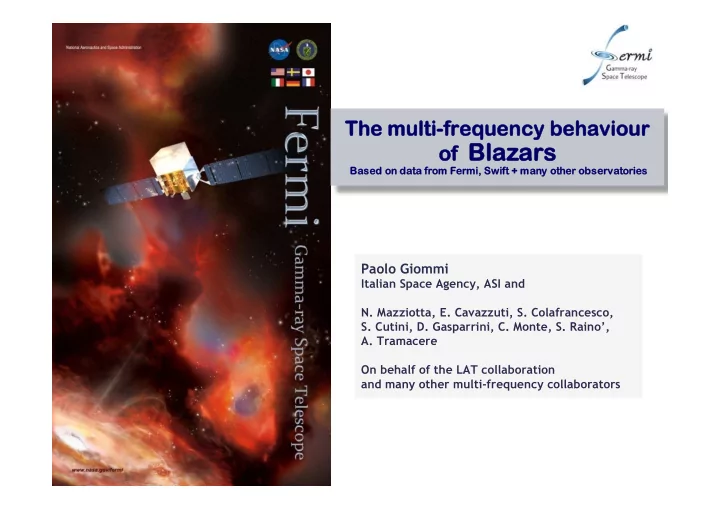
The The multi-fre ulti-freque quenc ncy be y beha haviour viour of Bl Blazars of Based o on d data f from F Fermi, S Swift + + many o other o observatories Paolo Giommi Italian Space Agency, ASI and N. Mazziotta, E. Cavazzuti, S.


slide-1
SLIDE 1

The The multi-fre ulti-freque quenc ncy be y beha haviour viour

  • f
  • f Bl

Blazars

Based o

  • n d

data f from F Fermi, S Swift + + many o

  • ther o
  • bservatories

Paolo Giommi

Italian Space Agency, ASI and

  • N. Mazziotta, E. Cavazzuti, S. Colafrancesco,
  • S. Cutini, D. Gasparrini, C. Monte, S. Raino’,
  • A. Tramacere

On behalf of the LAT collaboration and many other multi-frequency collaborators

slide-2
SLIDE 2

Qu Quasi simultaneous high quality SE SEDs fo for 4 r 48 L LBAS bl blazars

  • A sample

le o

  • rie

iented a approach -

  • Data from Fermi, Swift, Effelsberg, OVRO, RATAN, TANAMI-VLBI,

GASP-WEBT collaboration, VLT-VISIR, Spitzer, AGILE

  • Fermi data integrated during the first three months of operations:

4 August to 31 October 2008.

  • Quasi-simultanaous multi-frequency data taken in the interval

May 2008 January 2009.

  • Archival multi-frequency data (radio to TeV)
  • Representative of the entire LAT Bright AGN Sample (LBAS)
slide-3
SLIDE 3

P R E L I M I N A R Y P R E L I M I N A R Y

See S. Cutini’s Poster for more details

slide-4
SLIDE 4

The synchrotron/invC peak frequencies

νpeak and intensities νpeak f(νpeak) Measured from the 48 SEDs using 3rd degree polynomial functions

P R E L I M I N A R Y

See S. Cutini’s poster for details

slide-5
SLIDE 5
slide-6
SLIDE 6

A method to derive νS

peak and

νS

peak f(νS peak) form αox and αro

A “calibrated” version

  • f the method of

Padovani & Giommi (1995)

The position of a blazar in the αox - αro plane is determined by the synchrotron peak energy

Paodvani & Giommi 1995, ApJ, 444, 567

slide-7
SLIDE 7

PRELIMINARY

slide-8
SLIDE 8

PRELIMINARY

slide-9
SLIDE 9

PRELIMINARY

slide-10
SLIDE 10

PRELIMINARY

slide-11
SLIDE 11

PRELIMINARY

slide-12
SLIDE 12

PRELIMINARY

γ-ray vs radio/µ-wave selected samples

slide-13
SLIDE 13

PRELIMINARY

γ-ray vs x-ray selected samples

slide-14
SLIDE 14

Fermi LBAS

PRELIMINARY

slide-15
SLIDE 15

WMAP-5yr foreground Blazars

PRELIMINARY

slide-16
SLIDE 16

γ-ray vs radio/µ-wave selected samples

WMAP-5yr data

slide-17
SLIDE 17

γ-ray vs radio/µ-wave selected samples

WMAP-5yr data

slide-18
SLIDE 18

γ-ray vs x-ray selected samples

ROSAT All Sky Survey

slide-19
SLIDE 19

γ-ray vs x-ray selected samples

ROSAT All Sky Survey

slide-20
SLIDE 20

PRELIMINARY

slide-21
SLIDE 21

Conclusions-1

  • We have assembled high-quality quasi-simultaneous SED of 48 LBAS blazars.

This subset is representative of the entire LBAS

  • All Fermi bright blazars have broad-band spectral properties similar to radio

and X-ray selected blazars (double bump SEDs, same area of aox-aro plane, but no UHBLs… so far)

  • We have estimated the syncrhotron and “iC” peak energy and intensities for

all 106 sources in the sample.

  • The distribution of synchrotron and “i-Compton” νpeak distributions are very

different for FSRQs and BL Lacs. FSRQs νS

peak values range between 1012.5 Hz and 1014.5 Hz

BL Lacs νS

peak values range between 1013 Hz and 1017 Hz

  • There is a strong correlation between both νS

peak , νiC peak and the gamma-ray

spectral slope

  • The overabundance of HBL (HSP) BL Lac is a selection effect similar to what

experienced in the X-ray band

slide-22
SLIDE 22

Conclusions-2

  • HBL (HSP) BL Lacs radiate close to the predictions of simple one-zone SSC

models

  • Over 50% of known HSP BL Lacs (fr > 300 mJy) are detected as bright Fermi

sources.

  • LBAS FSRQs and LBL/LSP BL Lacs (all LSPs) emit much more gamma-rays than

predicted by SSC, requiring additional mechanism (e.g. EC, or multiple components)

  • However, only ~13% of FSRQs brighter than 500 mJy in the Bzcat or in

WMAP-5yr catalogs are detected in LBAS, despite having similar properties (same redshift, Vmag, νS

peak distributions etc). It is therefore

possible/probable that the majority of FSRQs actually radiate not too far from simple SSC.